
Greetings, citizens! ROBOGEEK here with a little something special for ya.
Let's say you happen to love movies (a fair guess, I'd venture, since you're reading this web site). Then let's say you're lucky enough to live in Our Fair City of Austin, Texas (if not, you just might want to stop reading this so as to avoid needless depression).
Anyway, if you meet the aforementioned (and admittedly slightly convoluted) criteria, then there's really only one place you should be tonight.
No, I'm not going to tell you to go see the LORD OF THE RINGS trailer in front of THIRTEEN DAYS (a good but not great film, IMHO). If you're a hard-core LOTR fan (ahem), you'll go to the first screening this afternoon; if not, it can wait.
And I'm not even going to tell you to go see CROUCHING TIGER, HIDDEN DRAGON (far and away the best film of 2000, IMHO), which finally opens today in Austin... in FOUR theaters, no less (I'd pick the Metropolitan); tonight's screenings will probably be sold out - and you're likely going to want to watch it again (and again?) immediately after you see it, so a Saturday or Sunday matinee might be a good time to start. (FYI: CT,HD is the first movie I've ever watched three times in one day... and I wish I could have gone for four.)
Personally, the only place you should even consider parking your backside this evening is at Austin's Movie Palace, the Paramount Theatre. Why? Because tonight they'll be presenting something truly special - a rare chance to have a magical and extraordinary moviegoing experience.
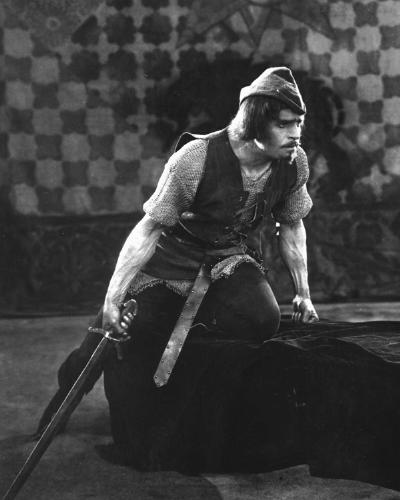
Gracing the silver screen at 8pm will be the Museum of Modern Art's restored print of the 1922 ROBIN HOOD starring (and produced by) Douglas Fairbanks. What makes this screening so special is that it will be accompanied by a live orchestral performance of the original score, conducted and restored by the renowned Gillian Anderson (no, not Scully).
Long-time readers will no doubt remember my interview with Ms. Anderson two years ago when she came to Austin with the 1927 classic WINGS, in which she discussed her work (click here to read). I talked to her briefly by phone yesterday, and she sounded extremely enthused by how well the first rehearsal went the other night (they made it through the entire score without a hitch on the first try, which almost never happens).
Tonight offers the next best thing to a time machine - the chance to be transported back to the movie palace days of yesteryear, and experience the sights and sounds of a bygone era. I can't possibly recommend this event highly enough (Harry, Father Geek and I will be in attendance, among others).
Tickets ($16-25) are still available (the Paramount seats over 1,200) at the Paramount Theatre Box Office (713 Congress Ave.), www.startickets.com, or 512-469-SHOW.
Hope to see you there! (Then go see CROUCHING TIGER, HIDDEN DRAGON!)
- ROBOGEEK
P.S.: Here's some more information from the program...
GILLIAN ANDERSON, CONDUCTOR
Gillian Anderson is an orchestral conductor and specialist in the reconstruction and restoration of the original musical accompaniments to early films (don't use the word "silent"). She has conducted throughout the United States as well as in Europe, South America, and Canada. Her performances have been described as "triumphant" (The Washington Post), "extraordinary" (Edward Rothstein, The New York Times) and "an enormously involving experience" (Tom Di Nardo, Philadelphia Daily News). Her reconstruction and performance of NOSFERATU (Murnau, 1921) with the Brandenburg Philharmonic (Potsdam) is available on BMG Classics (09026-68143-2; LC 0316; F:BM650). A videotape and CD of her reconstruction and performance of CARMEN (DeMille, 1915) with the London Philharmonic are available from Video Artists International (VAI 69222). She has been featured on a number of television programs, most notably "CBS Sunday Morning" and "All Things Considered Weekend."
She has restored 25 of the original accompaniments for early films so far. Two years ago she reopened the Egyptian Theater in Hollywood with an eleven piece orchestral version of THE TEN COMMANDMENTS and in two weeks she will conduct the Het Brabants Orkest in Holland with the full orchestral version. Recent restorations include D. W. Griffith's BROKEN BLOSSOMS, Cavalcanti's LA P'TITE LILIE, and Dreyer's MASTER OF THE HOUSE and HAXEN. In the fall of 1997 she established a small orchestra, Cinemusica Viva, in Bologna which performed at the Louvre, at CineMusic Gstaad in Switzerland, and at Cinema Ritrovata in Bologna. Currently she is working on a new project with painter/scenery designer Lidia Bagnoli to supply a type of scenery design for classical music concerts. The first presentation was in October with the University of Illinois chamber orchestra and three more performances are scheduled with the Orchestra sinfonica dell'Emilia Romagna in Italy.
THE MUSIC OF ROBIN HOOD
Film historian Kevin Brownlow refers to ROBIN HOOD's art direction as "an unsurpassed and unsurpassable achievement." Douglas Fairbanks was the moving force (he financed, acted in and wrote the screenplay), and to answer the challenge of a very specific period setting, he created a ROBIN HOOD research library. Mitchell Leisen designed the costumes and five hundred workers constructed the largest Hollywood set ever built to that time. It was directed by Allan Dwan in 1922 and lasts 122 minutes at 22 frames per second. The original accompaniment was by Victor Schertzinger (1880-1941) and A. H. Cokayne. Schertzinger also composed the original score for Civilization and went on to become a director (Road to Zanzibar, Kiss the Boys Goodbye, and The Fleet's In.)
Fairbanks' ROBIN HOOD is not like any other version. In fact this Robin Hood starts off as a man terrified by women who eventually succumbs to the charms of Maid Marion and rescues his king's kingdom in a merry adventurous romp. The musical accompaniment is a pasticcio of light-hearted original and preexisting music.
All the original orchestral parts for the score survive, except for the first violin and first trumpet parts. As a result, in addition to the usual refurbishing and correcting of the original parts to make them playable by today's profession standards, it was necessary for Anderson to rewrite the violin and trumpet parts. In most cases this reorchestration involved using the piano conductor score as a clue and together with the other orchestral parts, guessing what the missing parts might have been like. However, with Robin Hood's march, a theme by Schertzinger, which repeats many, many times, Anderson took the liberty of adding three melodies and changing the rhythm of the accompaniment every so often. One can imagine that the musicians in 1922 did the same thing, especially as they might have played the score at least twice a day, seven days a week, for months at a time.
