
The Diva Del Mar Sees Promise in Moonlight
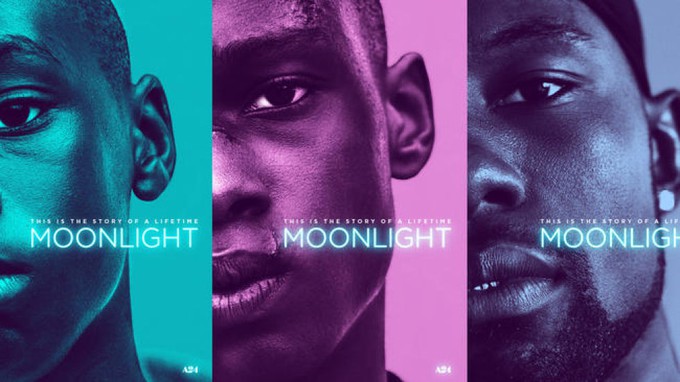
A little less than two weeks my good buddy Professor Bourbon invited me along to watch Moonlight in an advanced Victory screening at the Alamo Drafthouse. Directed and adapted for screenplay by Barry Jenkins, Moonlight is an intimate coming-of-age character piece about a poverty-stricken, black and gay young man. The movie is good, and some aspects are even great, and yet…well, I’ll get to my problems with it later.
We follow the main character through three stages and subsequent cathartic events in his life. We first meet the protagonist, played by Alex R. Hibbert, as “Little”, a skinny, pre-teen who is frequently the victim of neighborhood bullies. He is then depicted as teenager Chiron, the character’s real name and played by Ashton Sanders. And in the final act, we meet the main character again, this time as “Black” performed by the gorgeous (!!) Trevante Rhodes. As a child, the main character has shown signs of being gay, which is thematically handled beautifully in the film, and this has inevitably made him an outcast in his low income, crime-ridden community. To make matters worse, his mother prostitutes herself to pay for her crack addiction, frequently bringing men into their home to sleep with them. She is neglectful to an extreme and verbally abusive with her son. The mother and son interactions in this film are painful to endure, but handled with poetic vagueness, which I will discuss later in this review.
As “Little,” our main man has a moment of good fortune, when Juan, a local “trapper” (drug dealer) played by the talented Mahershala Ali, catches him hiding from his bullies. Despite his line of work, Juan exhibits sophisticated emotional intelligence and genuine compassion for the boy. He brings him home to his girlfriend, Teresa, offered up by the stunning Janelle Monae, and the couple inevitably become the only source of stability and safety in the boy’s life.
This first chapter is the strongest stage of the movie, mostly because Mahershala’s performance is absolutely stellar. Also, the vulnerability and trust that develops between Juan and Little is beyond endearing. I love the first beach scene, but I don’t want to give too much away, so I’ll move on.
The second chapter or “Chiron” moves us deeper into the confusion and despair of Chiron’s life. His mother continues to spiral into the depths of addiction, creating a dangerous and toxic environment for him at home. Chiron connects with another boy from school, Kevin (Jharrel Jerome), briefly introduced in his “Little” chapter, and through Kevin, he is offered a glimpse of affection and the possibility of love. Sadly, circumstances of his environment and social pressure destroy this fleeting happiness and Chiron is violently catapulted forward into the third act of the film.
In this final chapter, the audience is desperate for emotional relief for Chiron and some sense of closure. And the filmmakers do offer it up in heavy-handed spoonfulls, but by that time, I was simply exhausted with the story. Granted, I will say that this is an absolutely beautiful film and one that sparks interesting discussion. Professor Bourbon and I engaged in two debates over the movie, which is a sign of excellent filmmaking. The problem is that we weren’t debating the strife of black gay men in America, or the plot, we were debating whether or not the movie matched the tone of the message. You see, it feels off, for a few reasons.
The acting is superb and sublime, as is the fantastic cinematography. Every actor nails their performances with nuance and not once did I feel that a line was being delivered. The writing was decent, hinging on poor only because of the excruciatingly slow pacing of the dialogue. I understand that the main character is a shell-shocked, victim of abuse, and in some scenes the long pauses between lines speaks volumes in depth. However, by the third dialogue featuring torturously slow responses by Chiron to anybody who tries to talk to him, I started tapping my foot in impatience. It was just too much, and in this aspect I feel the story loses impact. The film aims to show a gentle spirit trapped in a world of violence and cruelty, and so they should show us more. I felt that the character’s development leaned too strongly on these slow conversations and more day-to-day scenes of each stage would have suited the story better.
In addition, the movie tackles some really brutal subjects, but with too soft of a hand. I don’t think offering us a closer look at the realities of living in the projects, of the abuse, or of the people that surround Chiron with more clarity and honesty would diminish the beauty or the power of the film. It would in fact strengthen it, and the film makers avoid tackling the ugliness of his life. Even the most abusive scene with Chiron’s mother is literally blurred out as a memory in his mind. The tone is just too pretty for the devastating and emotionally catastrophic circumstances of the protagonist and often flirts at the borders of cliche. This makes it seem like it was made to win awards and not to deliver the powerful message that hides behind the overall pleasing esthetic. This represent my biggest problem with the movie. The subject material shouldn’t be such a light jaunt down cinema lane.
Regardless of these flaws, Moonlight does engage the audience and shows off Jenkin’s artistic flair. He enables his actors wonderfully and crafts a gorgeous work of art, with a primed eye for beauty and flow. His repertoire focuses on social issues such as race and poverty in America, and these are indeed stories that need to be told. It’s nice to see that Moonlight is getting good buzz as it is an important message being delivered.
Thanks for reading!
The Diva Del Mar
