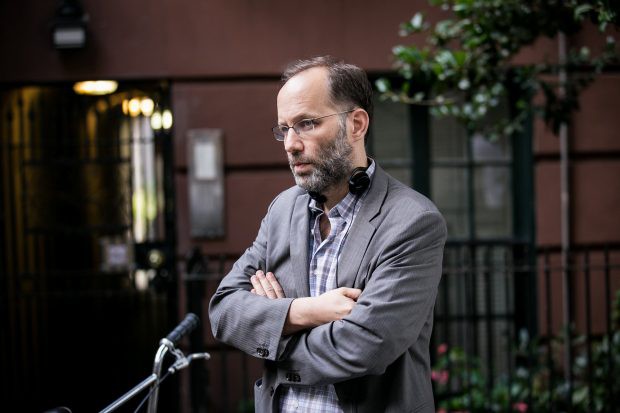
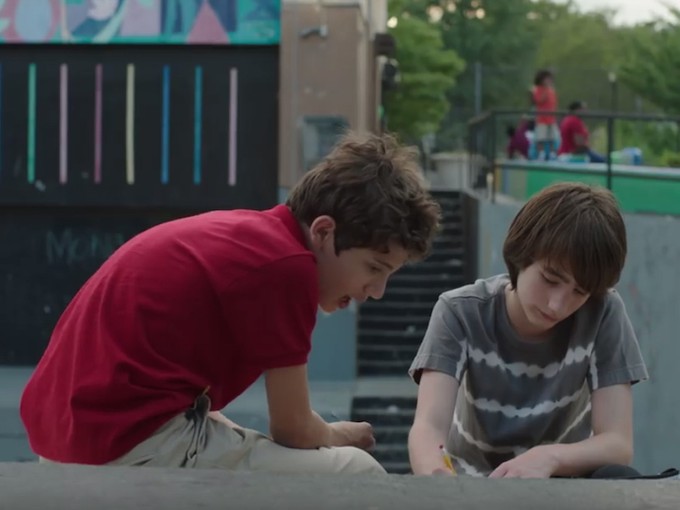
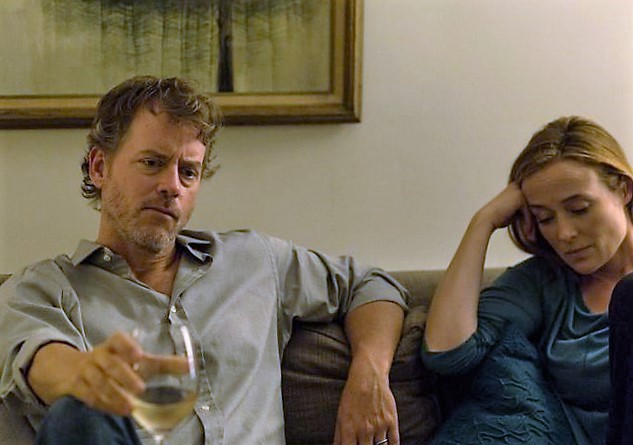
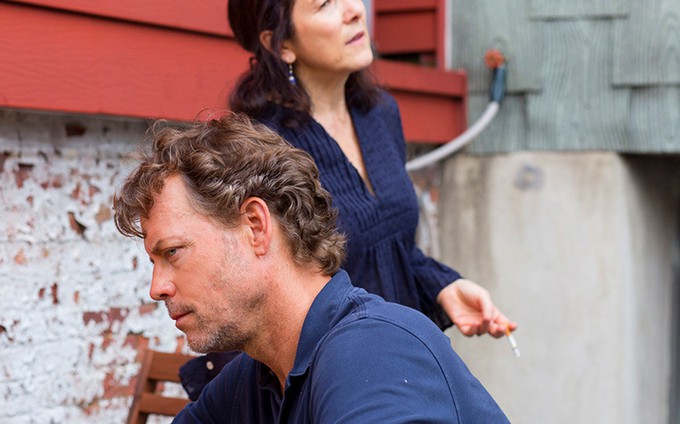
Filmmaker Ira Sachs’ last few films have been highly personal and beautifully realized experiences in cinema that often feel slightly European in their execution, but also uniquely American in their subject matter. And they almost always deal with a relationship in crisis and/or turmoil. His latest work, LITTLE MEN, both fits that mold and doesn’t. The crisis in this case isn’t between the two leads at all, two teenage best friends played by relative newcomers Theo Taplitz and Michael Barbieri (who has most recently shot roles in the upcoming Spider-Man: Homecoming and The Dark Tower). The trouble crops up between their parents—Greg Kinnear and Jennifer Ehle play one boy’s parents, while Chilean actress Paulina García plays a single mom raising the other)—over a real estate issue involving a shop that Garcia runs in a building inherited by Kinnear. It concerns real estate law in Brooklyn, so you know it’s a mess.
Sachs’ previous work includes FORTY SHADES OF BLUE, MARRIED LIFE, the 2012 film, KEEP THE LIGHTS ON, which was co-written by Sachs and Mauricio Zacharias, as was his beautiful follow-up LOVE IS STRANGE, starring John Lithgow and Alfred Molina, as well as this latest film. LITTLE MEN is the destructive love of family, and how even parents with the best of intentions can sometimes wreck the lives of their kids because they're unable to step back, take a breath, and re-evaluate a seemingly insurmountable impasse. Please enjoy my talk with Ira Sachs…
Capone: I realized in looking over our previous talks that this is the fourth time I’ve interviewed you, which I almost can’t fathom.
Ira Sachs: Wow! What was the first time?
Capone: 40 SHADES OF BLUE. I think the only one I haven't interviewed you for was KEEP THE LIGHTS ON, and I’m not even sure about that, because we might have done something on the phone. But in person, four time.
IS: It’s nice.
Capone: It is. I like coming back. There’s an evolution to your movies and I see connections. But I’ve noticed, especially in the last four or five years, I’m seeing your name in the “Thank You’s” of a lot of other people’s films, and I’m always wondering what you’re doing with these indie filmmakers. I saw it in one of Kelly Reichardt's films, for example. But what is your connection to these folks?
IS: Well, I think I’ve survived because I’m a community builder, and I’m a relationship maintainer, and that’s both integral to who I am as well as a strategic way of surviving. There are different roles that I’ve had, so starting out just being a New York filmmaker, and moving there in the late ’80s, and not going to film school, and having a group of filmmakers who we became very attached to, including a number of which we formed something called Dependent Cinema, so Oren Moverman and myself, Jonathan Nossiter, Karim Ainouz, Laurent Cantet, and Kelly and a bunch of people were just affiliated with each other, and we watched out for each other and we still do.
Kelly, Larry Fessenden, and I shared an office for about four or five years, so we have that history, then I taught at NYU for five years, and a lot of those filmmakers are now beginning to make their movies. I also run a program, a non-profit called Queer Art. So I literally like spend a third of my days organizing an apparatus that brings filmmakers and artists from a number of disciplines together, so I’m a community organizer.
Capone: Makes perfect sense. I just met Larry for the first time last year after being a huge admirer of everyone whose lives he’s touched.
IS: Larry’s wonderful. Talk about someone who has touched a lot of filmmakers. Larry was involved with producing my first film. He’s been great for many of us.
Capone: The thing that strikes me about LITTLE MEN is that this situation—the friendship between these boys that it is effectively ruined by their parents—must happen all the time.
IS: Yes. Someone tonight, at this party, was talking to me about it happening.
Capone: But I’ve never seen a movie about it. But seeing it play out here, I’m couldn’t stop thinking “This has to happen all the time.” Where did you see this in real life? Was it you?
IS: My best friend from elementary school is here.
Capone: Right, that guy we met out front.
IS: We didn’t have it though our parents; we had it through life changing our relationship in 7th grade. But I do think race and class are significant in those ways. We found the idea for the film really specifically through two films by Ozu. GOOD MORNING, and I WAS BORN BUT… They were remakes; he remade his own film. I WAS BORN BUT … was a silent, 1930s film, GOOD MORNING is a ’50s film, and they’re both about kids that go on strike. So that was the first idea, the silence part was the first idea.
Life and films are always both organically part of our writing process. THE WORLD OF HENRY ORIENT was a film that was really significant. It’s by George Roy Hill. It’s about two girls from different sides of the tracks who are in Manhattan. They both become obsessed with Peter Sellers, so it’s watching that film. Then having moved to New York in the 1980s and ending up on a corner of Brooklyn, where I was the white college kid coming into an Italian neighborhood on a Dominican street and realizing that within three years, all the Dominican social clubs were gone. I had never met any people who lived there. It’s the ugly nature, the violent nature, of cities and evolution.
And I think we really have to question words like “improved.” What’s lost? And I’m not a nostalgic person, I’m not a sentimentalist. Of course, I’m a preservationist, but I think these are the conflicts of cities and neighborhoods and lives. There was another book, a wonderful book by William Maxwell called “So Long, See You Tomorrow,” which is literally about two boys who become best friends whose parents become enemies. So that was a really important book.
Capone: There’s an element about class in the film, in that this family, you feel like they want to do the right thing, but at the same time, you know it’s not going to happen. Then you have this single mother who’s heroic in many ways, but she almost digs her own grave by being a little too aggressive with them.
IS: Well, she doesn’t have the right tools to be a strategist. What we wanted to do is not make anyone a victim or a villain. They’re both basically middle-class people with certain options and certain financial struggles. I think that makes the moral suspense more interesting. And it doesn’t allow any easy decision making. Really, I have found with audiences almost universally who have seen the film, they have a shifting idea of allegiances. I feel like everyone is fighting a great battle, which was always a line. A 13th-century Jewish philosopher had this line about that, and I think that’s how I try to approach characters in the story. The other line that someone has said since watching LITTLE MEN is “Everyone has their reasons,” which is from RULES OF THE GAME. It’s a great line. Everyone has their reasons, and I think if you can make films in which that’s true, they’re very open to an audience connection.
Capone: Some other filmmakers might have used this dispute as more of a backdrop for the story about the kids, but you treat them almost with equal importance. We are in a lot of meetings about a lease in this movie, more than I thought we would be, and it’s interesting, and think the more you detail it, the scarier it feels. It actually made me anxious.
IS: I understand that. I’ve actually experienced it once or twice watching the film where I like, “This is kind of like a thriller.”
Capone: It made me realize how little I know about real estate law.
IS: There’s like 50 lawyers in [the screen, which was going one during the interview]. They’re all going to tell me I got it wrong. I need to get it right [laughs].
Capone: There’s an interesting dynamic between the boys, but I suspect Jake, and he may not even realize it completely, may have feelings for Tony that maybe he’s not even aware of.
IS: I guess what I felt was, once I cast Theo, I really didn’t want to impose any definition on the character in terms of their sexuality. I couldn’t, in the same way you can about many kids. It’s all as ambiguous as it is for these kids. The film works as a Litmus test. Different people have different readings, which is what you hope for, particularly in movies.
Capone: Both of the boys, this is their first time acting in film.
IS: Yes, although one of them just went off to do THE DARK TOWER with Matthew McConaughey.
Capone: Right. When you’re directing them, do you treat them any differently than you would a more seasoned actor?
IS: I didn’t. After the first day, I wasn’t sure what they would need from me, but that’s what you always ask about every actor, to be honest. I don’t know until I start working with Jennifer Ehle on set what she needs from me. So what I found is they had an incredible natural emotional sophistication about the events in the film, as well as the words that they were saying that I didn’t need to intrude upon very much. They could also hear what I observed and internalize it and work with it, which was incredible. I just did interviews for a day with Theo in San Fransisco, and I don’t know if I’ve ever sat with an actor who I felt was more articulate and insightful. He’s also making his own movies and is in a band. Michael by the way, who plays Tony, did just get into LaGuardia High School for the Performing Arts.
Capone: I know they had aspirations to be actors. I’m sure they appreciated you treating them like all the other actors.
IS: We had a great relationship, and I have to say, they were probably the easiest actors I’ve ever had to work with, including all the famous ones.
Capone: This is another New York story, and again, it feels like a New York story, with the idea that the late father wanted to keep this establishment open just because he liked the idea of having this home, this family-owned shop under his roof. There does seem to be like an active movement to keep some of the places like that from going away.
IS: Well, they’re active until there are financial problems. And then the decisions people make around money are always different than the decisions people make abstractly when put to a moral test. I actually have recently, since I watched the film a few times and have been talking about it, I feel that the film in some ways is an unexpected metaphor for the independent cinema, whether it be an independent cinema house or the independent cinema maker. Because there is a reason to keep the independent cinema, yet in terms of capitalism, it does not work. It really doesn’t. So there’s a question of value and who defines what value is? Is it purely economic? Or are there other reason to keep us there?
Capone: Paulina Garcia is an absolute gift to this film, no matter how you react to her character’s personality. How did you find her? I saw her in…
IS: Did you see GLORIA?
Capone: I did see GLORIA.
IS: So we wrote for her.
Capone: That explains it.
IS: I’ve worked with Danish actors, I’ve worked with Russian actors, so I’m interested in acting styles that I find in non-American actors. It just works for me personally. I tend to like the actors that I have found. For me, her performance is actually the closest that I have experienced is it’s a lot like Dina Korzun in 40 SHADES OF BLUE. There’s a naturalness as well as a theatricality that makes her fascinating to watch.
Capone: She reminded me of Anna Magnani, and the only reason she’s on my mind is they’re about to do a big retrospect of her here.
IS: My friend is going today, because it’s in New York too.
Capone: They’re doing it here next month down at the Art Institute’s Film Center.
IS: Part of the thing about that, in terms of Anna Magnani, is that she’s willing to take risks, to be messy.
Capone: She’s not even trying to be likable most of the time. She doesn’t even give a shit.
IS: [laughs] No. I’m telling you that Paulina understood that that was not our goal to make a likable character. Our goal was to make a full-bodied, full-blooded character.
Capone: I was actually going to ask you what you’re up to next, but I actually heard you talking out it when I came in here about this HBO…
IS: Yeah, I’ve written something for HBO and with Mauricio [Zacharias, his screenwriting partner] about Montgomery Clift [called MONTY CLIFT]. We’ll see if they make that. And we’re also we’re just beginning to have conversations that will lead to a new film.The Montgomery Clift film is written, and it’s really an HBO decision whether they’re going to green light.
Capone: And I heard you say you wrote it for Matt Bomer?
IS: For Matt Bomer, yes.
Capone: You mentioned your co-writer. I thought it might be overly simplistic, but the LITTLE MEN story is about this Latin American kid. I don’t know if that part of the story was reflective of his life in any way.
IS: You know, it more reflects my relationship with my best friend in elementary school, who’s a black kid.
Capone: The guy who’s here.
IS: Yeah, whose father ran Stax Records, Al Bell. So that’s his son. And I think that was really influential. And my husband is from Ecuador, and he moved to New York with his single, Ecuadorian mom, and he was a painter, and he went to my high school for performing arts, so there was a lot of stuff around that.
Capone: How do the two of you write, then?
IS: We sit around and we talk about life and movies for maybe six to eight weeks, and usually at some point in that, there’s a particular movie we’re interested in in the story line, and then he writes the first draft based on the set of characters and the arc of the story. Then we start going back and forth. And by the last draft, it’s my draft. It starts with his draft, and it ends with my draft, and then I direct it. We have a great time.
Capone: I haven’t even asked about Greg Kinnear. I like it when he gets dark. I think that’s actually some of my favorite stuff, because he could have easily made a career playing the nice guys.
IS: My Greg Kinnear movie is the Paul Schrader movie.
Capone: AUTO FOCUS. That’s about as dark as he gets.
IS: I know Greg Kinnear mostly from that. I thought he was incredible. He’s incredibly nuanced, incredibly natural, and incredibly complex as a person and as a character. He gives texture to the struggle. He’s a great actor.
Capone: Thank you very much for coming. Best of luck with this.