
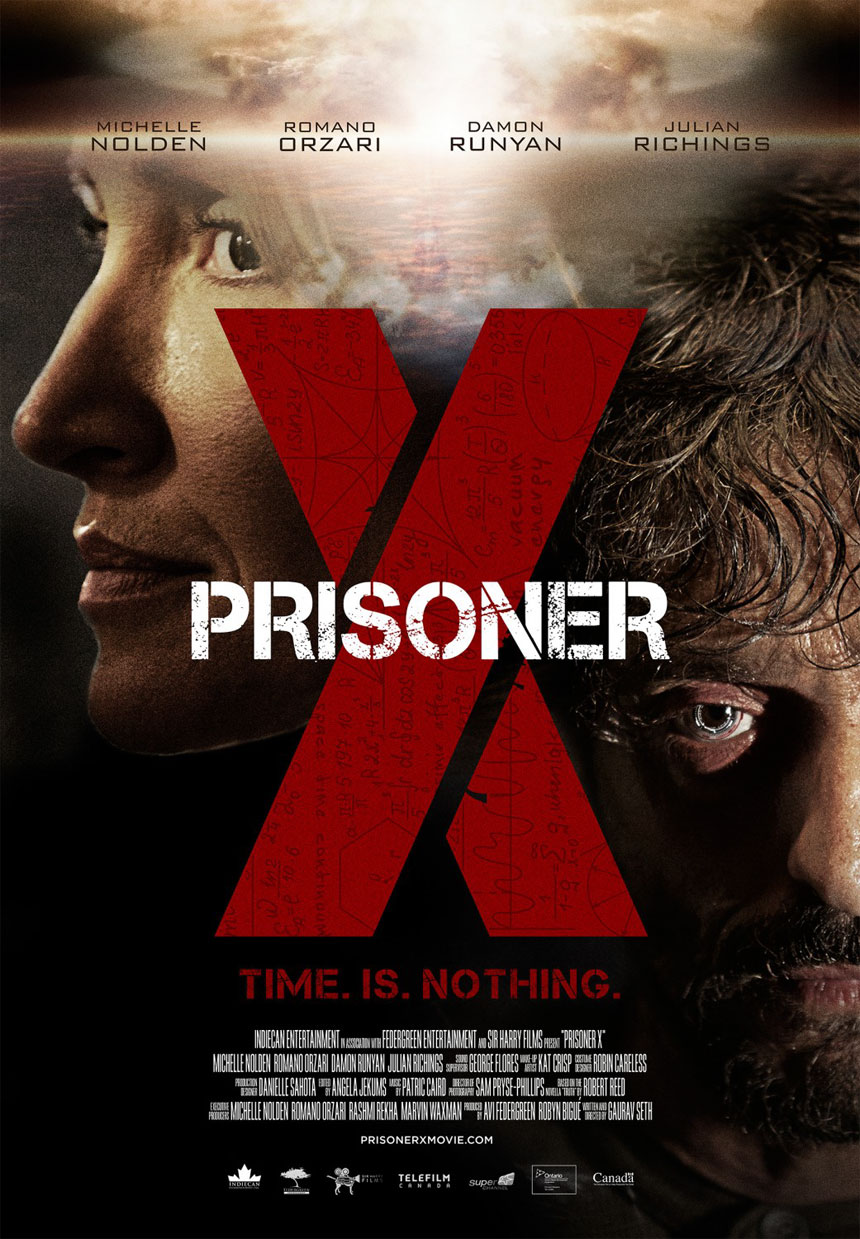
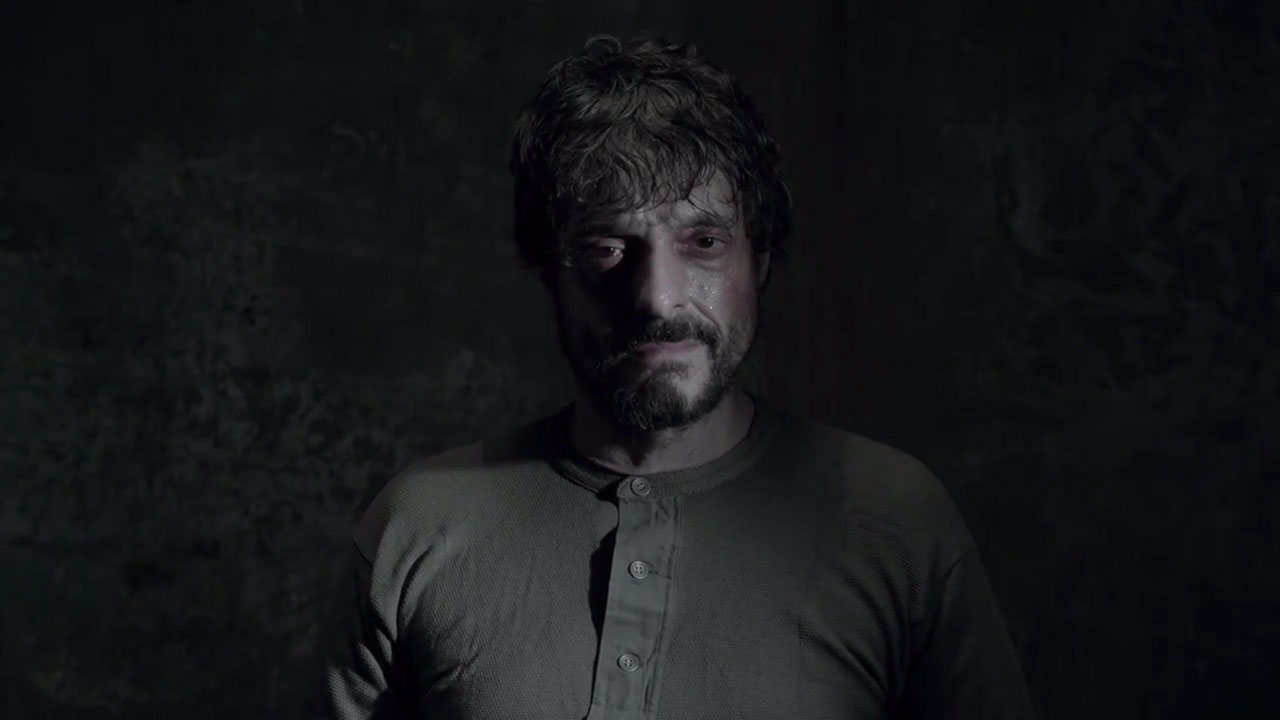
Hello ladies and gentlemen, Muldoon here with a somewhat lengthy chat with Canadian director Gaurav Seth for his latest science fiction thriller PRISONER X. The film has screened at numerous film festivals, including this past May's Fantaspoa, South America's largest genre festival. As the film is making the festival rounds, there's a special screening in Austin this Thursday as part of Other Worlds Austin's year long spotlight. I've seen the film. It's creepy and features Julian Richings chewing all sorts of scenery. Whether you're into science fiction, or just enjoy hearing stories from the other side of the lens, my chat with Gaurav below is possibly one of my favorite interviews I've done with AICN. He describes each step of the filmmaking process in a way that's almost tangible with a level of openness I rarely see. I find it utterly fascinating to hear from directors who aren't part of a large committee, but push a film into existence through gumption and spirit, which I feel perfectly describes Seth. Whatever your favorite genre of film, there are wonderful nuggets of knowledge below that comes straight out of reel world experience, an insightful perspective that I find refreshing from a filmmaker.
The film screens this Thusrday in Austin, TX at the Flix Brewhouse at 9:00PM as part of the Other Worlds Austin science fiction film festival's year long spot light on new and interesting science fiction films. Seth will be present at the screening and will hang around for a Q&A.
Hey Mike, how are you?
Great! Let’s jump right on it. I just caught the film a few days ago and was curious… It’s obviously based on Robert Reed’s book, but how did you first get involved with the project? It seems like such a drastically different movie than it looks like you’ve done in the past. Why did you make this movie?
Actually it’s based on a novella by Robert Reed, which was nominated for a Hugo Award, I think it was in 2010 if I’m not mistaken. Yeah, I just came across it. I read it and I thought, “This would make a great movie, especially a low budget independent film,” because it was very contained and it was just a great story, and it was exactly the kind of science fiction that I liked, which is big on ideas and high concept and doesn’t relay as much on gimmicks and special effects. It was more of a performance piece with these limited actors in one location, and the location itself was an interesting location, so it really had all the ingredients to make a great low budget independent film. So I just called Robert Reed and I asked him to option it, so that’s how it happened.
Although you are right that I made two other movies before this one and this was very different from them as the genre is sci-fi, a psychological thriller, but the thing is I’ve always been interested in this material, in this genre and these types of stories. As you know with the challenges of independent filmmaking, you make what you can get made. I actually have another script that I’m hoping to make soon which is also a sci-fi, which I had written before I read TRUTH, the novella for PRISONER X. I was getting the money together, and other projects came up, so I did those… Although it seems that this is something different than what I have done in the past, it has always been within the realm of my interest.
That’s fair. As you wrote the script, adapting it from Reed’s book, I’m curious about what the relationship was like considering that’s his initial imagination that you’re then interpreting for the screen. Were you deadest on staying as true as possible, or did Reed give you the go-ahead to make whatever changes you wanted? What was that relationship like?
Right, actually I was very forthcoming right from the beginning. It’s a novella, which essentially is a long short story. It’s not really a full novel, so of course it had the main premise and the plot was there, but obviously it wasn’t enough for a full movie. The good thing about this novella was, I saw themes of a lot of interesting ideas and thoughts mentioned in passing or very subtly hinted at, which would work well in movie where we could expand on it and make it more visual and kind of tighten the screws and heighten the tension. So I was very forthcoming… I told Robert that “it has the heart, the story, but a lot of work needs to be done to actually translate it into a movie.” Timing-wise it was great, because he had a few months prior to when I called him, he had actually been working on the screenplay, trying to adapt it, of one of his own books, which was optioned by some big studio… So he kind of realized that literature needs to be translated into cinema and a lot of things change and you cannot simply just shoot the book, you know?
You can’t just take every page and turn it into a movie, you have to translate it, which means certain things will be dropped, certain things will be added, characters will be interpreted first by me and then the characters themselves, so a lot of things will change and he was totally cool with that and he really gave me free reign. He’s written probably twenty or twenty-five novels with a career spanning four decades, but he still hadn’t had a movie made from one of his books. He was very excited by this possibility and several of the books have been optioned and they have been talked about with big studios showing interest, but nothing has actually materialized and so he was like “These big studios didn’t do anything, maybe you guys with a low budget… Canadian guys can make a movie,” so he was very cooperative on that front.
I would send him a draft, which I’m not actually sure if he read it, because he just wanted to watch the movie… (Laughs) He was cool with everything we did, as long as we kept the main idea and the story intact, which I told him I would do because that’s really what attracted me to it, the story. There was nothing that I was going to change in that, but a lot of other things had been added into the movie, which were not there in the novella or slightly hinted at.
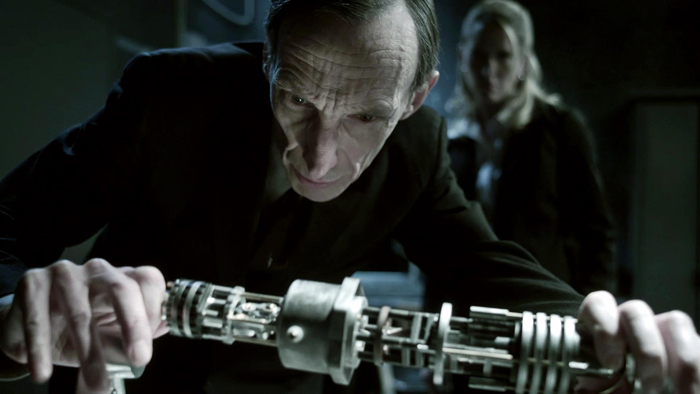
It sounds like there was a mutual respect with a lot of trust between the two of you. So you’ve got a great story that you’re really excited about telling, how do you decide who you’re going to tell it with – how did you line up your cast? Julian Richings… I feel like I’ve seen him in everything. He was great as your Jefferson character….
It was a bit tricky, just because our budget was very low. I had a lot of talented Canadian actors that I was hoping to get a chance to talk to them, but you know we weren’t sure that we would be able to generate the kind of interest from these actors that we were looking for, simply because we were such a low budget film and it was right away characterized as that by the actor’s union. This was the lowest tier of production, so they knew that they wouldn’t make a lot of money off this, so I was a little apprehensive. We set up these auditions, we sent out the script through agents, and I was very surprised with the kind of interest the script generated and I realized people were just reacting to the script. They knew that they were not going to make any money… I mean it was pennies, but I think it was the power of the script and the interest that it generated with the characters and the plot that brought the actors that I had in mind and was hoping would be interested in… They showed up in the audition.
Michelle Nolden was one of those actors where I was really hoping that she would like the script and she would come for a reading and she did. She was great and I was really happy to have her on this project. Julian… He is such a wonderful actor, and he was the very first person I cast. This was way before we managed to get the financing for the film in place. We applied for these funds in Canada, so we weren’t even sure if we were going to make this movie, but Avi Federgreen, one of the producers of the film, he put me in touch with Julian and he said, “Yeah, just meet with him. Have a coffee and talk to him about it.” I met him and Julian is just such an awesome person and a wonderful actor. Right away he bought into what my vision, which as I pitched it to him was “a sci-fi movie without a single special effect.” (Laughs) Right away he was in and was like “It reminds me of the kind of science fiction that I like, like THE TWILIGHT ZONE and the old STAR TREK stories” as they were basic ideas with a “what if?” scenario, which really excited him. Julian came on board that way and with Roman [Orzari], who plays Ramiro, it was again through an agent. We sent the script, he read it, and of course it’s a very interesting role for him as well, so he was into it right away. He lives in New York, so he recorded his audition and sent us the tape. So yeah, that’s how we casted it.
So next up, let’s talk about your department heads. Were these all individuals you had worked with before?
No. I’d worked with none of them, well I hadn’t worked with anyone although I knew several people that had been good friends for several years and I always thought “If I get a chance to make another movie, I’m going to work with this guy and that guy.” So although I knew them, I hadn’t worked with them before. Some of them were brought to my notices by Avi again, the producer. Like Sam [Pryse-Phillips] was the DP and it was very important for me to have the right DP. I went to film school in Russia and I am a qualified Director of Photography myself and so I had very specific ideas in terms of the look and the choreography and the mise en scène about the scenes and everything, so the DP was absolutely crucial for me and again, he bought into my vision of the movie. I told him “Look, I went to film school in Russia and it’s going to have this Eastern European look…” and I gave him some movies to watch, movies by Tarkovsky, STALKER… So he was very excited. He liked the story and it was like “Okay, I’ve got the right DoP.”
The next step was the Production Designer, and this was very challenging because of the low budget. We wanted to create this look with the bunker, but we really didn’t have a lot of money to do that and so Danielle [Sahota], who was the Production Designer of our movie. I met her and she’s young, she’s very energetic, and very meticulous. That quality, I really appreciated. She was so detailed about all of these small things and she asked me all of these questions and really made me think way more I thought that I would need to think about it. I really liked that when Danielle came on board. The last key person for me was the composer. Patric [Caird] is a Canadian, but he’s based in LA and has done a lot of television and movies as well, I’ve known him for more than ten years and he’s a good friend of mine. I love his music and the work he’s done on other films, I just never had a chance to work with him. I’d always told him, “As soon as I get some money to make a movie, you’re going to be the composer.” That’s how he came on board. So it’s all a combination of people I already knew and people that I met through the producers.
That makes sense. So how long of a shoot was it and did you just happen to find great locations or did you have to build quite a bit of your sets yourselves?
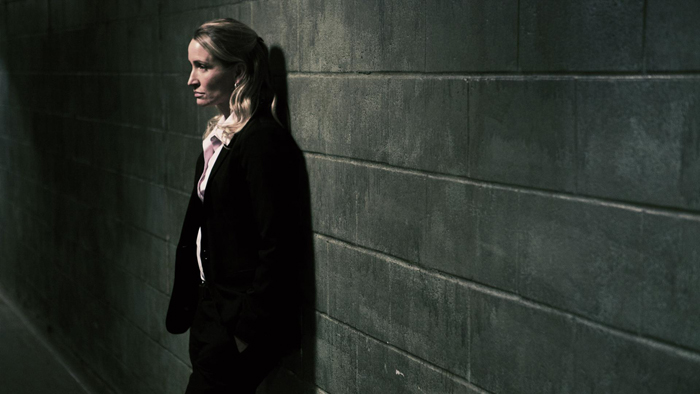
Yeah, it was a fifteen day shoot, “one-five.” (Laughs) It was a very short shoot, so the pressure was on for everyone, for the actors, for the crew… It was quite challenging and the movie shot almost entirely, except for a couple of scenes, which are outdoors, in a studio in Toronto, called “Cinespace.” In fact, it’s not really the studio, but the basement of the studio, which wasn’t being used for anything. So it was just a raw space and we built the bunker and everything there, so what we really had was a basement with that one corridor… (Laughs) We just shot it from different angles to make it look different, and yeah… our three or four rooms of raw space, which were then converted into these sets.
It’s funny you say it was such a small space. It feels much bigger than you’re describing it, so kudos for using what you had to that level. It’s claustrophobic, but almost spacious in the same sense, which shouldn’t make sense. It sounds like you really didn’t have much space at all.
(Laughs) No, we didn’t… In fact, one of the rooms was actually our makeup and clothing room for the actors, so in fact one of the sets had to be built and then broken down and this room had to be shifted around… There were four separate locations within that bunker, but we had only two and a half rooms to build those four different rooms, and so some of them had to be broken down and quickly assembled overnight essentially for the next day to play as a different location. We also had makeup and the actor’s makeup room and everything, craft services… all within that same area. It was very claustrophobic, even for the crew. We shot it in early January and it was one of the coldest winters in Toronto. It was freezing in there… We literally did not take off our winter coats the entire day when we were down there. It was challenging in many ways and I’m glad though that you get the feeling that it was a bigger space and that we had more time. I appreciate that.
I assume with that type of an environment and it being so cold with such tight space to move around, it probably helped a your cast get into the vibe of PRISONER X’s world.
Absolutely. It’s very interesting that you mention that, because Julian… again, this just show his experience and the caliber of an actor that he is. He said that. In fact he asked me this question, “Now we are in this bunker. Is it too hot or is it cold in here? We need to use that to motivate ourselves.” Because it was cold, I said “Maybe the heating or the filtration system that they have in there is not perfect,” as again you suggested in the movie that it was a mine which was then converted into some research facility like in the fifties and then it was quickly kind of repurposed and taken over by the CIA for this particular prisoner. So it didn’t have to be perfect. Things could be wrong and things could be not working. In fact, he brought up this idea that “Whether we actually portray it or not, we need to use that to motivate ourselves in the scene,” so it’s very interesting that you mention that and Julian did make a point to ask.
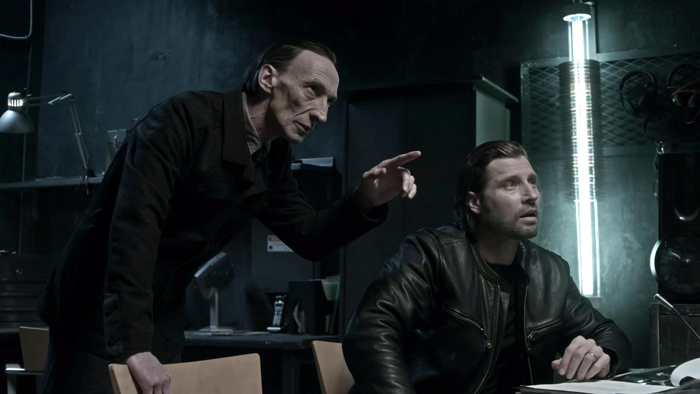
You’ve got to use whatever you have at your disposal and a gentlemen like that… a complete pro, I’m sure he took advantage of everything he could to better get into his character’s head space.
Exactly.
So from where you’re sitting, looking back to the actual production, what would you consider a day, a moment, a take, a set, a whatever that years from now you’re going to look back and remember fondly? What was the moment where you got out of your head a little bit and got to enjoy what you were doing?
That’s a no-brainer. For me, and I think it was for everyone on the day, because it was something unique. This was right at the end. This was the second to last day of the shoot. We’d shot for thirteen days in this bunker that we’ve created, and the first time we step out of the bunker is for this scene which is at the middle of the movie, in the cabin where Carmen supposedly has kind of moved to, away from the city, and she’s living in seclusion… So the scene that I’m talking about is just a brief flashback scene, which was literally at the halfway mark of the movie where she’s in bed with Fischer and the TV is on when they hear the news of this terrorist attack on this nuclear power plant. The location we were shooting in is a little bit north of Toronto and it was so cold… I think it was minus twenty-five degrees Celsius… I don’t know what that is in Fahrenheit, but it was very cold and we were told that this cabin would be heated, that there is heating and everything and even at the tech scout we were told that “Yes, right now it’s not working, but it will be fixed…” We came to shoot and it wasn’t. It was so cold… We were all in our parkas and winter coats and inside you can see our breath basically and the scene we are trying to shoot is intimate, a scene between two lovers who had just made love, just lying in bed.
I just couldn’t bring myself to tell Michelle and Damon [Runyan], the actor, to strip down and get in the bed. It was a disaster. There were so many problems… (Laughs) We couldn’t get the lights on, it was too cold, and of course the days were shot, it’s in the middle of winter… We thought about basically skipping the scene and I literally grabbed the script to see “If I drop this scene, am I losing something in terms of the plot? What is the most important thing that needs to come across?” Of course the most important thing in that scene was to establish this relationship, which is kind of unexpected. We didn’t know that Carmen and Fischer were lovers in the past, so that was important information with a backstory that needed to come out, and of course the purpose of the scene was the news that they get about this nuclear attack and the fact that Carmen’s sister and niece live in Brooklyn and are probably affected by it. There was no way I could bring out that information in some other scene, especially because we had shot thirteen days and almost the entire movie was shot. There’s nothing that we could go and add, you know?
I was out of my mind. I was panicking. I didn’t know what to do, and then the advantage of having good actors and really wonderful people… Michelle, Damon, and I got together and said, “We can’t drop the scene. We have to make it work somehow, so let’s come up with something. The way I had planned it and the way it is written is not going to work.” So we just talked about it and we started to improvise. In the mean time we had asked our crew to warm the bed. Essentially we had these big 4K lights, three or four of them, just blasting the bed and really the lights were warming up the bed. So while we were doing that, the three of us got together and we started just talking about it and we said “Okay, let’s give it a shot.” So they jumped into bed and we were just trying to set the shot when something really interesting happened, Sam was adjusting a light, which was outside the cabin and it was pointing through the window and on to the bed and while he was talking to the Gaffer and they were making adjustments, I was sitting there looking at the monitor and when he was moving the light it just flashed… There was a glare in the camera on the monitor and it gave a very surreal kind of glow effect. That really excited me. I thought, “Okay, there’s something interesting visually going on here” and so we quickly got the actors into position and I said, “Okay, you just improvise. You know what the gist of this scene has to be.” So that entire dialog is improvised there, it’s not according to the script. I was just sitting with Sam, my DoP, and when we started shooting I said “Don’t keep the camera steady, just keep slowly drifting, almost randomly… Let anything happen and let’s see what happens.”
He did that and I really… I really like that scene. Now when I watch it, that’s probably one of my favorite scenes as it’s so different from the rest of the movie. It comes right in the middle. I think it’s almost fifty minutes into the movie and having spent like forty-five or fifty minutes in this dark bunker… All of a sudden we are brought out into this scene in which it’s very bright, the sun is shining, and there’s these glares in the camera which reminded me of START TREK and JJ Abrams and all… (Laughs) On the day it worked. I felt there was something special there. We shot it in a way where I wasn’t sure we’d be able to cut it together. It was so random. It was improvised. There was no continuity there, in fact the continuity guy was going crazy. I didn’t know if we could actually edit it together, but once we put it together and worked on it a little bit, it turned out to be one of my favorite scenes in the movie. I think everyone on the crew, by the end of the day they realized “Not only have we saved that day,” because at one moment we thought, “this is a lost day,” “but maybe something interesting has come out of it. I think it has. I really like that scene. That would be the one day that was very stressful, but incredibly rewarding.
I love hearing that. On one hand you could have thrown your hands up and said “Well, we just lost a day… oh well,” but that’s not the spirit of indie filmmaking. You’ve got to always be able to switch gears and throw out whatever is not working to get the footage you need to tell your story. It sounds like you got a better scene than you would have if it had all went to plan. That scene is a breath of fresh air when we are under ground so much and then POOF we’re up there and even the camera work feels different. So what are some things you do with your cast and crew that shows them that you’re a leader and that they can trust you in your decisions? How do you win over your cast in crew in such a small time, so that they listen to you?
I think that’s a very important question, especially given the impression that a lot of people have as to what directors do, you know? Even the term “director,” meaning someone who directs or basically tells other people what to do, right? I don’t think that is a good title for what needs to happen, because what I’m trying to do, and this was right from the beginning… It’s not something that you can just create on set, it has to be at every step of the way with every member of your crew, actors and everyone else. From that very first meeting, my job as the director is to basically not just tell them what my vision is, but to help them make it their own and bring something to it. I’m very, especially with my actors… I told Michelle, Julian, Damon, Romano… right from the beginning “I am not telling you to do anything. What I’m sharing with you is what I have in my mind and I want you to tell me what kind of thoughts and ideas that is provoking in your mind. Then together something interesting will happen, a fusion, and the character that you are portraying will be a fusion of something that I had originally planned and something that you felt in the moment and the way the light fell on you and the way the production design hit’s the screen… It will be a collaborative effort and everyone will have an imprint on the final frame.”
That to me is very important, especially with the actors and then the key crew members, to win over their confidence that I’m not telling them to do anything, I am inviting them to partake in the vision that I started off with and invite them to kind of modify and bring something new to the table that would excite me and that certainly happened, especially with my actors. The scenes between Michelle and Julian, like while the scene was being set, they would discuss things on their own and then they would come to me and say, “We’ve got an idea. What do you think of this?” Most of the time they would be great ideas, My eyes would light up and I’d go, “You know, that’s a great idea.” Some other times I might just reminded them they’d forgotten about something that just wouldn’t work for some reason, not that they were bad ideas, just they might have not considered something where I just have a little bit better idea of the bigger picture as I’d been with the story for five years and there’s something that they might have missed and I would just remind them of that. So I think it was very important for me to win over their trust and make them realize that “This is the movie that we are making together. This is not something that I am just trying to force upon them with my vision” and I’m sure if you talk to Julian and Michelle and the others… I’m 100% confident they will tell you that they felt more involved than they would normally would have in some other productions, especially with Julian who has worked so much in TV and in independent films, and even big budget films where it’s very strict.
You come in, you’re told what to do, and of course you find something for yourself to make it work, but you know there are very strict guidelines and limits, especially in television as there are so many people and the director is probably the least important of all the people involved there. I’m sure if you asked them, then on this project they probably felt a greater level of freedom creatively, because I certainly encouraged it. I encouraged it as much as I could. If they were not comfortable with a line… If they wanted to say something differently, I never had a problem as long as the main bat of the line was preserved. Same thing with my DoP. I gave him this idea that I had and I was so pleasantly surprised when he himself came out with ideas that were actually… I told him that I liked a lot of shadows, because the story deals with the subconscious and we are deep under ground, so “let’s make it very contrasted with a lot of shadows” and so in scene where I didn’t even think about it, he would somehow create this great shadow of a hand hold a gun or this person walking and this long shadow on the floor or something like that. So that was very interesting for him as well, because this whole idea of shadows was implanted in mind by me, but he took that and ran with it. I think that was key for me, especially on a low budget movie like this where we are all going to be under pressure, we had to work fast, we had to be on our game, and the best way to do that is to make the actors and the crew full participants and partners in the process and make them own it. The level of involvement has to be something much more personal and much more intense than they normally would be. So that was what my goal was and I was certainly happy with the results. I hope I managed to achieve that level of comfort with everyone.
It sounds like a great deal of collaboration where you had enough confidence in the individuals you picked to surround yourself with to just trust them and welcome their thoughts. Especially with lower budget projects, no one is there “just for the money,” so if you can allow them to make it their own while it still follows your vision, I think that’s key. My answer to “How do you get people to trust you” is simply “You have to trust them” and it feels that’s exactly what you did. You’ve got a great head on your shoulders and I hope to see more films from you. That leads me to my last question, which is “What’s next for you?”
As I mentioned, the script I’d written before I came across this novella and this project happened, it’s also kind of a science fiction psychological thriller. It’s an original idea not based on anything and so yeah, that is next. It seems that because of PRISONER X and especially with the funding agencies in Canada who seem to be quite pleased with what we managed to do with the limited resources that we had, and the film has done well, especially in the international festival circuit… It just seems like the right time for me to go with another script which is in the same genre, the same psychological… I would again say “High concept, but not necessarily high budget.” It’s the “high concept, low budget kind of thing which can be done for a limited amount of money,” although I would certainly hope that this summer I’ll have a little more money. The budget on this one was just so ridiculously low that it did affect a lot of important things that I would have loved to preserved. I had to walk away from several things that were very difficult for me to do, but on this one I’m hoping we have a little more money. It’s a psychological thriller called BARDO. It’s based on the Buddhist concept of the afterlife as this story of two scientists who develop a hypothesis about the process of death and they conduct illegal experiments to try and prove that hypothesis. So I hope I get to make it in the near future.
Me too. I can’t wait to see BARDO or whatever else you end up doing, perhaps something you can’t even imagine falling on to your plate. Gaurav, thank you very much for your time today. You’ve gone deeper into the things I personally care about than I think most directors would allow themselves. I not only appreciate your time, but your willingness to talk in depth about so many topics related to independent filmmaking. I actually feel I’ve learned a little bit in these forty minutes.
Thank you, Mike. I really appreciate your interest and talking to me about the movie. I’ll be in Austin for the screening, so hopefully we get a chance to say hello then.
Sounds good, man. You have a great rest of your day.
You too. Thank you, Mike.
Adios. Bye.
There we are, ladies and gentlemen - an incredible look into the mind of PRISONER X's director, Mr. Gaurav Seth. I hope you all found the interview as fascinating as I did. If you're in or around the Austin area (I realize that's a small percent of the AICN audience) and are in the mood to see a quality science fiction thriller - then be sure to hit up this Thursday's screening of the film, along with the opportunity to ask your own questions!
- Mike McCutchen
"Muldoon"
Mike@aintitcool.com