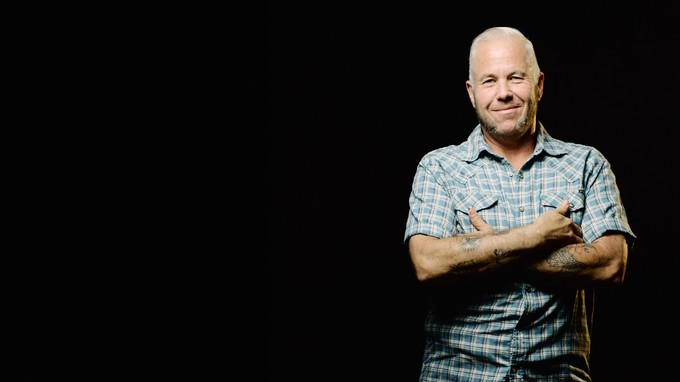
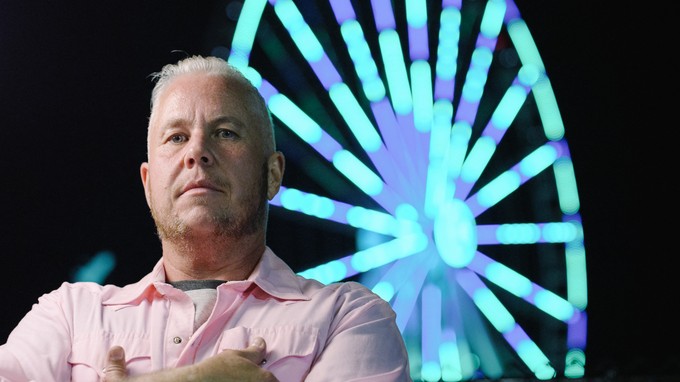
One of my favorite experiences from the 2016 Seattle International Film Festival was FINDING KIM, a documentary focusing on a Seattle transgender man as he goes through the transition process after living as a woman for the first fifty years of his life. It’s a really warm, honest look at the process, and I was delighted to have the opportunity to sit down with director Aaron Bear, DP Gabriel Bienczycki and subject Kim to discuss the film.
Horrorella: Can you guys talk a little bit about the genesis of the project and how everybody came to be involved?
Kim: I've been friends with Aaron for 12 years. I was at a party and sat next to him and said, you know, I'm going to transition. He asked me a bit later if I'd be interested in doing a documentary. I was reluctant but we both felt it could help some people if done right. And we decided to do it, in the hopes it would help someone like myself, an older person who might be thinking, "I can't do it, I'm too old". They can.
Aaron: And then Gabe and I had worked professionally, and then we started doing some projects together on the side. And I always wanted to make a documentary film, and I would always start and stop things, but nothing that truly ever spoke to my heart. So I was trying to always find what I could tell a truthful story about. And it finally dawned on me that this could be really cool. To show the world what it’s like for someone to transition. At this point, Gabe and Kim hadn’t met yet, so we had informal drinks at my house and we discussed it.
Initially, Kim was really hesitant, because it’s about somebody’s life. We had to assure him that we weren’t ever going to exploit him and we were going to tell the best story that we possibly could.
Gabriel: It might also be worth noting that this started right before the transgender conversation came into the public eye. So it was sort of this unexplored subject and we didn’t know it would get this reaction and that it would be this national point of interest.
Horrorella: Given how personal the process was, how the three of you work together to ensure that Kim was comfortable and supported throughout filming?
Kim: Well Aaron is a good friend and Gabe was a new friend but we got along right away and my dogs love Gabe! That's a good sign. They were friends, so even though it was still very uncomfortable to show myself to anyone like I did, it was relatively comfortable and it was fun, and cathartic in a way too. We all worked around each other's schedules but mostly they worked around me and my comfort level and were very nice and helpful.
Aaron: There were plenty of talking down from the ledge moments. But, first and foremost, Kim is a friend and I always wanted him to know that our friendship is more important than making a movie. And it still is. And I always wanted him to feel comfortable.
Kim: They wouldn't do things if I didn't approve but I really didn't say no. I did have a few requests and they honored them.
Horrorella: What were some of the more challenging aspects of filming?
Kim: I am very outgoing yet very private. It's a strange combination so it was difficult to be in front of the camera especially in the first two years when I was quite large and felt very ugly. I lost 80 lbs due to diet changes. Being out in public filming was challenging for me, because people would stare. It was kind of fun though too.
Aaron: The nudity was a big thing. And I really had to say “people need to see this. They need to see front and center what goes into this.” And there were a lot of phone conversations about that and ultimately, he knew that it was going to work.
Gabriel: The surgery was also something that we discussed should that be seen or not and we went with what we think is the more tasteful way to do it.
You know when you do a portrait of somebody, by editing, you flavor it certain ways, so you can make somebody look good and bad with the same footage. As much as we were friends with Kim, we didn’t want to make some sort of artificial puff piece about how wonderful Kim is. But also we didn’t want to show him in a bad light because we would feel that it would exploit the situation. So there’s a bit of a balance to preserve journalistic truth and also be respectful and kind and not really punish him for exposing himself or making himself so vulnerable.
Aaron: The hardest thing was when Gabe and I knew we had one of the final cuts I sent it to Kim and as soon as I hit send I was like ‘Oh shit. Oh shit.” And I was waiting and waiting and all of a sudden I got a text message and he said “This is beautiful. I love it.” And I was waiting for the notes and he said “The only thing…I think I cuss too much in it.” Which, I think he says fuck and shit maybe 5 or 6 times.
Horrorella: And then apologizes – which is so nice!
Aaron: Everybody laughs at that moment. But yeah, that was it. And at that point, Gabe and I took a really big deep breath and knew that we could move on, find the edit, push it more.
Horrorella: Kim, what was your reaction when you first saw the finished film?
Kim: It was emotional. I cried. The more I see it, the more I like it. It’s weird to see myself, especially on the big screen. I don't like looking at myself, or hearing myself. But at the end of the film I DO like looking at myself, relatively speaking. I look like how I pictured myself, at the end of the film. But they did such a good job. It's a more generalized approach, a brief look at me but a larger look at transition and transgender folks and community and the struggles and hopes there, I think. It doesn't go into detail about the how’s of my transition. The paperwork, the struggle for healthcare, how to do a name change, a gender change with social security, etc. It didn't show me going to or to Ingersoll Gender Center which is such a great place and really helped me…So much happier than before the film started. I was a bit shocked and overwhelmed by the support for me and the film.
Aaron: Last night especially [at the premiere], we saw the outpouring of support and people who love him who are there and people who just want to come up and meet him. It was really cool. And I felt so good for him.
Gabriel: There's that last interview where he’s sitting on the chair outside and he talks about how he's not dating yet but gets to dance with girls and he's flirting with them…and that's how you know that he’s at peace with himself and there's a term for this - some sort of gender congruence or coherence - when you arrive at the point where things are right. And I think that interview is that point.
Aaron: And if you compare the two interviews - that was the first thing we shot of him - the first thing you see, and then compared to that last interview at the very end where he's sitting outside in the sun - two totally different people.
Horrorella: Kim, what kind of an impact did being filmed have on the transition process, if any? Do you think you approached it or handled it differently that you might have otherwise?
Good question. I believe it had a huge impact on me because really I was able to get the surgery due to the film being made. An old friend from high school days who I'd been in touch with the last couple years before filming, we got together for dinner one night. They asked me about the transition and I told them about the film and the Kickstarter for it. They wanted to help in some way but the fundraiser was over. They found out my surgery wasn't going to be covered by my insurance due to the surgeon not taking insurance at the time. Most don’t accept insurance so it doesn't matter how great your coverage is, it does no good. My friend offered to pay for the surgery. They said they wanted to help me become me, and that they were more than able to do it, and it was shocking. I was in shock. I still plan to repay them one day. That gift changed my life immeasurably and I think that really it all happened due to the film.
Horrorella: Can you talk a little bit about shooting here in Seattle and incorporating the city into the film?
Kim: It was fun shooting with my friends. It was weird to walk around in public, however, with a camera man following you! It made me a little self-conscious but then again I always am. I love Seattle and the places we filmed are places I go. I've lived there most of my life till now, so it's a definite character in the film I suppose.
Aaron: Yeah, we wanted Seattle to kind of be a character in the movie, because it's Seattle - it's gorgeous. Also, for the whole trans population. Seattle is leading the way in that. I also wanted Seattle to shine in that way too. And that’s sort of reflective in the trans pride parade.
Gabriel: In the medical field as well. Dr. Mangubat [Kim’s surgeon] lectures at the University of Washington, so there is a segment where we filmed at one of the lectures, and it seems like this is a hub for surgeons to learn the techniques and pioneer new stuff. Also, shooting in Seattle is simpler than shooting in a film town like New York or LA. Nobody bothered us. We didn’t have a single permit for anything.
Horrorella: Going back to all of the transgender issues that have been present in the media and in the government over the past year, it makes the film very timely, which adds to it, but what are you hoping that this film can add to that conversation as it moves forward?
Kim: I just hope that it will show more of a regular person transitioning, rather than a rich celebrity or a rich person on a tv show. I hope it puts a normal face so to speak on the issue. Also, transgender males are sorely underrepresented in the media. I wanted people my age range – 40s and 50's and above to know that it's never too late to transition! I waited a long time. I waited almost 30 years from the time I heard about transitioning! I wanted to say that you can do it! Also to young people, if you know who you are ( I did at age 2 or 3) then try to speak up about it because today people can talk about it. But my message is that we can't give up. That you can be who you are. Also that there isn't one way to transition nor is there a right or wrong way to come out.
Aaron: Yes - I’m hoping that it clearly states that everyone’s transition is different. No transition is going to be the same. These people are human beings and they should be treated that way. And I feel FINDING KIM is really strong in that narrative.
Gabriel: And obviously ignorance breeds this crazy behavior that is happening with all this intolerance with the bathroom question for example. So the more voices that are out there in the aether the better educated people are and they can form their opinions based on actual information and not scare mongering.
Aaron: It sounds so cliché, but seriously, if we can help one person come out and help them transition just by watching this, I feel like the movie did its job.
Gabriel: Especially with the suicide rates being so crazy. 40% of transgender people attempt suicide so if by watching this they don't, that's great.
Horrorella: Tagging on to that since all of this is so in motion and so present in the public’s mind, what of you see coming next on the political front, if you had to guess?
Kim: I'm not political and I sadly do not keep up on everything. I just can't. It's depressing and scary to me.
Aaron: i would guess more rights. Buck Angel sort of mentions this [in the film] – it’s happening so quickly. And just like the gay and lesbian movement, the Stonewall Riots, stuff started happening overnight. And within the span of 30 years, rights changed, people were recognized, voices were heard. And even though this is a new conversation I feel like this conversation is going to start to happen. All this bathroom nonsense, it's stupid. I feel like once this bathroom thing is done we can move on and focus on the rights that actually need to be on paper, set in stone so this group of people can move on.
Horrorella: Kim, What advice would you give to someone who is considering transitioning themselves?
Kim: My advice like I said in the film is research everything. Not just online. Read books, talk to people, find groups. READ BOOKS. I know in this day and age people want instant information so sometimes they get the wrong information because they've clicked on such and such blog by a sociopath who hates transgender folks (yes those blogs exist), or are basing what they know only on some YouTube videos they've watched. There is accurate and scientific and medical information out there online that one can access. Also, do your own inner research, into yourself. For me, I knew I was male since I was a little kid. I always felt it. I didn't know what to do about it. As I got older I did try a couple times to be "girly", and date men, and I was drunk the whole time. I'm lucky to be alive, really. People do destructive things when they are hiding who they are sometimes. I took a long time to transition. Now, people have many more resources at least online, than I had. There was no internet when I considered transitioning for the first time. Some states and cities are horrible to trans and gay people. So it will be hard to find groups or even healthcare. In other countries, as well. But most people I hope have the ability to reach out online somehow, and to find good information. I have also changed what I believe to be true over time, because of my open mind and wanting to learn. Some of the most judgement on trans folks is given to us by ourselves. So my other advice is to be nicer to yourselves and nicer to others even if you don't agree about the way they are doing their transition, perhaps. It's all subjective, we all do it our own way.
Horrorella: What was the experience of the premiere at SIFF like?
Kim: It was incredible. Terrifying. Luckily I had my dear friend Vincent, my friend and producer Consuelo's son who I met about a week after he was born. He was sitting with me the whole time and I was able to watch it without losing it. It was pretty cool to know that the film was sold out, and we got a standing ovation, and it was rather overwhelming.
Aaron: Yeah – standing ovations – you never expect that. It’s hard to believe.
Kim: I'm glad personally that it opened at SIFF because I love movies, and have attended SIFF various times over the last 30 years. I saw the world premiere of Evil Dead II at SIFF almost 30 years ago, not the same theatre my film was in but it reminded me of my youth, and how I loved film, and now I was in a film. So weird.
Horrorella: At the end of the film, we saw you going on your first real vacation in years - how was it?
It was great. The greatest! This was another rockabilly festival that I had already been going to go to, this one was in October of 2014 called the Rockabilly Rockout in Las Vegas. So tons of my friends from Seattle area and all over the world. I was ecstatic. I made new friends on the trip as well. But of course the best thing about the trip for me was being there at the pool, with my friends, swimming as myself! How I'd pictured myself since a youth.
Horrorella: What are you hoping audiences take away from this film?
Kim: I hope that they will see that trans people are people that they already work with, see every day at the grocery store, in the car next to them on the street, walking their dog in the neighborhood. That's ME. So be nice to people because you do not know what they are going through. What they have gone through. I want people to see that transitioning isn't done for "fun" or to "trick", as Carmen [Carerra] points out in the film. We transition, we align our bodies with our brains as Jamison Green has said in his book. We have to. Some folks will say gender is fluid for them, or that it's not a medical issue. For me it is a medical issue. I think that it is for everyone, because we are born with different brains than most of the population - this has been proven by various studies. It's not up to me to tell anyone else what to do. I did what I had to do for me which is get medical help in the form of hormones and surgery. So I just want people to remember that this is a brief look at someone (me), and a look at the issues that surround people like myself, and see that transition really is a normal thing to do. It really is. It's healthcare. Whether or not one uses medical means, it's caring for your own body and mind and spirit and how is that different from what anyone else is doing?
Horrorella: Well said. So what’s next for the film after SIFF?
Aaron: We just found out we got into the Rhode Island International Film Fest. Then, we would love to find a home for it somewhere, whether it’s the online channel, and the whole shebang, we want it out there. We want people to watch it.
Horrorella: What’s next for you guys?
Kim: I am trying to figure my life out. Transition doesn't make everything ok, just some things. However it enables one to help themselves more because it's easier to help yourself when you can be yourself.
Gabriel: We have two projects we’re working on right now – one of them is a documentary that we’re hoping to make about people who live off the grid, who find happiness away from society. And then we want to make a feature film that we’ll be filming this winter. So we want to make cool stuff and we found a way to work in a very very small footprint, with a small crew and supplies and were basically able to self-finance so we didn’t have to convince a producer, a studio or anyone to do what we want to do. And that allows us to have great integrity in what we do.
Horrorella: I’m so glad it went so well. It’s a really great film. You guys did a great job. I’m so excited for you.
Aaron: Thank you.
FINDING KIM is currently hitting the festival circuit, so be sure to keep an eye out for it this summer. You can find updated information at findingkim.com, and on the film’s Facebook page.