
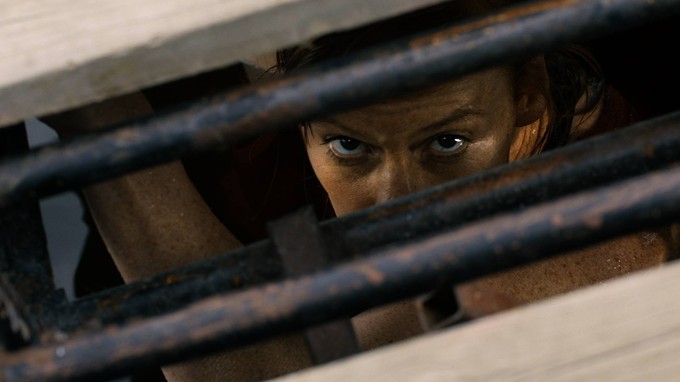
Hello ladies and gentlemen, Muldoon here with a talk with Director Remy Auberjonois about his directorial debut with BLOOD STRIPE. You've likely seen Auberjonois on screen as he's acted in THE AMERICANS, MAD MEN, WEEDS, THE INTERNATIONAL, and more, though BLOOD STRIPE is his first outting as director. Having just seen the film myself, it's quite an impressive film to begin with, and the fact that its his "first feature" is something truly remarkable. While we do discuss films that made an impact on him and helped influence where he wanted to take his film, it's very much a story we are all used to, that of a hero returning from war and the subsurface damage that person is left to cope with while acclimating back into "the way things used to be." While I neglected to bring it up in our brief encounter, the film reminded me of William Wyler's THE BEST YEARS OF OUR LIVES, the 1946 classic in just how well it showcased what war and being in combat can do to a person, not just physically - but psychologically. The film was co-written by Auberjonois and his wife Kate Nowlin, who is also the lead in the film. Nowlin's performance in this film is so utterly genuine that I found myself getting lost in her performance more often than not. I don't want to scream hyperbole, but she's that damn good in the movie and as she'd not been given the opportunity to carry a heavy dramatic film before - I can't help but respect that she and her husband made an opportunity happen by pushing this film into existence. It's a wonderful reminder that if you want something, you should go get it. That's what Auberjonois and Nowlin did and now they are premiering their labor of love at this year’s Los Angeles Film Festival.
While I believe the film's June 2nd premiere (8:30 PM) is sold out, the film screens again on June 7th (4:10PM). Hopefully you enjoy the interview below as much as I did. I appreciate Mr. Auberjonois giving me a piece of his time to talk about the film.
Hi Remy, how are you doing today, sir?
Okay, Mike. How are you doing?
I’m doing pretty great actually. First off, congratulations on the film. I found it incredibly well done and think it will play well with the LAFF audiences.
Thank you so much.
So how did this project first come to you? What pushed you to tell “The Sargent’s” story?
The project came from a push to create. The story developed really organically actually out of the place we… I’m a professional actor. I’ve been an actor for a long time; it’s what I do, and I decided that I wanted to expand what I do into directing and in deciding that, I realized “Well, you can’t just raise your hand and say ‘I want to direct,” you’ve got to make it happen. I wanted to go for the gold and make a feature. We started to make a micro-budget feature, but it kind of grew further as the project progressed. My writing partner, who is also the lead, Kate Nowlin, who is also my wife (laughs), she and I approached it really from what was doable and how and where we felt we could best make a film for the best value. I wanted to center it around her, because I felt she was my primary resource as a director, as an actor who would be a hundred and fifty percent on board and I could focus on one character. We were looking at a little website about the town of Cook, Minnesota on Lake Vermilion, which is where we really wanted to make a film, because we had access to this summer camp where I felt we could live and work and would be a good gateway to that area.
There was a little article on this little website about the town of Cook, Minnesota about a woman who had been named “Soldier of the Year.” That seemed like a good character for Kate to play. That woman’s story is not this story… We are not telling that story at all, but it was inspirational to us and it lead us down this road. A lot of people from that area, “The Iron Range” serve in the military. It’s one of the ways that people get education, or get to leave that area if they want to. So there are a lot of people serving from there and as we started to look into that character for Kate, of course we became very aware of the PTS epidemic and the Military Sexual Trauma epidemic and the epidemic of Veteran Suicide. We were inspired to write a story that had a lot of those elements in it and none of which are entirely explicit. It came sort of organically from that place.
Even as a professional actor, no one is going to “just give you a movie.” You have to take it upon yourself to make it happen and see it through. It’s refreshing to hear how BLOOD STRIPE came about. Given Kate Nowlin is your wife and co-wrote the film with you, is it safe to assume she was always intended to play the lead?
Yes, it was very much a part that we were writing for her. It was something that I didn’t know that I would be able to do, direct a film. I just approached it in the same way that I always approach my work, with that perspective, and a lot of people have told me that I have a director’s mind, but it was something that I didn’t know I could do and she believed that I could, but I really believed that she could carry a film and she hadn’t had the opportunity and I’ve known for a long what a tremendous and authentic she is, so it was something that kind of gave to each other, by being each other’s greatest fan. (Laughs) We relied on each other in that, too.
And rightfully so; she gives and incredible performance in the film. I assume also there’s a shorthand there where she can kind of read your mind a little bit, so on the day it probably wasn’t as crazy as it could have been had you cast an unknown or someone you hadn’t worked with before. Looking at the emotions and the situations embedded into the film’s core, what kind of research did you and Kate do? With her, both for the script and her performance? I’ll be honest, it’s tricky to separate the two at this point, because she co-wrote the film and yet is also the lead. What kind of research did you two do to make sure you paid your respects to the individuals who actually struggle with PTSD and these suicidal tendencies?
Kate had a personal experience with trauma that was not related to the military, but the sort of kernel, at least experientially for her and for the way that it affects how one moves through the world, that was very personal. It’s not a personal story in terms of military background, but Kate had an experience that was life threatening and also therefore life changing. Getting over that and the passing through that became a positive, but she had the experience of her worldview being entirely altered and colored by that experience. So there was a real place where she was starting from, which was real and personal.
We definitely read a lot, a lot of first person accounts, a lot of books on the subject, and watched films. We had a female Marine actually on the set with us, not someone who struggles with this, but she helped in providing some perspective on that experience. A lot of it was an imaginative exercise based on her personal experience and our encountering literature. We took a lot of inspiration from two documentaries, one called LIONESS and one called THE INVISIBLE WAR. That really informed the authenticity we were going for in the film in terms of the level of the performances, and the look of the world that she comes home to. We modeled the world in the film off of the world presented by those films.
I believed her character had gone through some incredibly tough situations. At no point did I think, “Here’s an actress memorizing lines and repeating them.” Again, I think her performance in the movie is something rather special. You felt her pain. You felt for her when a guy put is hands on her, even in a non-violent way. Point being - you felt for her.
I’m glad you had that connection.
I’m always curious about the length of a shoot. In this case, how many days did you have to shoot the film? Exactly where in Minnesota did you shoot this?
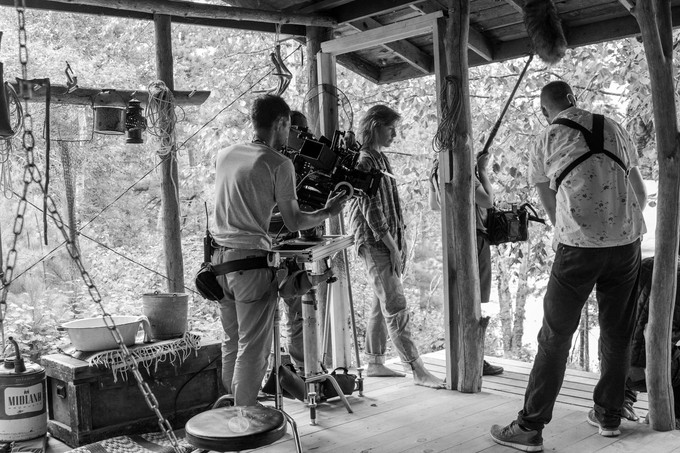
We had sixteen days of principle photography, and then some B Roll stuff that we were able to do. We shot it in northern Minnesota at Lake Vermilion for 16 days where we did a week in St. Paul and then… Well we did two weeks in the summer around August of 2014 and we finished the movie this past April. So we shot two weeks in Vermilion and then I had to go back in the winter time and I got some more footage and I got that final shot where the lake freezes over. So we let six months go by and I went back and got some more footage, but it was quick. We had to reconfigure our shooting schedule based on some financial constraints, which meant we reconfigured the script.
That’s a very indie headspace to be in, to be able to shift gears when needed. There are a handful of intimate or vulnerable moments in the film and my original question before realizing the lead was your wife was “How do you get an actor to just trust you when you’re directing them?” But I’d like to take that in a different direction now and just ask, “How have your acting experiences come into play while shooting this movie?” This is your first time to write and direct a feature, so how did your acting sensibilities come into play while on the other side of the camera?
That’s interesting. I’m actually doing a write up right now for another outlet and am writing on that theme of how it informed my directing. I think the biggest thing is I did have… You talked about a short hand, and I do have the language that actors speak in. It was the one thing that I said in approaching the prep of the film… My experience in television and filmmaking has been limited to “the trailer, to wardrobe, rehearse, hit your mark, go back to your trailer… maybe stop by craft services “ (Laughs) I have taken a view of everything that’s going around, but in the prep I said very clearly to my partners, my stellar cinematographer Radium Cheung, “Look, I know narrative. I know performance. You’re going to have to help me with coverage.” He did, and the same thing went for my producers. The same thing went for the designers.
I trusted and relied on my partners to bring their artistry to it and then they would present me with things and I would respond and we would go. So the performance was in my wheelhouse and all the rest of that stuff was a challenge, but certainly the intimate moments it was about… We were interested in a female character playing the wife to someone being portrayed in a real way where an audience might judge what she does in the film, but we wanted to let the woman be a full woman and I think Kate demanded that stuff as much as anybody as the creator of the story herself. The other actors, Chris Sullivan and Tom Lipinski are both total pros and very committed. They were game. We were shooting however many pages a day and it’s like “Okay, now we’ve got to do this love scene,” none of which were particularly really explicit I guess, but everybody was game.
I’d assume you and your lead were on the same pages well before any cameras came out, and it seems like you surrounded yourself with good people, which is always good. As we wrap up, what do you hope people walk out of this movie thinking about or feeling?
I want people to feel a sense of loss (Laughs) and responsibility. I want people to feel a sense of potentially hope. I want awareness to be raised. We’ve told these stories about individuals coming home from war for as long as we’ve been telling stories and there are new people to tell those stories about now and I think that would be women. I think that’s a revelation that they deal with different impacts. I want people to get wrecked in a good way, in a satisfying and cathartic way.
When the film was over for me, I felt it was a reminder to respect the fact that these people are going through something crazy even after returning home where they’re supposed to be safe. To see it played out with so many different scenarios, like her at her new job, in her interaction with her husband, her friends… it’s just a small reminder to take a second and appreciate that these folks have gone through so much.
One thing about that too is a lot of what we heard about is some women veterans, it’s assumed that they were not exposed to any of the impactful experiences, and that’s just not the case. A, women are serving in combat roles, and have for a long time, but also these wars are messy. There is no front line and it can be traumatic in many different ways and women deal with a lot of different kinds of drama and then they come home and it’s not even assumed that they would be carrying that. I think that’s one thing that I want the movie to bring up to people, that “Yes, women experience it too.”
That’s a great point and I’d say you’ve succeeded at least with just me. Last question of the day, “What’s next for you?” That’s in terms of writing, directing, acting, anything at all that you’re excited about that you’ve got lined up.
I am continuing to act. I’m about to do a lead role in a play and I’m also developing multiple projects. I have two film projects that I’m developing, one that I would try to shoot also in Minnesota, a story about the area that’s more focused on a story of human trafficking as there’s a lot of that going on. I’m also working on a story that’s set in LA in the seventies. Both of those are entirely different tones, so I’m going to see which one I get more traction with creatively myself. In the mean time, I am continuing to act on the small screen, the big screen, or a stage near you! (Laughs)
Well cool. Best of luck with those future films and here in the present, best of luck with BLOOD STRIPE’s premiere at LAFF. I think you’re going to be very happy with what people come out of there thinking, at least that’s my expectation. Thank you for your time.
Thanks for talking.
There we have it, ladies and gents, a brief chat with Director Remy Auberjonois. As you can tell - I found the film rather special, a true drama that isn't filled with musical cues to tug at your heart or get your blood pumping, but a soild film made by passionate people that actually delivers a welcomed punch of perspective. If you have an opportunity to check it out, you should take it. If like most people, you're nowhere near Los Angeles, but want more information on the movie - head over to their Facebook Page to see where it's going next.
- Mike McCutchen
"Muldoon"
Mike@aintitcool.com