It’d be easy to make a film that makes fun of Slash fiction writers in the way that GENTLEMEN BRONCOS spoofed aspiring sci-fi writers or ART SCHOOL CONFIDENTIAL mocked young artists. Thankfully, writer/director Clay Liford had no interest in doing that with his film; in his story of young Slash writers Neil and Julia, played by Michael Johnston and Hannah Marks, the idea of exploring sexuality through the prism of pre-existing IPs is portrayed as a natural, even innocent occurrence, an outlet for sexual and romantic feelings that may not quite be fully realized yet. As Neil conjures up sexual scenarios involving his favorite superhero, “Vanguard,” we see that he does not emphasize one gender over the other, and harbors feelings for both sexes, even though he acts shy and invisible in school. When Hannah’s Julia sees his penchant for Slash fiction, she encourages him to post his stuff online, leading him to enter this anonymous online community where his work is celebrated even though he doesn’t meet the mandatory 18-year-old age requirement. Meanwhile, Neil and Julia get closer, and begin to become important in each others’ lives as they get ready to go to a local Comic-Con in an attempt to make a big splash in the Slash world.
Liford’s film sidesteps a lot of the stuff that people normally associated with movies about “geeks,” and uses the subject of Slash to put these characters’ sexuality front-and-center without making it into a KEN PARK-level teen sex drama. It’s a coming-of-age dramedy that rarely falls into the traps so many similar films stumble right into, and features several performances (including Johnston, Marks, and an against-type Michael Ian Black) that keep the film grounded, funny, and relatable.
Liford and I packed a lot into our less-than-20-minute conversation, including how he shot the sci-fi “Vanguard” sequences, how he cast and directed his lead actor, Johnston, and the difficulty in building a believable recreation of a comic convention:
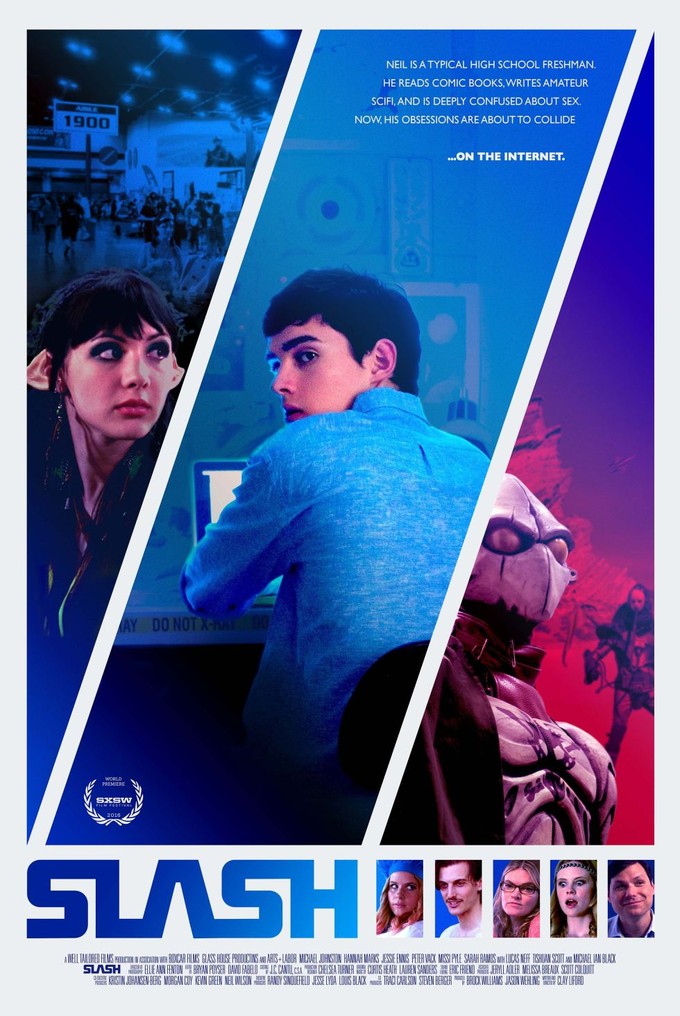
VINYARD: Did you shoot the SLASH short here?
CLAY: I did. It was actually the first movie I made when I moved back to Austin a few years ago. I made the short in 2012, it premiered in 2013. It played Fantastic Fest, it played around a lot. Based on the strength of that, I decided to go ahead and expand it. That wasn’t even the initial thought. I wasn’t sure until I just watched how people reacted, and then I decided I wanted to do more with those characters.
VINYARD: What was the jumping off point in terms of story? Where did the short end and the movie begin?
CLAY: The short weirdly hits a lot of the same beats. The narrative follows a decent amount of the same path. A kid discovers this online community, has potentially inappropriate relationships online, and then goes to meet the people he’s been talking to at a live convention. Then whatever ensues at that point ensues, you know?
VINYARD: But the romance angle wasn’t really there.
CLAY: Not so much. In the short, there’s no foil for those characters. In the short, it’s just this very young kid who is just kind of possibly dipping his toes into waters that may be outside of his age range.
VINYARD: So Hannah’s character was a construct for the feature.
CLAY: Absolutely. She’s such a huge part of the movie. Completely changed everything.
VINYARD: She kind of takes over the movie, and serves as (Neil’s) mouthpiece for a large amount of it.
CLAY: His journey is going from introverted to coming out of his shell a little bit more, with her help to some degree.
VINYARD: One cool thing about the movie is that the romance isn’t one-sided. They both have other people they’re interested in, and even other genders. They’re not necessarily heteronormative teenagers, they’re both essentially bisexual.
CLAY: I think we’re in this…I think kids are getting more post-label, or whatever it is. It’s so much more inclusive now. Kids are getting exposed to things at a younger and younger age. That heteronormative aspect is slowly starting to get eked out of standard society. I feel, to some degree, I’ve never seen a movie where a kid is really trying to figure out where his place is, and have the big lesson be that he has time to figure it out, and labeling himself isn’t the most important thing in his life. It was such a quest for him to do that, that’s part of his journey, getting to that spot where he’s comfortable not knowing.
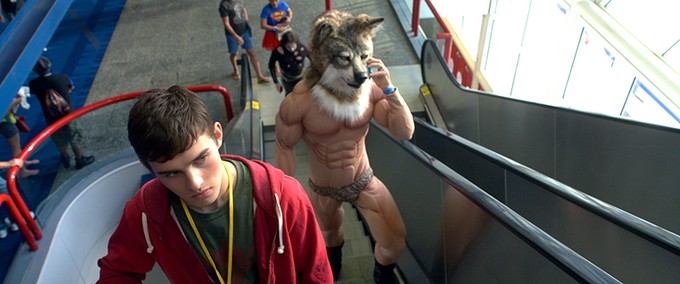
VINYARD: Let’s talk about the “slash” aspect. How did you initially become interested in that subject?
CLAY: It’s always been on my radar. I was always a convention kid. My parents would take me to conventions and drop me off for the day, and I’d go wander about, and there was always that 18-and-up room, which I think a lot of times could be hentai or something like that. But sometimes you would see gatherings of people, and this is before the internet days, so they’d be zine writers. There’s just something very cool about the idea of zines, and I was in a lot of film clubs for non-erotic fan-fiction when I was younger. It was always there, and as my interests went other places, it kinda fell of my map a little bit. Then, it kinda came up again because I wanted to do a comedy.
It was originally this very loose idea for a sketch: I thought it would be really funny if it were two very young kids on the internet without their parents’ supervision, just looking up Harry Potter stuff, and accidentally fell into a Harry Potter porno site, a Slash site. After doing some research, I realized, “You know what? There’s a lot more to it than just making it one goofy joke.” I started getting more and more into the characters, and then reading correspondences between different Slash writers, and even talking to a few, and that just led me to want to not make the joke such a base level, low-hanging-fruit kinda thing, which led me to a larger concept. I feel like any films I do, and I’m not sure how successful I am, but I try very hard to take what some would consider “wacky” subjects and kind of ground them, and actually make them empathetic.
VINYARD: That’s one of my favorite things about the movie. It’s never judgy, it’s never condescending towards the subculture, even at points where it almost does seem like something that’s a little bit sinister or a little dangerous.
CLAY: It was very important to me not to make the Adam Sandler version of this movie, where it’s like, “Look at these people!” I think that’s highly unoriginal, highly uninteresting, and not challenging at all. It’s far more challenging to go this route…maybe “challenging” isn’t the right word. It’s not challenging for me to be empathizing with these characters, but it’s maybe a little more challenging to be able to take something that’s so insular, like the writing process, and externalize it to the point where it can be absorbed by people that don’t know anything about this world. Whether or not anyone would want to try their hand at Slash-fiction writing after this, I have no idea, but I feel, at the very least, everyone, to a person, would understand why the characters, both Neil and Julia, do what they do.
VINYARD: There are two reasons why I think that comes across in the movie as successfully as it does, and I want to ask you about both of them. The first one is the recreation footage of “Vanguard,” which is shot in a very specific way that feels completely visually different in terms of palate from the rest of the film.
CLAY: I’m so happy it came off that way.
VINYARD: I know you have a history as a cinematographer, so how’d you visually distinguish those sequences from the rest of the film?
CLAY: We made the decision very early on that we wanted the movie to be in scope. We didn’t invent this or anything, but the idea of taking a character piece and making it feel more epic by using lenses you wouldn’t normally associate with stuff like that. Not like in a Wes Anderson type of way, where it’s meant to show the artifice, but more of a naturalistic way. We shot that in what we call, “open-matte,” where we just did the cropping after we shot. We shot in high-enough resolution that we could add cropping to it. But when we shot the science-fiction stuff, Ellie Ann Fenton, my D.P. and I, made the decision to actually get some old-school anamorphic lenses and shoot on a slightly different camera so it would actually have a distinctively different look. We shot them on these kooky anamorphic lenses which are pretty old, I think they were possibly even used on RAIDERS OF THE LOST ARK, though I might have to do some fact-checking on that. We purposefully tried to go with these older lenses that have that in-morph aberrations so you can see the distortion on it, and we really tried to push that. In fact, to see how dorky we were about it, we actually distanced it to add even more of that effect in relation to the tiny, tiny, 2% vertical stretch on those scenes to make it feel like when you see slightly misprojected anamorphic, which is so typical on almost any ‘80s epic movie. They just had that look to it, where everyone’s just a little skinnier and taller. Ever so slight, super subtle.
Even the locations we found. Being a huge STAR TREK nerd, being able to go to Vasquez Rocks where they famously shot the Gorn episode, and several others. Also, BILL AND TED’S BOGUS JOURNEY was filmed there. It’s funny, as an Austin resident, I go to Terror Tuesday (at the Alamo Drafthouse) all the time, and literally the week before SXSW, Joe Ziemba, who runs Terror Tuesday, played BIOHAZARD, which had a huge, huge point-of-view shot on Vasquez Rock, and I’m like, “Vasquez Rock!!” It was so great. It was important to make it feel real and interesting. One of my biggest pet peeves is in movies about writers or filmmakers, when you see what they did, especially in science-fiction, it’s always winky, like, “We know this is stupid.” There’s some jokey stuff in there, but we wanted it to be visually legit, for lack of a better term. We shot in Vasquez Rock, we shot in this spaceship set down in Laurel Canyon where they shot FIREFLY episodes.
VINYARD: I had a great time looking at the corners of those sets.
CLAY: I feel they were also used in ICE PIRATES and CRITTERS, the opening sequence.
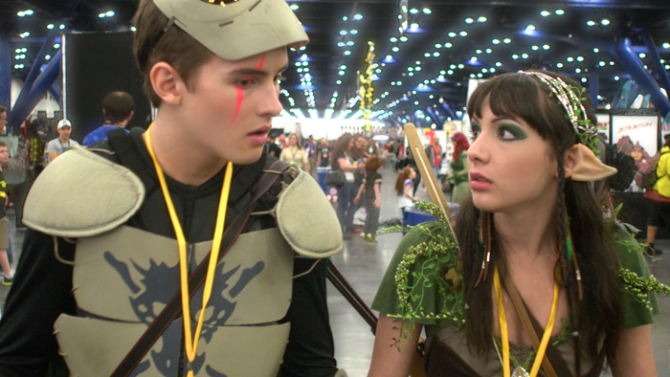
VINYARD: That’s awesome. The other thing that I thought really sold the honesty of the film was Michael (Johnston). It’s a really quiet, subtle, expressive performance, and he’s the emotional center of the movie. How’d you find him?
CLAY: We had a fantastic casting director, J.C. Cantu. He’s worked with Soderbergh, he’s worked with Rodriguez, he’s just a great guy. He had a pool of people he was interested in, and he would just have them come in. I did a session in L.A. because he’s out in Beverly Hills, and I got to be in on one of the sessions, but I only saw a handful of people. Everybody was great. Every person he brought in was either someone you’d recognize or was just fantastic. I had to go, then there was a round of tapes, and that one tape of Hannah (Marks) and Michael was in those. Michael was one of the least known of all the people who came to the auditions, the only person I did not recognize. But he was the only person that, without any direction whatsoever- oh, I’m sure Jason gave him something- he just naturally was there. His chipset, he was hardwired into the role. I knew that by going with Michael, I could sit back and take a nap, you know? He was so wired into that character.
I think my biggest strength as a director- I don’t necessarily think I have a lot of strengths- but the one I’m not modest about is my ability as a team-builder. I always like to build teams that are really good at what they do, and then get out of their way. “I’m there if you need me, but I’m just getting out of your way.” Hannah and Michael have different processes. Hannah’s very meticulous, maybe the most put-together 22-year-old I’ve ever met in my life, completely had everything locked down, had lots of questions, good, good, solid questions. She’s coming from that end of that end of the acting school, a little more experienced. Then you have Michael, who’s a complete natural who is just wired to the character.
VINYARD: That fits so well with their characters too. In terms of how expressive and active she is, and how reactive he is.
CLAY: There’s this weird thing that you see happen where she’s up here and he’s down there, and they slowly come towards the middle as she’s going down and he’s going up. They have a weird nexus point that they hit in that hotel room together, which is my favorite shot in the movie, where she’s over his shoulder and leans into him. It’s hard to watch your own movies, but that’s like one of the only times in my entire career where I could watch a scene and go, “Okay. This is why I made this movie.”
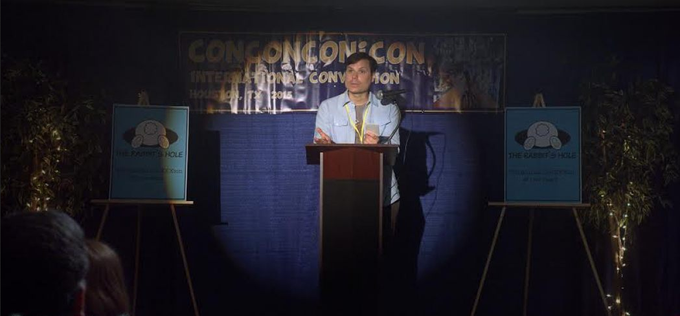
VINYARD: I like the scene with Michael and Michael Ian Black in the car. I’ve been a fan of Black’s for forever, but I never thought of him as a dramatic actor. How’d you land on him?
CLAY: We had a relationship with his manager, and he thought he’d be really great for it, and I said, “That’s an outside-the-box idea. That’s a great, outside-the-box idea.” I was always a huge fan too. But I’ve always felt like comedic actors can just nail drama, like always. There are so many times you can point to. Some of the best dramatic work comes from actors, ‘cause comedy comes with this great degree of pathos or whatever. Comedians tend to be very emotional people…I’m not saying Michael is, necessarily (laughs), but the idea is that they’re working with a lot. He was a dream. He was so incredible, and he put so much thought into it.
I’m so used to doing these low-budget movies, where people just kind of show up and do their thing, and then you’re faced with actors like Michael Ian Black and Hannah and Michael Johnston, and you’re like, “Oh my god, they actually really put a lot of thought into this,” and you’re like, “Okay, dummy.” I don’t even match them, they make me do my own work harder. It’s easy to forget that you put this thing together and people are actually investing. And that’s the difference between dealing with these actors who’re your friends, and dealing with these actors who do it for a living, because they’ve done their work, which forces me to then rise up to their level.
VINYARD: What was your big takeaway from working with these guys?
CLAY: There’s nothing that’s missed. I’m not a big backstory guy. A lot of filmmakers do amazing work with backstory, but I’ve always tried hard to bake into the script the elements I think are necessary to understand the characters. I always assume that no one’s actually going to pick up on them, but then you see the actor working, and nothing gets by them. Their filter catches everything. Michael Ian Black, who we cast not long before he showed up, but what he had done and how seriously he took it. I don’t know if you would agree with this, but for him, it was an opportunity to show a side of himself that we’d never seen, and he committed to it to such a degree that I can’t imagine of anyone else doing it. I can think of more stereotypical people, where you’re like, “Oh, they did this, they’d be good for so-and-so,” but it wouldn’t be a defining role for him. This role is defining because it is so not what you’d expect, and I hope he’s proud of it.
VINYARD: He adds so much shading to a character that should’ve been kind of like a dirty old man.
CLAY: Right, and that was like our twist. A pleasant surprise.
VINYARD: He’s a sweetheart who lives with his mom! Last question: the movie’s kind of split in two, with the stuff in high school and their hometown, and the stuff at the Comic-Con. So you had to recreate this Comic-Con setting essentially with a different cast. Did you shoot that somewhere else at a different time and place?
CLAY: it’s a combination of like 5 things. Hopefully a relatively seamless combination. We were worried about how seamless it would seem. We shot some B-roll initially with the participation of both Wizard World in Austin and Comicpalooza in Houston. Before we got out cast, we did some B-roll shooting in Austin, and then when we got our cast, we actually just took them as a weekend by themselves with a skeleton crew to Comicpalooza, shot some of the larger scenes, the ones that are like vista shots. If you notice, there’ll be scenes where like, “Wow, look at this crazy thing we walked into. Let’s go over to this corner and have a conversation now.” And then to recreate that, we actually recreated part of it at the Marchesa Theater where we’re premiering tonight. The second screening tonight is actually at a location we subbed for the Comic-Con, along with a hotel in south Austin. We use a lot of pipe and drape to sort of hide transitions. A lot of pipe and drape happening in this movie. It’s a term I use a lot, “pipe and drape”. But yeah, it was a combination of many, many things, and no one is more amazed than I am at how seamlessly it held together.
SLASH screens one last time tomorrow at 11:00 A.M. at the Topfer Theater.
