
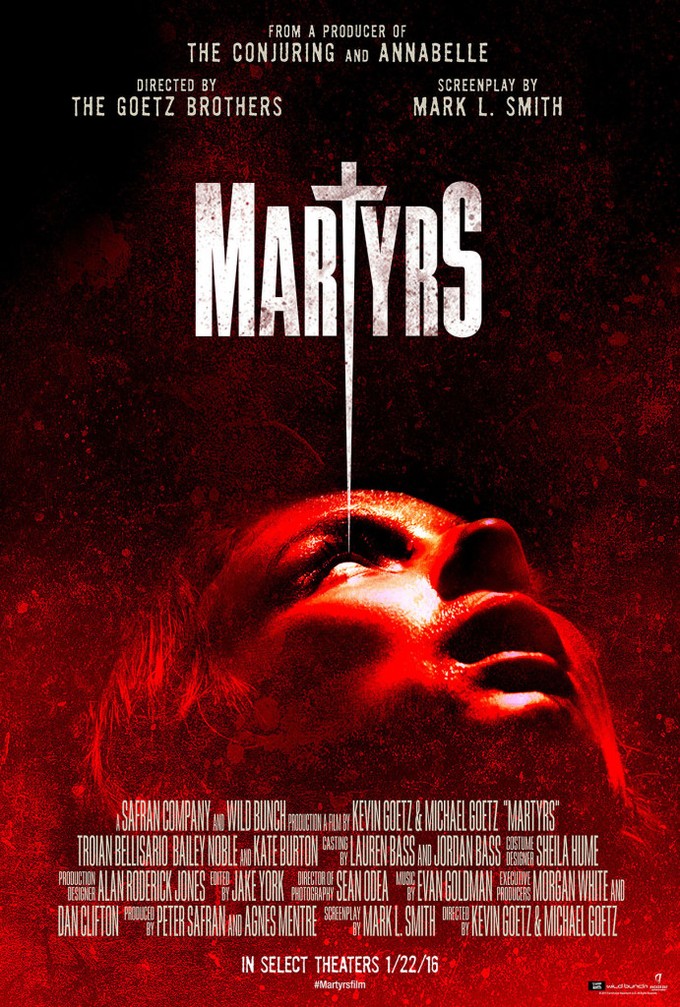
If you’ve seen Pascal Laugier’s MARTYRS, you might think making an American remake isn’t even worth trying.
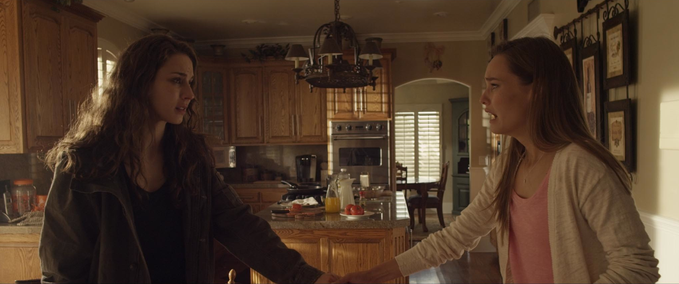
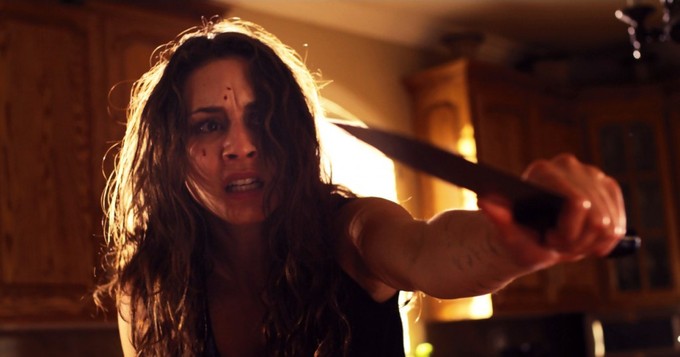
Sure enough, that’s just what brothers Kevin and Michael Goetz have set out to do. Though it was never in the cards to go as far with the brutality and gore as the original film, this remake still follows the framework of the original and never seems like it’s pulling its punches. The script by REVENANT scribe Mark L. Smith focuses on both of the central female characters, played by Troian Bellasario (PRETTY LITTLE LIARS) and Bailey Noble (TRUE BLOOD), the revenge Bellasario’s character attempts, and the impact her actions have on their friendship. The third-act turn (the same as the original’s) arrives, and ups the amount of violence and provocative ideas, and that’s where the most significant deviation from the original takes place. It’s some ambitious stuff from the Brothers Goetz, and their clearly strenuous efforts in getting this movie in with the time and money allotted have resulted in an tough horror flick that’s light on dialogue and heavy on emotional and physical intensity, and that somehow manages to hit hard within the constraints of what’s acceptable out of an American studio.
Read on to learn about the brothers’ approach to the material, their read of the script’s themes and intentions, and how they’re able to create distinctive, effective work on a budget:
VINYARD: First thing, how did you guys get involved with this remake? I know it was in development for a few years, but at what point did you guys jump onboard?
KEVIN: We had a meeting with Peter Safran of the Safran Company, who said, “I really enjoyed your guys’ first film, SCENIC ROUTE, and I really liked the psychological aspect that you brought and the thriller aspects, and how you guys managed to tell such a compelling story on such a small scale. I got this other project that I think you guys would be great for, would you like to read it?” So we read the screenplay by Mark L. Smith, and we were interested. It was a great story, especially between the two girls, and how far they’ll go for each other, and their journey was really exciting to us. It’s kinda like this beautiful friendship/love story between the two, set against this really dark world. That dichotomy really excited us. About three months later, we were shooting.
VINYARD: Were you fans of the original?
KEVIN: We hadn’t seen it! We’d heard about it in a few different circles and stuff, but we hadn’t seen it. We made the decision to watch it after we booked the job. We watched it once, and…yeah. It’s incredible, the way it makes you feel and how far it takes you into that world. It’s extremely successful at that. We knew right away that our script was completely different in a lot of ways. Mark L. Smith had written a different version set against the same backdrop of the original film, so it never became for us, “Oh no, how are we going to make it like the original film? How can we make it like that?” It became, “We need to make the script that’s in front of us.” So that’s what we did.
VINYARD: So you didn’t make any significant changes to the script by Mark L. Smith?
KEVIN: I don’t think we did, no. Certainly no dialogue scenes. There might be omitted scenes that we shot and had to cut, but yeah, the storyline’s right on.
VINYARD: Like you said, the script was different in that it’s not as violent or out-there as the original, which was extremely intense and very shocking in it’s imagery. How did you maintain that line between going too extreme and on the other side, going too soft and not doing the story justice?
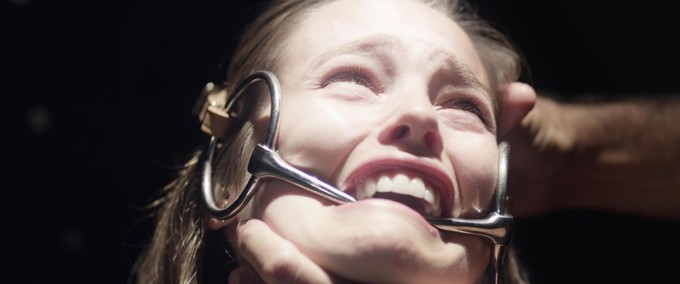
MICHAEL: We definitely wanted to navigate the line going in. The screenplay itself didn’t call for the same 50-minute-long torture scene that really pushed the boundaries like the original did. We knew going into this, with the producers onboard and whatever the screenplay was, that it wasn’t going to stretch the boundaries quite as far. But that said, we were never interested in doing some completely watered down version. We really had to navigate that line of how much you show. Our film was never a shot-for-shot remake of the original. We never set out to make a film that was as torturous as that first one. To its credit, it did well for itself, but there’s a lot of people who couldn’t even watch that film that never got to experience the world of MARTYRS or they simply couldn’t sit through such high levels of torture. We defintiely wanted to peel back a little bit (heh), and that was the screenplay. It was a challenge to navigate that line while still staying true to the story, which calls for visceral torture to some degree.
VINYARD: Were you worried about the classification of “torture porn” and whether that would apply to your film?
KEVIN: Absolutely. That’s not a term that we want to be attached to. People say, “Oh, that was so eight years ago,” and blah blah blah. For us, the story is timeless, and the story of the original, and it’s themes of the quest for knowledge and what’s on the other side, and all that seems to transcend, for us, any kind of torture elements. We had people walk out of this halfway through who can’t bear some of the themes in it, and they obviously had never seen the original. When we’re screening it for audiences who have never seen the original, there’s people covering their eyes for 50% of the film, so you can imagine that there’s a whole gamut of people out there who can’t handle the original film. Perhaps this one is a bit wider, for a bit more people to experience. It’s only bringing about knowledge of the original film too. We know for sure the original film is now getting more attention than ever before. So it’s kind of a win-win. We’re proud of this film, and we thought the actresses did an amazing job. Troian and Bailey really put their hearts into it.
VINYARD: So much of the film, like the original, just has the two lead female characters. How did you settle on Troian Bellasario and Bailey Noble?
MICHAEL: Going into this, we wanted to find girls that would really come at this with everything they had as well as being very talented, so we had this massive casting agent team, and just went out with it when the movie was greenlit. Both (Troian and Bailey) came in and had a chemistry read, and we loved them from the moment we met them. Honestly, it was a 17-day shoot, and there’s not one scene where these girls aren’t getting tortured, chased, emotionally riddled. The physical and emotional toll on them, just as people doing a movie, going to work every day, every night, it was difficult. We were always surprised when they’d come out of their trailer when they did. We always thought they were gonna leave halfway through, but they didn’t. They really gave it their all, and we were really happy to be working with them.
VINYARD: What about Kate Burton? Her part is really crucial in both films.
MICHAEL: Our father’s an actor. Peter Michael Goetz is a character actor, he’s done theater, Broadway, movies, and TV. We like actors who act, we like actors who have been onstage and who do a lot of backstory and history and stuff like that. So when we went after that role, we looked for someone who was established who would put in the time and effort in to try and make it even deeper than what was on the page, and she was really well-respected, and that’s how we landed on her.
VINYARD: Back to the gore for a second. How much of the gore was shot live on-set versus digital added in post?
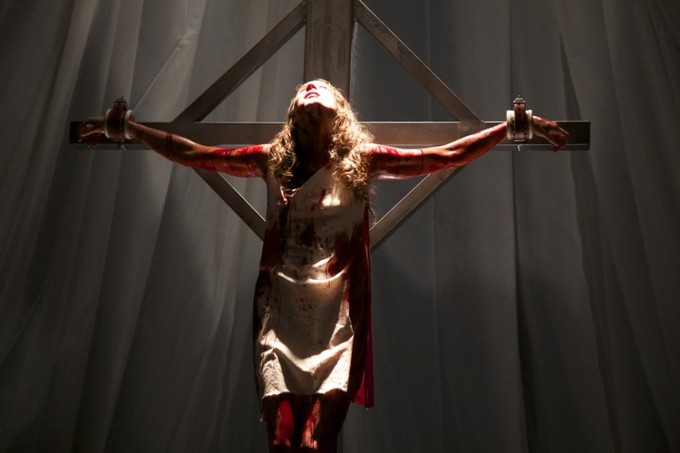
MICHAEL: People make the comparison between our film and the original, and there’s all kinds of differences creatively, but I think another big difference was budget-wise. We didn’t have the budget for anything, visual effects especially, so we just had to do it all in-camera on the day. It was very challenging, but at the same time, we knew what we were up against, and we knew that we had to get it on the day, and if we didn’t, it wasn’t going to be saved in post.
KEVIN: That informed some of our decisions on how we had to shoot stuff. The stabbing the mother in the back and stuff, we had to become creative in how we covered that because we didn’t have a $10,000 body double, some plastered, molded thing that would shoot out blood and stuff like you might have on a bigger-budget set. We had nothing. We really had to make what we could with it. The entire family that gets killed in the farmhouse was day one, because that was the day we had the armorer with the gun, and the stunt team that would be able to use the ratchet-pulley system that pulls the father back, and the squibs that would go off, and every one of those was one take. There was no room for error because we only had one take. A lot of planning went into it, and almost everything is in camera. There’s only a few bits of blood hitting the lens which was done as a favor by a really talented VFX artist we know, and you can’t really tell, which he’d be proud of.
VINYARD: Do you think the budget and the short production time added to the intensity on set at all?
KEVIN: Yeah, it was an extremely intense set. You can imagine shooting five family members, shooting the entire breakfast scene, upstairs underneath the bed with the feathers flying and everything. All that was in one day, and that was day one, so that sort of set the tone for how we were going to shoot these days. Everyone had to be at the top of their game. Luckily we shot in Los Angeles, so we were able to call in a lot of favors from the commercial world and stuff, “Can you guys come Steadicam for a day?” “Can we get that Technocrane for a a really good price for two days?” Stuff that you wouldn’t be able to do on such a low-budget feature we were able to pull off, and that worked well for us.
VINYARD: Were the exteriors of the house done in L.A. as well?
KEVIN: Yes. Just on the edge of a 30-mile zone. We scoured and scoured locations for that, miles and miles and miles. We wanted a pretty farm house, something that looked completely benign, yet underneath it is this dark cell of this horrible world. We looked for this beautiful, white-yellow farmhouse with an avocado grove behind it. That was the main location, that was eight of the shooting days. The other six shooting days were in a prison youth camp, a youth prison, which is not there anymore, they just tore it down.
VINYARD: I wanted to ask about your relationship as co-directors.
MICHAEL: We’re really one mind. We’ve been directing little movies and stuff since we were little kids together. We went to different film schools but they were both in L.A., so we got to work on each other’s projects. We’ve been doing commercials and music videos together for about 15 years now, and now two feature films, so we’ve been at it so long together. It helps that we’re brothers and that we have the same instincts creatively, but it also helps that we have a smooth working relationship. The way we approach it- every team’s different, on some teams, one person is this department, the other person is that department- we really switch off. It’s really an energy thing for us. Sometimes one of us will talk to the actors and the other guy will talk to the D.P., or vice-versa. It kind of goes back and forth and mixes all around, but we really try and attack every project like we’re one mind. The way we do that is prep. We just prep, and prep, and prep for every project and get on the same page as much as we can together.
VINYARD: What’s your prep process like?
KEVIN: It’s intense. We get together a month before. We rely heavily on storyboards and shot listings. We kind of feel like we’re cinematic storytellers, and using the camera to tell the story has kind of been our niche, if you will, in the marketplace. We have to be ready, so like Mike said, we prep so hardcore. Luckily, Sean O’Dea, who’s we’ve done dozens of commercials with and who did SCENIC ROUTE and now MARTYRS, the three of us would meet two hours before call, would shoot the whole day, then stay afterwards for two hours prepping for the next day. Then the very next day, we’d come two hours earlier again. You have to have that kind of prep time so that you know what you’re doing on these incredibly shrunken time schedules and stuff. There’s just no room for error, and you have to have a good, solid team around you that’s willing to give us those hours. So those 12-hour days would always be 16 hours for us. Sleep a few hours, get back on set two hours early and go at it again. We’d pre-plan what we were shooting. We’d shoot with Cannon 5Ds, (check out) angles we wanted to do. We’d pre-edit them if we could. We were willing to prep hard, other way there would’ve been no way to do it in 16 days total.
VINYARD: Both your movies so far have been intense, two-hander thrillers. What other genres or styles of filmmaking would you want to tackle in the future?
KEVIN: Well, we’re definitely into strong, character-driven stories. We feel that character wins out on everything. We have a couple of projects in the pipeline. We have one that we’re very passionate about that’s a four-hander, kind of an ensemble piece. Sort of a crime-thriller. Not so much a whodunit. We know who’s dunit, and it’s how they kind of unravel from what they’ve done. It’s a great story of people and character. That’s what we really like. We’d like to do something much bigger and grander, and we feel like this next project that we’ve got lined up should be able to showcase that we can make kind of a more epic, broader-scoped drama that still has a lot of thriller elements to it.
You can catch MARTYRS in select theaters and VOD starting today.
