Australian-born actor, writer and now feature film director Joel Edgerton has long been one of my favorites since I first spotted him as young Uncle Owen in STAR WARS episodes II and III, as well as memorable roles in such films as NED KELLY, KINKY BOOTS, and SMOKIN’ ACES. He and brother Nash Edgerton, along with David Michôd and a handful of truly gifted Australian filmmakers formed a loose collective that made some great films including THE SQUARE (which Edgerton wrote and acted in), FELONY (ditto), and ANIMAL KINGDOM, one of my favorite movies of 2010.
Outside of the STAR WARS films, many Americans got their first look at Edgerton opposite Tom Hardy in 2011’s WARRIOR, and he’s been steadily working every since with parts in THE THING, ZERO DARK THIRTY, THE GREAT GATSBY, and EXODUS: GODS AND KINGS. And in the next year or so, expect to see him opposite Johnny Depp in BLACK MASS, in the next two Jeff Nichols-directed works MIDNIGHT SPECIAL and LOVING, and in Gavin O’Conners next movie JANE GOT A GUN.
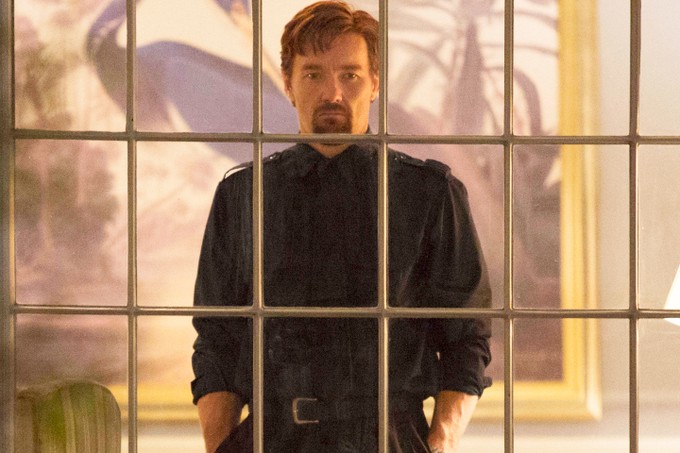
Edgerton is the classic definition of a working actor, but since that isn’t enough for him he’s also written, directed and co-starred (opposite Jason Bateman and Rebecca Hall) in THE GIFT, in which he plays Gordo, an old high school acquaintance of Bateman’s who reconnects and won’t let go. And that’s as much as I’m saying about this creepy psychological drama whose marketing campaign has done a fairly effective job of not revealing what it’s really about. I had a chance to sit down with Edgerton recently in Chicago, and thankfully he’s nothing like the strangely clingy affected guy he plays in THE GIFT. Please enjoy my talk with Joel Edgerton…
Capone: Hello, sir. How are you?
Joel Edgerton: Hey, man. Good, how are you doing?
Capone: Good. I remember when David Michôd [the Australian filmmaker who directed ANIMAL KINGDOM and THE ROVER] came through here with ANIMAL KINGDOM, and I remember just getting so excited about the collective that was happening in Australia back then, and the way he described everyone working with each other. And you finally making your own film seems like an extension of that initial group effort.
JE: It’s just me keeping up with the gang. In fact, the only one to not make a grown-up movie at the moment is Luke Doolan [editor of THE SQUARE, ANIMAL KINGDOM, THE GIFT], who was nominated for an Oscar for his short MIRACLE FISH. Luke was my editor on this, and he cut ANIMAL KINDOM as well. So everybody is still working together. Nash, my brother, who’s his own consummate director, was my outside eye when I was in front of the camera; he was my stunt coordinator; he played a character in the movie; and he did some additional editing. So everybody was around. David Michôd, Kieran [Darcy-Smith, actor and filmmaker], they all watched early cuts of the movie. We’ve all shifted to the states now, but we’re keeping the same spirit alive.
Capone: I was going to ask if you had somebody else who directed you or keep an eye on things while you were busy acting.
JE: Yeah, it was Nash. What was good, because we only had a very short shoot, I could look at Nash after I finished a take and give him the gesture of “Was that okay?” And he’d be like, “Yeah, let’s move on,” or, “Why don’t you try this?” Because we didn’t have time for me to go back and look at a whole take and decide for myself what to do. Having said that, fuck, the toughest days on set were the seven days that I worked in front of the camera too. The first two days were the trickiest. I did two weeks where I didn’t get in front of a camera, then I did the last two weeks where I got in front.
Capone: To this day, SPIDER [directed by Nash Edgerton, who co-wrote with David Michod; Joel has a small role in it] is my favorite short of all time. Just absolutely, bar none has the best ending of any short I’ve ever seen.
JE: It’s great, isn’t it? You know when your short film is cool? When there are videos on YouTube of people watching it.
Capone: The reaction videos, sure
JE: “Me showing my grandmother SPIDER.” [laughs]
Capone: Had you always planned on being in it? Was that just out of necessity? You could have made it easier on yourself.
JE: [laughs] I know, yeah. And don’t think I didn’t think twice about it leading up to the shoot. I was like, “Should I really step aside?” Initially when I wrote it, I had written the character for myself. A year and a half ago, I shot a test scene with myself, and as I got closer to the shoot, I was like, “I think I can manage. If I have Nash there, if it’s only the seven days.”
It was tricky. I was definitely nervous about doing both. I was already nervous about directing. If I’m really honest, I’ve danced with the idea of it for two years. Every time we got close to financing it, it wasn’t all financed. And then Scott Cooper was like, “Hey, come over here and do BLACK MASS.” And I’d be like, “Uh, okay.” And like as much as were or were not financed, I was terrified of directing a movie. I was terrified of just getting to the start blocks. But once I was there, once I was about halfway through day one, I knew I was going to be okay. I couldn’t tell whether the movie would be fantastic, but I just knew I was going to be okay.
Capone: I really dug just how subversive you are when I comes to using the tropes of a certain type of thriller and upending them. You talked about it last night, some of the films that are in this vein from the 80s and 90s. We think we know where it’s going, we think we’ve got everybody figured out, then you completely turn our empathy around in terms of who we’re feeling bad for, who we’re identifying with. We even think this is going to be Jason Bateman’s story. It’s actually Rebecca’s story. She’s in almost every shot of the film. Was that a conscious effort, to say, “Here’s the formula. Let’s deconstruct it and really mess with people’s expectations”?
JE: It was definitely something that I set out to do. When I first sketched out the story, without giving spoilers away, the real turning point is when the couple finally break up with Gordo. That’s the moment in this movie when we go, “Let’s saddle up. We’re in it for the butcher knife chase up the stairs kind of scenario.” I thought, what about we take their dog away, and that’s the moment when we feel “Here’s the dog in the body bag, hanging from the shower, cooking in the pot.” What does it feel like in this decade, given that the launch pad has already been set, the ramp has already been set by other movies. What if the landing point for us right now in that genre is that the dog comes back in the middle of the night completely healthy? How does that make me feel?
That was my constant reminder through the thing. I wanted to take the monster and have him almost receding into the shadows. The movie that made me feel really unsettled, that made me feel it was really possible, was CACHÉ, because depending on how you read that movie, you never really even meet the antagonist. I felt so off balance watching that movie. I thought, what if Gordo somewhat disappears? Haneke's a genius at it too, and there’s a little moment in my film that’s a bit of a tip of the hat to him, when Rebecca’s cutting the apple and she hears the noise, and her nature is that she’s not going to carry a knife down the corridor.
Capone: Right, she puts it down.
JE: She puts it down. There’s a beautiful moment in FUNNY GAMES when he sets up the knife. Have you seen FUNNY GAMES?
Capone: Both of them.
JE: Oh right [laughs]. He sets up the knife on the yacht, and of course later when the shit’s hitting the fan, they run to the boat to get the knife, they go to pick up the knife and drops it in the water. “Oh no!”
Subverting was a really big thing. My promise to the studio, to Jason Blum, and everyone involved in the movie at the very beginning when you forecast where you’re going to land, I said, “Where I want to land with this is, I want to have one foot in the genre world, in this familiar genre world, and one foot somewhere more interesting, which says a lot about the roles we played in school, whether or not people can change, and the idea that ideas can be more unsettling to your life than actual events.” And for that reason, the second half of that movie is loaded with silence and confusion and mystery. The idea that names do hurt you as much as stick and stones, and stuff said about you can affect the course of your life was very important.
Capone: A lot of the angst between this couple is self generated. It’s not because of anything Gordo’s doing.These events reveal the cracks in their marriage. This is a very personal, intimate story. You have a couple of classic scare moments. Did you feel any pressure to include those? They almost defy the tone of the rest of the film. They almost feel out of place, because that’s not what this is.
JE: Yeah, me and Luke, my editor, became obsessed, because if we’re going to have a scary moment in there, let’s let that be the foot that’s landing in the genre world. When that dog returns home, let’s lean into the genre when we need to. And in fact that second scare, the shower one, was an idea of mine that came out of… I had this instinct that an hour into the movie is a nice place to really send a jolt through the audience, but it had to come from a place of character and story, that at that point, because you know when they argue about the pills, and she says, “I feel like he’s going to show up at any moment. I don’t feel like I’m alone in this house. I feel scared when I’m alone.” I was like, “Have we really earned that yet?” So when that letter arrives, which is really Gordo’s bomb in that relationship. “ I’m going to write a letter to both of them saying I thought we’d let bygones be bygones.” In that place in the movie, her paranoia is getting to the point where maybe, just maybe, we could then lean into the genre again and have that.
Capone: For a lot of this film, you let us think maybe this is just them being paranoid. Maybe Gordo’s not doing anything weird. He’s coming off as weird, because he’s a little strange, but maybe he’s not doing anything menacing. Especially when the dog comes back and you’re like, “Wait. What has he actually done up to this point other than lie?” You do hint that her losing that first baby was something caused by anxiety. Maybe it was the pills to treat her anxiety.
JE: Yeah. You can make up your own history of her, but the idea that she miscarried late in her pregnancy and it caused all this anxiety that then made her lean on this great American institution of prescription pills, and that that somehow allowed Jason’s character to take control of her in a way that his nature really wanted. “Now we’re going to go to this safer place, and now you probably shouldn't work as much as you want to.” So the dominance is something she almost had to sign up to, because she in her own mind had become weak as a person. She was already a captive in this house before Gordo even showed up.
But definitely making us feel in that second half of the movie that maybe it is all in her head. It allows Jason’s character to go, “You’re just being paranoid, honey.” Even though ultimately we know he’s hiding a shitton of stuff that he should know that Gordo is a potential danger. I always love when two characters get to a point where they’re arguing, and you go “I see both sides of the coin.” When he comes to her in the end and says, “I was trying to protect you. I didn’t want you to have to deal with this. I didn’t want to cause you more stress.” You go, “Yeah that’s a valid argument, but the other valid argument is you should tell me every fucking thing so I know what I’m dealing with.”
It was a very delicate balance to strike in the writing, but the other thing is I had such great partners in Jason and Rebecca, who were very smart with the script. In fact, Jason had a very clever idea throughout the middle of the movie. You know when he writes “Weirdo” on the board? I had had that happen off screen, so when Gordo comes around to fix the TV and sees that, it’s new information for the audience. Jason was like, “I think we should see me writing that.” I was like, “That’s a really good idea, because you’re going to save me potential confusion.”
Capone: Jason is a really smart choice with this. We actually did a Q&A with him when he came through with his film last year or the year before. He does come with certain baggage that he completely undermines as the film goes on. How did you come up with him? That wouldn’t necessarily be someone’s first choice for something like that.
JE: It wasn’t my first instinct. It wasn’t like I write the script and say “This smacks of Jason Bateman.” But what I had initially is I was looking at two different templates for the character. One was more your high school jock, who wasn’t so much a man of his wits but a man of brawn. Then, as he is receding or getting older, showing that age, and was letting go of his physical prowess, had learned to throw people under the bus over the years in order to get ahead. That was one version. The other version of the character, which was more interesting to me, was the kid who had the gift of the gab. Do you say that over here?
Capone: Absolutely.
JE: The ability to talk his way out of anything. The teachers would have thought butter wouldn’t melt in his mouth. He could talk his way into a girl’s pants, and he was probably a guy who lived by his wits. That person is really dangerous because they have the ability to shape shift. Then I knew I needed that guy to be very likable when we first entered the movie—unthreatening, trustworthy. It’s like, “Who do we like? And who is going to be more interesting when he becomes a jerk when we stop to see the true nature of his character?” I love when usually comic actors take a stroll down Drama Lane. We’re always reminded how great comic actors are at taking that turn in a direction, where dramatic actors can’t necessarily go the other way. There’s evidence in so many of Jason’s lesser-known movies where he plays smaller parts like STATE OF PLAY, THE KINGDOM, and DISCONNECT. I watched that recently when I was leading up to working with Jason. He’s got everything he needs to do to make this movie sing. And I just love watching him. There’s a handful of sscenes, when he beats me up, when he’s arguing with her in the kitchen. What happens after he beats me up is really interesting—the breakdown almost.
Capone: Before they break this up, you mentioned BLACK MASS earlier, and I couldn’t be more excited about that. But you’ve made a film with Jeff Nichols…
JE: …and I’m about to start the second one, yeah.
Capone: He’s just one of my absolute favorite people. He hasn’t made a bad movie yet. What can you tell me about your role in MIDNIGHT SPECIAL?
JE: Jeff is amazing. I’ve had a real privilege lately of people I’ve gotten to work with. Gavin O’Connor is one of my favorites, and, I pinched myself when I got to work with him. Strangely, Ridley Scott sent me a message going, “Let me know when you need me to turn up to shoot second unit.”
Capone: For your movie?
JE: For my movie. In the middle of the night saying, “Don’t take any shit from anybody” with a martini kit. But Jeff and Scott [Cooper, director of BLACK MASS] are these young guns who are really carving it up. Scott’s made three movies now. Jeff’s already on to his fifth. Jeff is one of these guys who is one of the most prepared, self-assured filmmakers I’ve ever met, while pretending he’s not really sure of everything he’s doing. Jeff is one of the most affable guys you’ll meet, but then the contradiction in that is, if you try and get him to change something that his instinct is telling him is right, it ain’t going to happen. If a studio is trying to tell Jeff this isn’t right, he knows what he wants and he will get it.
He’s wonderful with actors. He’s such a smart writer and so thorough. And he’s younger than me, which makes me hate him. I’ve lived my whole life working with people who are older than me, and suddenly I’ve crossed over. Jeff’s 36 or something, but he’s such a beautiful guy. Him and Scott both. Scott’s a little bit older, but they’re both these young, very thorough, very talented filmmakers. Jeff’s a machine. He’s a complete filmmaker. He knows how to operate on set. He’s a great writer in the background, in the shadows. He’s out there tapping away on his next thing. He knows how to use a camera. He trusts his instincts. I love him.
Capone: You’ve also done this film, I think it was a while ago, with Anton Corbijn [LIFE]. Again, as a child of the ’80s, his photography pretty much shaped my visual world. His movies have been great, too. Tell me about that film, because I don’t really know much about LIFE.
JE: LIFE was written by a very good friend of mine, Luke Davies. It’s about Dennis Stock’s three- or four-week interaction with James Dean just after EAST OF EDEN was made, just before it came out, while James Dean was waiting on the phone call that would say he would be starring in REBEL WITHOUT A CAUSE. So it deals with James Dean courting with fame, while appearing seemingly to be reluctant to it. As we all know, I don’t think he turned up to the premiere of his first movie. But it’s about that relationship. I just play a small roll as a favor, well, I wouldn’t call it a favor. Luke is a very good friend of mine, the writer, and I’d worked, at a distance, with Rob Pattinson on THE ROVER [Edgerton has a story credit]. Rob actually is an extremely talented actor who’s often underrated because people just see him as that guy in the vampire movies.
Capone: I think it’s finally emerging that that is true.
JE: Yeah, he’s very special.
Capone: And THE ROVER was a huge part of that for me, actually.
JE: Oh, I thought he was incredible. So the fact that I get to work with Anton—CONTROL was one of my favorite movies of the year that came out. Luke as a writer and with Robert as an actor [in LIFE], I think I’d wrapped MIDNIGHT SPECIAL, and I just skipped into Toronto and did like three days with them and then took off. It was fun to do a cameo in the film.
Capone: Alright, thank you so much. Best of luck with this.