
Ladies and Gents, citizens of all shapes, sizes and temperments... Gather round, for you've a rare treat today... For it is not so often that one so rotund as I has such a privilege to produce for your examination and perusal, a writer of such wit and charm and in such wonderfully antiquated bullet bras and an absolute refuser of the stiched in corsets of yore... I am, of course, speaking rather largely about Dorothy Parker, the square shouldered well styled intelligent uber-woman of a time long in need of a pair of paddles and jelly with a scream of CLEAR. ZAP! We have Ms. Parker in her radiance to provide a look at the world of Kerouac as he is being adapted into the 24 frame variety. Now, as much as I love Kerouac and his works and wit... I've always been a Ferlinghetti nut primarily... But is there anyone unfamiliar with the great ON THE ROAD? Well, as is always the case... all novels seems to be optioned, but not all novels need to be made. Kerouac is a particular hard writer to adapt in my thoughts... but let us see how Coppola's folks faired. Also, Dorothy looks at the CINEMATEXAS film festival occurring in Austin... and the fact that Jim Jarmusch (genius god) is in attendance. Here ya go....
My Dearest Red Headed Angel!
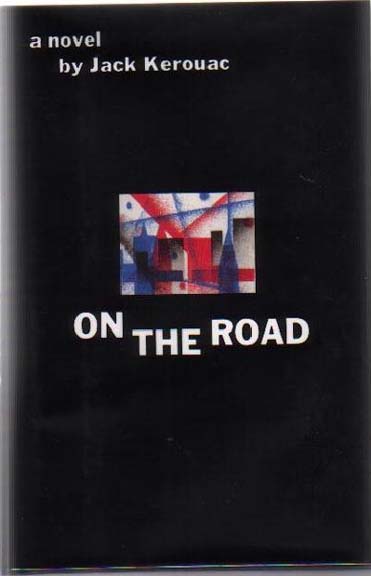
I read this script (Francis Ford Coppola and Michael Herr's's script of Jack Kerouac's On the Road) over two weeks ago, and as it was the first time I'd read a script cold, or reviewed one, I wrestled with what I should or shouldn't say. Tonight however, after just watching the Cinematexas5 Robert Frank program, which included Pull My Daisy, and Me and My Brother, two films that include Allen Ginsberg, Jack Kerouac, Gregory Corso, Peter Orlovsky and that gang, now I'm properly inspired. I think my thoughts have jelled.
Jim Jarmusch is here for the Cinematexas5 festival, and he gave a good mellow introduction to the Robert Frank program. "I'm not a film historian, but I'm a fan of Robert Frank's work." It was a nice minimalist break to some of the academic introductions at the festival. He laid out a basic framework to the pieces, but let them speak for themselves. He also described his favorite point in Pull My Daisy, where Kerouac narates: "Unrequited love's a bore." And I mention this because it really struck me in relation to the Coppola script of On the Road--this slam against romanticising Kerouac and his friends in retrospect.
If you ever get the chance to see either of these films, do it do it do it. They are incredible simply as film works themselves, but if you are a fan of any of the writers involved, they say volumes about their humor and personalities.
So down to reviewing that Coppola script.
I tried very hard while reading this to think nice things about Coppola, after all, he wrote Apocalypse Now and the Conversation, but considering the more recent movies with his name on them, I couldn't help but imagine this as being over produced, slicked up, and containing all of the attributes of Hollywood that give satirical fodder to the writers of the Simpsons.
Enough about my reservations. Throw all that out the window and screw the fact that we know some stuff about the writer. Let's just look at what's on the page.
I guess the burning question is, is it true to the events of the novel? Technically, Yes. Is it the novel? No.
I'll begin with the good stuff. In starting the read, I was very excited as each character was introduced. The chief difference between this script and the novel, is that the writer of the script did some homework and attempted to clarify the biographical elements in On the Road. He includes all manner of things that have been uncovered about Kerouac and his friends, and weaves them into the dialog and action. As each character is introduced, they speak in a manner that reflects their writing style. Allan Ginsberg's Carlo Marx has dialog that echos lines out of Sunflower Sutra and Howl, Burroughs' Old Bull Lee reflects the paranoia of Naked Lunch, and through extensive voice overs, Kerouac's Sal Paradise is able to maintain the narative flavor and confessional feel of On the Road. All of this, for a fan of the these writers is seriously magical stuff. On top of this, the shot direction in the script focuses on showing the elements that inspired these guys to start writing in the first place: Working class New York, bohemia, the disenfranchised. One of my favorite tidbits was during a montage of New York, having the vitalism and euphoria of the beat movement spouted out of the mouth of "some incredible HOMOSEXUAL flouncing by with effeminate shriek of general greeting to everyone, anyone: HOMOSEXUAL: 'I'm just so knocked out and you all know it, you mad things!'" There's no softening or censorship about sexuality or drug use in the script, and there's plenty of detail in the scenes including these elements that can be shot with the necessary realism and grit. When the road adventure begins, the focus zeros in on Sal and Dean's relationship, which while it omits some of the other powerful portions of the book, is reasonable and necessary for the sake of time constraints.
BUT there's a revisionist angle to the script, which while not always a bad thing, it was so ever present that it gave me pause. It begins straight off with returning the opening paragraph of the novel to how it appeared in the rough draft. Originally, Kerouac mentioned the death of his father and his post war depression as the catalyst for his road adventures, but he edited these personal points in the published version, softening it to a split up with his wife. The problem here is the attitude. From the start you get the feeling that Coppola thinks he's smarter than the audience, and hell, that he'll take license with Kerouac's words too. Later on, Coppola becomes inconsistent, picking and choosing which element to include from the novel and which to include from Kerouac's life.
I won't go through a blow by blow of the differences, but the questions that start to come up are: Is Coppola trying to present the novel as a historically accurate bio pic? Is he really trying to pay homage the novel? Is he trying to say that he has the final word on the mythos around these writers? There's plenty of elements in the script that suggest he's going to forcefeed his interpretation to his audience instead of letting them react to it and draw their own conclusions.
For example, he reduces Sal Paradise's relationship with Terry to a single wishful fantasy imagined on the bus, and he concludes this by having Sal say that the girl he's imagining this relationship with is not that pretty on second look. Maybe the relationship with Terry never really happened in Kerouac's life, but why not omit it rather than reinterpret it into something else?
Coppola's not consistent in his historical revision either, I guess looking for an upbeat element to the ending. By the end of the script he does a total about face and focuses on Kerouac/Sal's comments that he's been always looking for that "pure and innocent" girl, his soul mate, and that he's found her, nevermind the fact that Kerouac left his wife Joan Haverty as soon as he'd finished his legendary nonstop roll-of-paper draft of On the Road.
About my reservations that the look of the movie will be slicked up and over produced. The ending is really the only concrete evidence that this will be the fate of the completed film. The final scenes turn incredibly maudlin complete with a sentimental flashback and forboding flash forward of what will be Dean Moriarty's fate. There is even a voice over of Dean's voice being echoed, that feels contrived and manipulative.
On the whole, I think this is a borderline call. There's a lot of wonderful elements to this script, but it looks like those elements will be lost in the translation and the ambivalent ending. If a concrete decision was made to do either a historically accurate version, or an honest interpretation of the fictional novel, it might pan out. As far as the spirit of the piece, I think everyone involved should be sure to watch Robert Frank's films again.
Good night Harry Dear!! Excuse my dust,
Dorothy Parker
