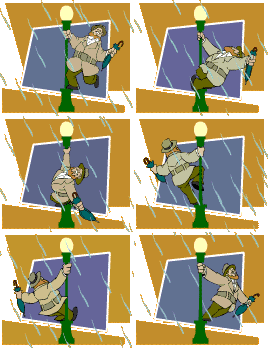
ELECTRIC CITY is a new animated web series created by Tom Hanks, and it finds the normally genial movie star in a pensive, post-apocalyptic mood. Set in a rebuilt society controlled by a seemingly innocuous knitting circle of old women, Hanks and his collaborators have envisioned a world in which electricity and the flow of information are carefully monitored. The civilization has its steampunk touches (there are dirigibles, Victorian era gadgetry and ham radio-like devices called tap kits), but it's also got flourishes of secret agent espionage and grim, nuclear holocaust horror. It's a disorienting mixture at first, especially since each individual episode runs an average of five minutes; there's a lot of world building and exposition to dispense with (and a sprawling cast of characters), and if you don't pay extremely close attention, It's not going to make a lot of sense. Actually, even if you <em>do</em> pay close attention, it's likely you'll need to consult the character guide positioned at the right of the media player from time to time.
Sounds like work, right? It definitely is at first, but if you stick with the series, it becomes a fascinating, bleakly comedic depiction of a civilization being ruthlessly propped up by those who risked their lives to restore it. The elderly knitters run the show, while "grid operatives" like Cleveland Carr (voiced by Hanks) do their neck-snapping dirty work. Rebellion comes in the form of the unofficial dissemination of information - the old, unruly enemy of any fascist society.
When Hanks banged out the first ELECTRIC CITY story in 2003 (on an Olivetti Lettera 22 typewriter, he proudly notes), he wasn't sure what shape the work would ultimately take. He just knew he wanted to do something "deadly serious". As he explained on a conference call with a small group of journalists last week, his first inclination was to take the audio of Michael Corleone executing Sollozzo and McCluskey in THE GODFATHER, and re-stage the scene with marionettes. These are the kinds of experiments Hanks gets to conduct at his production company, Playtone, which he describes as an "idea laboratory"*. Ultimately, ELECTRIC CITY moved in a noir-ish direction, with the dystopian civilization becoming intentionally vague. Meanwhile, the narrative took on a more discursive quality. According to Hanks, "This is not a movie. It's the cultural equivalent of writing a bunch of short stories and putting them out there for people to read."
It's good to know this before you dive into the series. Though bewildering at first, the narrative and thematic threads begin to intertwine after five episodes, at which point I was hooked. There's no predicting where ELECTRIC CITY is headed because Hanks seems indifferent to telling a completely straightforward story. Sure, it gets a little more conventional as it goes along, but the strangeness of it all keeps you off balance. It's smart, surprisingly savage stuff.
As a daring new direction for Hanks as a storyteller, I asked him if he'd been inspired by his collaboration with the Wachowskis on the ambitious, genre-blending CLOUD ATLAS (due out later this year). "Well, we were all done by the time I made CLOUD ATLAS," said Hanks. "But I know exactly what you're talking about. [In developing ELECTRIC CITY] we definitely talked about the intricacies of THE MATRIX, the level-upon-level-upon-level. But I didn't know the Wachowskis at that point, so we were just talking about it as fans. And if you talked about how often we talked about Patrick McGoohan and THE PRISONER? And THE MATRIX series? Even such things as... because of the knitting society and secretive organizations, THE MANCHURIAN CANDIDATE? Those old ladies which they see when they're hypnotized. We went back and drew on all sorts of permutations of what that is, but what we always ended up taking out of it was the fantastical, science-fictiony kind of elements to it. We also talked about the original STAR TREK, and STAR TREK: THE NEXT GENERATION when the Borg got involved. Essentially, you've got three or four geeks sitting around a room talking about the TV shows that they really loved when they were kids. My references to THEN CAME BRONSON might've fallen on deaf ears, but whenever anyone would bring up something like THE MATRIX, everybody knew what we were talking about."
Perhaps the biggest triumph of ELECTRIC CITY is that it resists encapsulation: if reduced to a logline, it wouldn't be much, and if pitched in a traditional studio setting, it would surely befuddle the execs. When I asked Hanks what he was trying to accomplish thematically with the show (particularly within the parameters of traditional science-fiction), he broke it down like this:
"The elusive power that everybody is trying to possess and control is information. The place that radio plays in our story is not a technological one. It's not about 'There's this technology out there that is dangerous.' It's what the technology allows. In this case, it's information. Who is going to be able to lie to the masses, and have the masses believe it? That is what is at the crux. Science-fiction? I don't know what it would be called..., but the key element that both Mrs. Orwell - and you can take her name at face value - and Cleveland Carr, what they are trying to suppress is the next generation of the control of information. Right now in the Electric City, this hodgepodge of a municipality that has barely been able to eke out its survival, and is now branching out into the only form of mass communication they can muster, which is posted newspapers and the copper wires that run into the speakers inside everybody's houses. That means there are really only two sources of official news outside of gossip and black market. Official news comes to you from two sources, and two sources are relatively easy to control. Now, with the advent of radio, in which you can pick not only music and signals and sounds right out of the air, you can pick out voices, and that means you can pick news right out of the air. And who is going to be telling you that news, and is that news going to be true or not? That is the big power structure that is going to be either toppled or buttressed in the course of how ever many episodes of ELECTRIC CITY that we get to do. You take that battle, and it affects everybody's life, every one of the characters who are involved in the Electric City. So the theme that drives the plot of every episode is 'Who is going to control the information, and are those people going to be benevolent and tell the truth, or are they going to be proactively lying to promote their own agenda?' There's the Electric City in a nutshell."
And once people have that secondary news option, it comes down to deciding which truth you want to believe. If this is the direction ELECTRIC CITY is headed, it could very well end up being a keen commentary on our information-loaded twenty-four-hour news cycle. With such a broad canvas, Hanks has left himself myriad options. And he can keep going as long as he wants.
"There's no money in it," laughed Hanks. "You might be able to make the salaries of the people who help you do it, but it's literally in order to be creative. I guess money is made somewhere up the huge corporate ladder somehow, but it's like self-publishing your own poems: some of them are good, and some of them are bad. But the good ones are pretty cool."
Twenty episodes of ELECTRIC CITY are currently available on Yahoo! Screen. Dig in, and mind the knitting needles.
Faithfully submitted,
