Britgeek here.
Last August, as part of the ever-wonderful Film4 FrighFest, Robin Hardy's first feature film since 1986 played on the big screen at the Empire Cinema in London to over a thousand excited and particularly anxious horror fans. Anxious because they were bearing witness to a film by the name of THE WICKER TREE, written and directed by the man who gave us THE WICKER MAN, one of the most legendary genre films of all time, almost 40 years ago.
There has been a lot of confusion surrounding THE WICKER TREE as most believe it to be a sequel to the aforementioned horror classic. After all, not only do they have similar titles, they share themes of religion and feature another legend in the form of Christopher Lee. But as per Hardy's own words, THE WICKER TREE is not a direct follow-up.
In my words, the film may be a hard one to swallow for most audiences who are familiar with THE WICKER MAN. Why? It's a black comedy.
I recently had the absolute privilege of speaking to Robin Hardy to discuss the film, his return to film-making and his plans for a final entry in what he calls his 'genre trilogy.'
BRITGEEK: Hi, Robin, it's Adam from Ain't It Cool News.
ROBIN HARDY: Adam, fine, good.
BG: How are you?
RH: I'm fine.
BG: Great stuff. Well-
RH: Just a minute, Ryan's saying something to me. … Adam, do you mind? We're just making a quick cup of tea and I'm just showing Ryan how my kitchen works. I'll be right with you in a moment. Do you mind holding?
BG: [laughs] Not at all.
RH: Sorry about that, Adam, I had to show Ryan the strange gizmo I've got, which makes instant burning hot water. Without instructions he would have burnt himself nastily, so anyway he's alright now.
[NB. I couldn't resist leaving the tea-making part in the transcript. I presume it wasn't a kettle that publicity extraordinaire Ryan Holloway (thanks!) was having difficulty with in Robin's kitchen.]
RH: Okay, so, let's go!
BG: Well, thanks a lot for speaking with me today.
RH: Not at all.
BG: And first thing's first, congratulations on THE WICKER TREE.
RH: Oh you like it?
BG: Yeah, I did, I saw it at the Empire last August at FrightFest.
RH: Oh, you saw it at FrightFest, yes.
BG: It was great to see the film play to a packed house at the Empire.
RH: I know, well I was there and I really enjoyed that festival. I don't usually enjoy festivals, but I thought those guys ran it so well and they had such enthusiasm and the films they chose were very good. It was really a terrific scene. They got the film, they understood it immediately. It has been shown here to audiences of film salesmen who have not been told it's a black comedy and think it's a horror film [laughs]. They sit there in appalled silence waiting for something horrific to happen. If you go into it expecting it to be particularly a classic British horror film... I mean there's a pint of blood in the first five minutes, isn't there, normally.
BG: Yeah.
RH: It's not that we don't have horrific moments in it because I think we have.
BG: Oh absolutely. I think it's a film that deserves to be seen by audiences who are open-minded. Thematically it's similar to THE WICKER MAN, but at the same time it's a very different film. As you said, it's very funny for one, and I mean, of course, you hear about a film by Robin Hardy called THE WICKER TREE and featuring an appearance by Christopher Lee, and I think it would be kind of impossible not to have certain expectations.
RH: Yes.
BG: But part of the fun of THE WICKER TREE is actually having your expectations defied.
RH: That's a very good comment, very good comment, yes. One is happy as the film-maker to reward you for having liked THE WICKER MAN and come back for more as it were.
BG: [laughs] Yeah, I think that doesn't happen nearly enough in cinema today, I mean so often people know what's going to happen and it was so nice to actually leave the film and have to think about what you just saw. It was refreshing.
RH: There are film-makers like the Coen brothers who always do something utterly original, nearly always, so that's the continuity in their work, I think. These two films of which we speak are obviously similar in genre, and the one I'm about to make up in the Shetland Islands, god willing, will complete this cycle of three films which are in the same genre. But I do understand why the film business has some problem with it.
There's a well known Christopher Lee quote on the film which he originally made on the book when I wrote it, I'm talking about THE WICKER TREE. He said it's comic, it's erotic, it's romantic and it's horrific enough to melt the bowels of a bronze statue. Wonderful sort of Christopher Lee hyperbole [laughs]. That does describe the genre, doesn't it? It's all over the place as a genre and that's the fun, as you say.
BG: So the film is based on your novel COWBOYS FOR CHRIST.
RH: That's right.
BG: What inspired you to write the book?
RH: I'm trying to remember when I wrote the book. I think I wrote the book about six years ago... six or seven years ago, I've forgotten the exact date, and I suppose I had a film in mind when I wrote it, but not terribly specifically. It's a novel I'm quite pleased with as a novel. I've written other novels and I like this one. On the whole it's been realised as a film, as far as one can, you know.
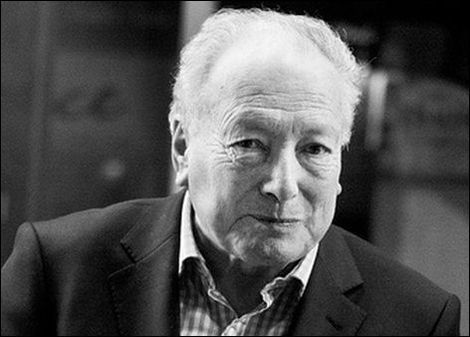
BG: Would you say THE WICKER TREE is more of a spiritual follow-up to THE WICKER MAN?
RH: Yes, I suppose that's right. If I can make an homage to my own genre, it's an homage to the genre that we created in THE WICKER MAN and wanted to have another go at to see if it still worked. If it works for audiences in the same way it did for the first one, in that sense it's a sort of spiritual brother, I take your point.
BG: Speaking of Christopher Lee, what was his initial reaction to the script when you approached him? I believe you originally intended to cast him in the role that was eventually given to Graham McTavish.
RH: He actually read the book, you see, cause he gave me a review for the book which is what I quoted to you, so he knew pretty much what was coming. I think he was always quite happy with playing Lachlan, which is what he was intended to play, you know, the lad, but he then went off and made a film while we were getting things together, in Mexico, and had a nasty accident and hurt his spine very badly and he had all kinds of treatment. It's very difficult for him to stand for any amount of time and of course he's not in the first flush of his youth – when we made the film he was already 86 – and so I was more than a bit concerned that he wouldn't be able to last the course of the entire film in terms of all the standing and rushing around that he had to do, and so we agreed that he would just do a vignette, and I'm quite pleased with the vignette, I think it works. What do you think?
BG: It definitely works. I think it's an integral part of the story.
RH: Do you think it's a good thing to be ambiguous about who he is?
BG: Yes, I think it adds to the mystique as a film that keeps you thinking.
RH: Yes, I agree. If you're going to do a cameo like that you can't do it simply to get the character in for the billboard, it's got to have a real purpose, doesn't it?
BG: I was listening to an interview actually that Christopher Lee did at the end of last year and he said that as he's limited with his time these days, he only wants to do small roles, but roles that are an important part of the story, and I think that, as far as THE WICKER TREE is concerned, that's absolutely true.
RH: I absolutely agree with you. And he was made to do that because the extraordinary thing about Christopher Lee is that when he's on the screen you can't look at anybody else really.
BG: No! [laughs]
RH: He has extraordinary screen presence, that's why he's a star. It's wonderful to work with him because you know that once you've put him there, you've got something really potent going on, almost regardless of what you have given him to say, although of course he says it very well. And he's got that wonderful voice, sort of deep voice of his, which I tried to have on the soundtrack before he actually appears so you think, 'who's that?' [laughs].
BG: Oh really? [laughs] He certainly commands the screen. So obviously the film was given the title of THE WICKER TREE rather than the book, COWBOYS FOR CHRIST. Was the title changed to help sell the film?
RH: Well, I think it was a bit of both really. The COWBOYS FOR CHRIST thing had problems in the States when that was the title because we had one investor, who was going to put quite a lot of money into the film, withdraw because he was worried about a film with Christ's name in it. Americans are rather more extreme in that way than we are. So that influenced it a bit because we didn't want to alienate a great piece of the American audience, although it seemed absolutely stupid. It's far from an anti-Christian film. You pay your money and you take your choice really, I think.
The other thing was that I saw a tree not unlike the tree we eventually created and I thought it would be fun to have a wicker icon which was as striking perhaps as THE WICKER MAN, and so I had my art director design that tree and I think the guys who made it, who were sort of woodsman from down Dumfries way, did a marvellous job. They do the effigies or whatever you like to call them for the Wickerman Festival; they make new wicker men to be burnt every year at the Wickerman Festival in Galloway. What is wonderful about their work is they managed to put sort of movement into them. These people almost look as if they're dancing, don't they?
BG: Yeah, yeah.
RH: That's the skill. All I did was the sort of sketch of two figures coming together and rejoicing and they absolutely got it, I think. I would like to have one put in my garden actually [laughs].
BG: It definitely looks great on screen.
RH: Yes, I think so.
BG: Your explanation of the title change there, I think it's quite ironic given the film's story. Obviously there's the culture clash in the film itself, but then there's the kind of grinding between Christianity and Paganism, and I think there's quite a lot of irony in there about the themes of religion in the actual story and having an investor who is worried about the religious aspect of the original title.
RH: Yes it is, it is ironical. Irony isn't the great forte of our cousins across the Atlantic I don't think, although that's not really fair because I think Woody Allen does a pretty good job of being ironical [laughs], in fact a very good job, so it's not an exclusive for us, really. But I'm glad you like the jokes, I think the jokes are quite funny. What did you think of Lolly? Have you seen her in FOYLE'S WAR?
BG: I haven't, no, I've never seen the series.
RH: You might be intrigued if you happen to be switching on the television and have a look at FOYLE'S WAR, because she is goody two-shoes. Butter wouldn't melt in her mouth. She's a really nice, nice lady. She loved playing the opposite in the film, it was great fun for her. Every now and then she would say, 'Oh my god, if my granny could see me now!'
BG: [laughs] I imagine it was quite a refreshing role to play.
RH: Yes, indeed.
BG: So having not directed a feature film since... I believe it was THE FANTASIST in the mid '80s?
RH: '90s. Oh no, '80s, you're right, sorry.
BG: What was it like to step back behind the camera?
RH: Well I've done quite a lot of television in the States in the interim. I did various sorts of biographies for PBS and things like that. It wasn't all that unfamiliar to me. I felt perfectly comfortable from minute one, the only problem was that I had never used one of these huge digital cameras, which actually at first experience are considerably more difficult to work with than film cameras and present all sorts of problems of their own, but of course the results are very good and the things that you can do with the material are very good, so what was it like? It was familiar but [I was] faced with some intriguing new technical problems which I hadn't faced before because in the intervening years I'd used digital, but not on this scale.
BG: The landscape of film-making is changing.
RH: At a very brisk rate.
BG: Yeah, I mean quite often these days you have directors who sit two-hundred feet away from the actors or in an entirely different room glaring at monitors and giving directions through a walkie talkie. Do you think the differences were for the best?
RH: Well I think in the end for the best from an economic point of view because what you can do with the material in post-production is really awesome, whereas the shooting experience is not quite as pleasant as travelling light with a 35mm Arriflex or a camera like that. It's not as flexible. You can get a situation where you have something like double the crew you feel you really need and monitors all over the place. I think once you're really familiar with it you can cut it down to size.
The trouble, in a way, with all the wonderful things we can do with CGI and that nowadays is that people like playing with it like a video game and forget their making a story [laughs] and it's a temptation because there's so many possibilities that are thrown out. One of the sort of obvious ones is that every time you're setting up a major scene and you've got a truck sitting on the horizon, one of your trucks, and you're shooting a hunt, as we were in THE WICKER TREE, you say to the assistant, 'Would you please get this truck out of it?' and they say, 'Oh, don't worry, guv, we'll take that out in the CGI,' and that happens all the time.
When you get to that stage you find yourself taking quite expensive time which you can save simply by getting someone to drive the bloody thing out of frame.
BG: [laughs] As you mentioned earlier, you have one more film to come in your genre trilogy. What can you tell us about THE WRATH OF THE GODS?
RH: THE WRATH OF THE GODS … was set in Iceland but I've re-set it in Shetland, and as you may know, Shetland is full of Scandinavian people, not Scots, because it was ruled by Denmark for something like five centuries. The gods there are not Celtic, they're Nordic.
The film is about the gods getting their comeuppance. In a way it's a fitting third film. It's rather like what happened in the Ring Cycles, you know Wagner's Ring Cycles, which is based on the same set of stories. The gods in the end have to go back and hide themselves in Valhalla having messed up so many people's lives [laughs].
My god-like characters come to that sort of end in this film. I'm greatly helped by the fact that they have wonderful sort of fire celebrations and sequences, which they do up there, with marvellous costumes, and all that's going on for real, you know, so if I can interweave my story with the real thing we'll have a lot of production value.
BG: Excellent. It definitely sounds intriguing and I look forward to it.
RH: Well, me too, and I can't wait to get out. Having got the film-making bug again I think it's going to take me out of it [laughs].
BG: Thanks a lot, Robin, it's been a pleasure.
RH: Not at all. Thank you for your call.
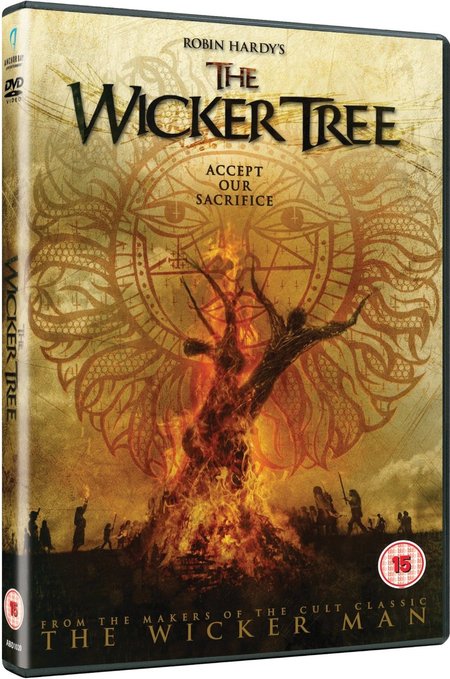
THE WICKER TREE is available on DVD and Blu-ray, as well as in a two-disc DVD set along with THE WICKER MAN, on April 30 from Anchor Bay Entertainment.
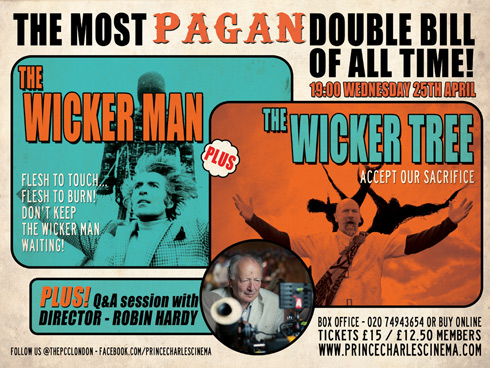
But you can check out both films back-to-back on the big screen at London's Prince Charles Cinema on the evening of Wednesday, April 25 with a special live and in-person Q&A with Robin Hardy himself.
TTFN.
Follow me on Twitter!
