

@’s by ADOLESCENT DEMO DIVISION (A.D.D)
Author Douglas Rushkoff!!!
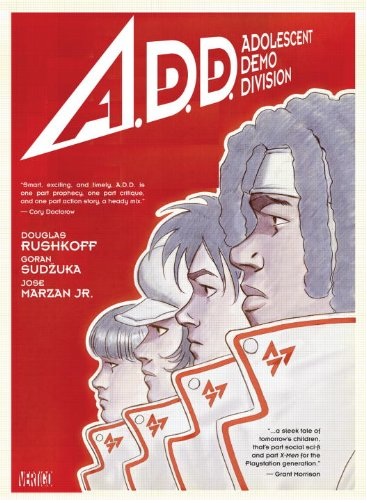
A.D.D. – ADOLESCENT DEMO DIVISION HC OGN
Writer: Douglas RushkoffArtist: Goran Sudzuka
Publisher: DC Vertigo
Reviewer: Optimous Douche
The current comic portrayal of evolution is bullshit; it’s a frothy mixture of bad 50’s science interlaced with the aspirations of what we want to ultimately become as opposed to what the most probable outcome of our next level will actually be.
Evolution at the highest level dictates that we develop favorable traits to best serve our continued survival in the world and if those traits are deemed useful, they get passed down to the next generation. Why on earth would we develop optic blasts, and wouldn’t they be detrimental unless a mate developed an optic blast resistant head to absorb the dreaded O face? Teleportation: unless we run out of food within walking distance, I don’t see any of us evolving the ability to BAMF in the near future. Steel skin, wings, ice form…all nonsense when put against man’s needs to acquire resources.
Telepathy…ahh, now here we have something. Since we left the farms and formed cities the mind has truly been the muscle most heralded outside of the fortunate few that can leverage physical prowess in professional sports. If you don’t believe me on the attractiveness of the mind, I implore you to look at some couples the next time you are at the mall. An ugly doctor has a much better chance at bagging a hot desirable mate over his simpleton doppelganger that works at the sewage treatment plant. I once thought the book SWEET TOOTH was the most accurate representation of man’s next level. I would believe us sprouting antlers and taking on animal attributes over the ability to shed my skin with different elements or my asshole turning into a rocket. Well, I’m sorry Mr. Lemire, as much as I will continue to love SWEET TOOTH, you are no longer my barometer for what man may become. The future of mankind belongs to A.D.D.
There is no doubt the title of this graphic novel is a double entendre. In the context of the book, A.D.D. is the catchy acronym used to describe the super star team of gamers that are the heroes for the day after tomorrow. But readers will also be quickly reminded of the literal meaning of this acronym that is making Ritalin a required staple for life, because while the gamers at the center of this title are supremely twitchy, able to catch any fruit on the Pac-Man board with uncanny deftness, they are also all suffering (or flourishing depending on your viewpoint) from some form of what we naively call a “disorder” by our current myopic definitions.
Autism, attention deficit disorder and the like run the gamut in severity. What’s been found, though, is an overwhelming case of compensation in kids that suffer from these disorders. Call it class balancing for the real world. While they might be distant socially, many of these children counterbalance with strong, almost genius level attributes in science, math, music, or…well, anything.
This is Rushkoff’s theorem: these disorders are not an anomaly--they have been purposely placed into the gene pool as part of our ascent to our ultimate state of enlightenment or to the final destination of entropy. In a world where eHarmony is our first stop shop for a booty call over the local bar, or where kids beg to log on to play the latest MMO rather than go out on a Friday night, I can’t say his vision of social inaction becoming the norm is all that outrageous.
Cloistered, sheltered and a more than pampered, Team A.D.D. lives for the game. Rushkoff heavily leverages the superstardom of today’s Asian gamers to build the foundation for the Team’s rock star success, but in the good ol’ U.S. of A. each gamer valiantly battles in VR for their master NextGen Corp, a media conglomerate with sticky fingers embedded in all aspects of digital collateral consumption. NextGen sidesteps slave labor laws by saying the kids are all adopted and dangles this carrot to get the kids to perform. The end game for Team A.D.D. is to “level up.” They believe this holds the premise of leaving the sterile walls of NextGen to become fully functioning members of society and one day meet the parents that abandoned them. Of course, all is not as it seems. Unbeknownst to the kids, there is no real “level up”, and unbeknownst to NextGen, these kids are doing far more than just “playing” the games.
A.D.D. is truly the “Matrix” of the wiki generation. Just as Neo eventually saw the binary code and was able to control the virtual world he once thought so real, the adolescent teams of gamers that make up the A.D.D. squad are able to “dekh” or see through the games. Actually, as the story unfolds we find that some of the kids are able to “dekh” through anything, including “meatspace”—or, as we call it, life.
I say the wiki generation because just as Windows and Apple helped dumb down…I mean, make computers more accessible to the masses, wikis did the same thing for the web. It allowed the masses to become masters of their virtual universe without an inkling of understanding into how any of it actually works. I teach a social media class each year at my company’s customer conference. Most people don’t even know the word wiki (outside of its brother term pedia); all they know are the apps that make publishing possible like blogs and FaceBook. This is a big message in A.D.D. and all of Rushkoff’s work--being able to use an app is a very different animal than truly understanding how something actually works. Are all of the toddlers currently swiping their way into a fugue state on Mommy and Daddy’s iPads gaining valuable skills or simply becoming lambs for the digital slaughter? Yes, Rushkoff believes the only way to responsibly use technology is to understand it at the most fundamental levels. And after reading A.D.D., I can’t say I disagree.
Rushkoff uses the concept of “dekhing” to unearth his other cautionary message to humanity: corporate control. As the kids begin to “dekh” deeper into the world of NextGen they realize that subconscious images are interlaced inside every commercial and game. Each subliminal message delivered is geared towards gaining Nextgen profit at the cost of all else, including our humanity. Play more games, play longer, play alone…each message acts as a subversive Big Brother guiding the flock to empty out their wallets.
No review would be complete without a discussion on the art chores. In a recent interview I did with Ruskoff he mentioned how he wished they had more time so Sudzuka could have rendered deeper and lusher backgrounds. I respectfully disagree. When dealing with the future, any future, I feel the less shown the better. Look at any movie of the future; whenever too much detail is given, anything that is wrong or untrue will immediately date the piece (i.e. “Back to the Future II”, “Sleeper”, etc…). For me, as long as characters aren’t perpetually standing in a sea of white, I’m fine with solid austere backgrounds. Hell, I have a lot of conversations standing in front of walls; not every moment in life is or has to be a cacophony of sensory input. Also, with this approach your focus is laser-sighted on the people. The turmoil these kids are going through as they try to understand the world and themselves is the perfect marriage of art reflecting the writer’s intent and tonality.
I love A.D.D. for the book it is and the adventure it presents. I also love that A.D.D. exposed me to the mind of Rushkoff. Technology, when used responsibly and with a deep understanding, can propel us to untold heights; technology as it is used to today by the masses is churning out digital zombies one Farmville click at a time.
And now here’s my interview with Douglas Rushkoff. Bear with Doug and I. We’re both stream of consciousness types--we get to the new book eventually, I promise.
OPTIMOUS DOUCHE (OD): Until I started doing research for this A.D.D. interview, I had completely forgotten you were the author of TESTAMENT. I read the first three issues of it, loved the book, and then my store just stopped getting them.DOUGLAS RUSHKOFF (DR): I actually don’t blame your store. I blame Diamond. It’s really insane; the comic distribution system seems designed to undermine the viability of the industry.
OD: It would be ironically funny if it wasn’t so sad. What seemed to really raise the ire of the industry was when they upped the preorder prerequisite to be listed in Diamond. It’s a ludicrous number that means the small guys can’t even dream of getting in Previews.
DR: I know. As soon as the numbers for TESTAMENT dropped below 20,000 a month is when they said I had to stop, but the numbers TESTAMENT was at towards the end would be considered phenomenal by today’s standards. I kept thinking, “Gosh, if there are 15 to 17 thousand people willing to buy this story every month, isn’t that good?” And I was told “Nope, that’s bad.” It seems kind of screwed up.
OD: It’s a systemic societal problem I deal with every day in corporate America. Endeavors are judged solely these days on return on investment (ROI) and no projects are initiated unless you can have pretty solid projections on what that ROI might be. This is actual whoring of our souls for profit, was one of the many prevailing themes I walked away with from A.D.D.
DR: Right--while that’s not how things or innovation work. They work through speculation. Speculation is a long term process. Speculation is a branching tree that doesn’t always curve in the most efficient manner, but it will find the light in the forest if it’s allowed to grow unhampered.
We’ve become so risk-averse as a corporate culture that we don’t do anything. This is why corporate profit over net worth has gone down over the last fifty years. The model has stopped working. It was bound to happen--it’s just happening much sooner than we expected.
OD: The example I always use to prove the fallacy of this model is John Kennedy’s famous speech to go to the moon. He didn’t challenge us to find a profit model before going to the moon--he just told us get the fuck into space.
DR: It’s a shame; we can’t even invest in a solar company at this point because of this profit before progress model.
OD: So, before Vertigo PR and my editor kill me, let’s really talk A.D.D. First off, I loved it.
DR: I’m glad you liked it; I was very nervous about this book. This is the first time I’ve written something without a net.
OD: How do you mean?
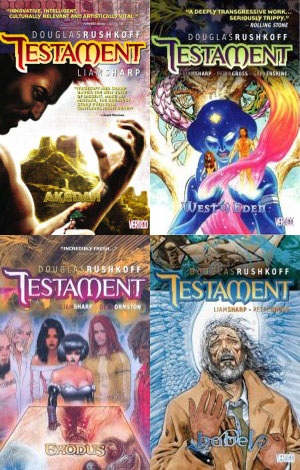 DR: Well, with TESTAMENT I had The Bible. So, if any part of the narrative didn’t work or any of the themes weren’t relatable, it’s like, c’mon! It’s the fucking Bible, the most popular book in the world--chances are it’s going to work. So if someone didn’t get something in TESTAMENT, I could say well, they just don’t get it. I could take a plot point like Lot having sex with his daughters and I know it’s going to work because it made it to the final cut of THE BIBLE! So if I’m going to translate that to a modern scenario, if I just maintain the core dynamic I know that these are archetypal dramatic situations so they are going to fly.
And with non-fiction it’s always easy because I have facts. Like with “Ecstasy Club” and my other novels I knew they worked because I understood the worlds so well that the truth would come to light because I’m a native of the dot com insanity.
But A.D.D. is a world that doesn’t exist; it’s a true “What if?”
OD: It’s interesting you say that because I’m an avid gamer and as I was reading through A.D.D., while the events were certainly an extrapolation towards dystopia, everything still rang true and resonated for me.
DR: Right, well, the whole trick with this book, this is the one where I actually did what you’re supposed to do when writing fiction. I took every force and idea I wanted to talk about and embodied them into a person or a situation. So it’s not people just discussing ideas like “what are games for” or “what is media for”; it’s not like some Bernard Shaw drama with people just arguing ideas. It’s what I see as the systemic role of corporate media in programming us into submission ends up becoming a person who does that. When you hear one of Harlan Ellison’s talks about how to write fiction or you listen to one of those panels of smart science fiction writers, this is what they tell you to do. This is going to be about people. I know what I want it to be about, but I’m going to force myself to write about characters. This was the scariest, highest risk thing I’ve ever written. I knew if things didn’t work, I wasn’t being emotionally true.
And using an artist that is totally unencumbered by the trappings of style and transparent makes it all the more incumbent on me to have honest moments. I was thinking originally I would want like Bill Sienkiewicz--you know, some over the top portrait of the modern American interactive media landscape and I would be able to hide behind that.
But Jon Vankin and I decided we would want someone who is good with the actors. That’s how I view artists; they are the actors and I’m the director/playwright role. Goran, if he’s anything, he’s a great actor. So it’s a transparent, naked-feeling comic book. So I don’t have the same thing I did with TESTAMENT with giant Gods reaching through panels and performing transubstantiation acts. Instead it’s just this girl who doesn’t understand the place she’s in, or there’s this kid who wants to get laid and can’t relate to other people. It ends up a starker, more revealing place to be as a writer.
OD: One of the things I noticed about A.D.D. is that I wanted it to work on two levels and it did. When I read a book I want a deeper meaning, an overarching theme, but I also want the characters to be engaging and clearly guide me to that deeper meaning. I see A.D.D. as being akin to those pictures in the mall that when you stare at them long enough a sail boat or a dinosaur appears. Sure they’re esthetically pleasing before you get the migraine from crossing your eyes to see the hidden picture, but it’s worth the effort to get the headache and ultimately the deeper picture.
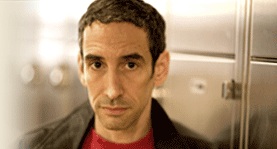 DR: I appreciate you got that. In the fiction I’ve written before my ideas became so important to me that I felt like the requirement to spin a yarn was an obligation I had to my commercial leaders. OK, I’ve got these really important ideas, but now I’ve got to do some Neil Simon or Sam Peckinpah to get people to pay attention to the ideas I wanted to jam down their throats. This is a very combative relationship to have with one’s audience; it’s actually audience contempt. It’s not the way to approach a project. It’s almost like I feel when watching something by David Mamet--it feels like he doesn’t really like me as an audience member.
Originally A.D.D. was going to be a series, but when we switched to a graphic novel, I picked up my Robert McKee again and decided I want to make this work classically as a story and not just a stream of consciousness or rhetoric. So I really committed to the people for the first time in my writing. I read a bunch of novels as opposed to comic books so that I could really imbibe the people. This is the first time I was driven by the characters, and I understand what they mean now when they say that the characters wrote this for me. I was driven by the needs of the characters rather than forcing the characters into the permutations of my ideascape.
OD: So how did A.D.D. originally come into being, then, if it wasn’t cemented until the characters brought it to life?
DR: Well it started with Karen Berger saying I want you to write about media and kids. So it started with the question of what if ADD and the spectrum disorders that we’re seeing amongst America’s youth was not a bug, but a feature. What if this is an adaptation, and the rest came from there?
OD: Perfect--I definitely walked away with the concept that ADD and autism were not afflictions, but rather our fate as a species.
DR: Then the inspiration became what would these American “NewTypes” like in GUNDAM be like? Like the kids in AKIRA that use ESP to control robots. I decided the American NewTypes would be more subtle; they wouldn’t have telepathy, exactly. But maybe one kid would have natural neurolinguistic programming, one kid would be able to see through media, or do D&D style strategy in the real world. What would gamer abilities look like one step further naturally imbedded in human capability?
OD: So, it’s not like the Silver Age concept of what a mutation would be like. Why would anyone need to shoot optic blasts to survive? Where you’re taking the concept of evolution, with how engrained we’ve become with media, these are the skills one would need to propagate our seed into the future.
DR: And what we would need to survive in this new digital landscape.
OD: I like to play a game with all my interviews called “write your pull quote.” Grant Morrison said A.D.D. is “Social sci-fi and part X-Men for the PlayStation generation.” I’m calling it “THE MATRIX for the wiki generation.” What would your pull quote be if you had to summarize the book in a blurb?
DR: “Catcher in the Rye” for the Ritalin Generation!
OD: Douglas, when you go through the comic writing process, how detailed is what you hand over to the artist? When I was writing my graphic novel, given my theater background, I gave play-by-play, panel-by-panel exact descriptions. Since you also come from a strong theater background, is your process similar?DR: With TESTAMENT I did a whole lot, because those were super-complex concepts and we broke through the panels-- there were Gods reaching into the panels and then their arms would change into elements. In the panels was linear time, and outside the panels were mythical times. Since I’m a media theorist, in each issue I tried to use the comics medium itself in a way it hadn’t been used before. I was trying to show that things could be done we weren’t exploring yet in relation to words to panel and panel to gutter. So it was really complex and I drew a lot of stick figure story boards.
With A.D.D. I did very very little. That’s partly because I wanted it to stay about the people. I had to fight the temptation to describe every background and scene to the nth degree. It’s interesting; if Goran and the team had more time I think they would have drawn more scenery. But when you focus on the people and the acting you end up with a more A CLOCKWORK ORANGE-type universe. So I ended up describing very little; I was starkly minimalist with the stage direction, like where people were in a room in relation to one another. I focused more on the emotional state of the characters at given points, so Goran could draw real expressions. Sometimes I had to add extra lines to the story because it wasn’t coming across--I went too minimal. Sometimes too minimal is asking too much from an artist.
OD: Speaking of A CLOCKWORK ORANGE, you leverage a lot of futurespeak like that book. The word “dekh”, for instance, permeates almost every page of A.D.D. Where did these words come from?
DR: There are two reasons I did that. One, I wanted to show that these kids were living in their own universe, they had grown up together, they were in their own culture so it would feel foreign to us. The words they used to describe things are words for things we don’t have.
“Dekh” is like grok or understand. Not to just understand, but to see through to truly understand, decipher, own the true implied value.
Like when the kids talk about “real world”, you understand that the kids understand they are not in the real world. They are on reality show; they are in the A.D.D.
I was in this world a few years ago when I did a documentary for “Frontline” called “Digital Nations”. I went to Korea for a couple weeks and got to hang with the pro gamers. That’s a whole different life. We don’t have the equivalent of that here, where a corporation basically plucks these kids out of junior high school and puts them in high rise penthouses and they just live there playing games all the time and eating ramen at night. It’s bizarre. They go to events on buses and have girls screaming for them. They’re playing Starcraft, of all things, and achieving superstardom for it.
OD: Great game...
 DR: Sure, it’s a great game, but to watch other people play it on TV???? On prime time every night.?
OD: So, are you a gamer?
DR: Not so much right now. I don’t want to over pathologize myself, but I find I’m either playing or not. And if I’m playing I’m not doing anything else. When I do play I play one at a time. I’ll play for five months until I get nauseous with myself and then go back to getting real work done.
The last game I really experienced was Starcraft and ,believe it or not, Second Life. That is really strange; it’s not a game per se--not a game at all.
OD: Have you played Minecraft yet? I see it as the next evolution of Second Life. It throws you into a virtual world with no objective. You basically destruct and construct the world to your choosing. Plus it’s 8-bit graphics so it’s very kitschy and old school.
DR: Good--I have problems with the highly detailed worlds. I like vector graphics. There’s something to be said for the idea that the technology you’re most comfortable with is what you had when you were young. For me, the Atari 5200 is video games and everything else is early video games or new fangled. What a video game is for me is what was forged in little Douglas’ head.
Like now, these Zingo social games…
OD: Zynga.
DR: People think THAT’s gaming? It’s upsetting--that’s just marketing.
OD: Did you hear about the guy that developed a “game” as a fuck you to Zynga? He basically made a cow that you come and click every so many hours. That’s it, you just click the cow. He thought for sure it would just be for a laugh. It ended up surpassing Farmville hits for a few months.
DR: Beautiful…
OD: Beautiful and terrifying for the fate of humanity.
DR: I don’t fully understand what’s going on with the gaming industry. I was hired to do a few graphic novels for a company called Smoking Gun in Canada. They designed Tour of Duty. The people that actually designed the game left the company because Smoking Gun was only working on Tour of Duty expansions and these guys wanted to program new stuff. So they created a new company to do an entire alien conspiracy saga that I was writing the backstory for. What looked like the most super promising deal ended up losing all of their money. It’s like the whole economic model behind gaming has completely been transformed over the past few years - it’s more tightly controlled by the consoles.
OD: So are apps games?
DR: No, it’s an activity.
OD: Since we’re running short on time, I wanted to ask you how hard you found it to get into the head space of today’s youth culture. You’re not a teenager, so how did you get back to adolescence again?
DR: It’s pretty damn accessible. You know, we forget how intense those years are compared to what we live later. I have a daughter now who’s seven, but seeing her go through her firsts in life brings it all back. I also spend a lot of time in high schools talking to them about media. Just going down a hallway in a public school and seeing the lockers, you would be surprised how quickly that brings back the memories of when you went through during that time in life. You think kids today are so sophisticated because they have access to porn or whatever, but they are going through the same stuff we went through, only they go through it in this hyper media environment, but the emotional throughline is still the same. In some ways it reminds me I’m still dealing with the stigma of being a fifteen year old geek gamer afraid of girls.OD: Theater helped me shuck that shell.
DR: Yeah, it certainly wasn’t gaming!
OD: Or comic books. OK, one final question. It seems you have a love/hate relationship with the new media culture and technology. Would you say “use it with responsibility” is your mantra?
DR: Not even with responsibility, but with literacy. New media literacy is the only way to orient yourself in this world. People are content to be passengers instead of drivers in this new world, and that’s not going to work. If you’re living in a programming reality you are one of the programmers or one of the programmed. There’s no two ways around it. Our generation will be able to skate by, but kids need to know the core of how all this works. They can’t just sit on top of yet another operating system separating them from the reality underneath. The human organism didn’t evolve to live in a media space. We still have that biological connection to day and night, the circadian rhythms of the real world. This is why I wanted to tell the story of people in puberty; that’s nature in its rawest form.
OD: Thanks, Douglas. For a more cohesive narrative about the affects of new media on tomorrow’s culture be sure to pick up ADOLESCENT DEMO DIVISION from Vertigo.
Optimous has successfully blackmailed fellow @$$Hole BottleImp into being his artist on Average Joe. Look for Imp's forced labor on Optimous brain child in mid-2012 from COM.X. Friend Optimous on FaceBook to get Average Joe updates and because ceiling cat says it's the right thing to do.
Proofs, co-edits & common sense provided by Sleazy G
