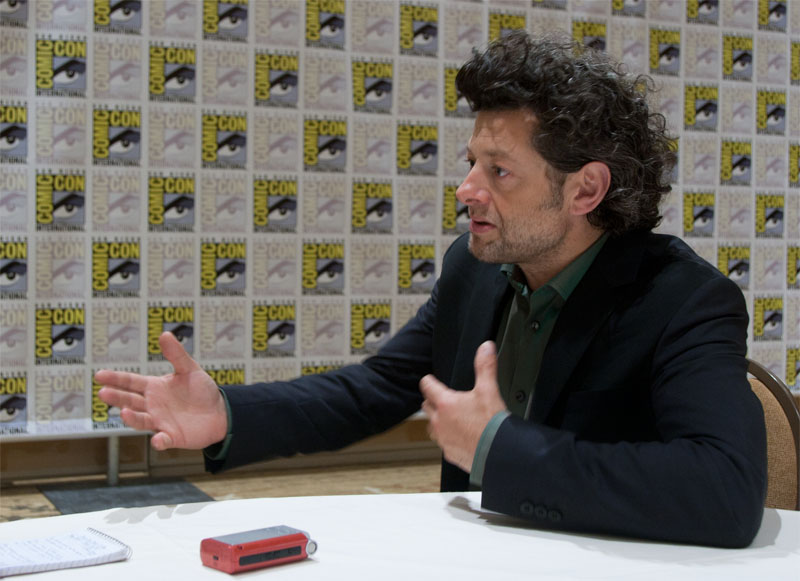
Some of you might not be aware that Andy Serkis was an actor before he became the go-to guy for motion-capture performances. But the bottom line is that what propelled his career was being tapped by Peter Jackson to do the voice and body work for Gollum in THE TWO TOWERS and THE RETURN OF THE KING chapters of THE LORD OF THE RINGS TRILOGY (he did do voice work for THE FELLOWSHIP OF THE RING as well).
Clearly not being able to separate himself from Serkis, Jackson also cast him to do the motion-capture acting of the titular character in KING KONG. Meanwhile, Serkis was popping up in films as diverse as 13 GOING ON 30, THE PRESTIGE, INKHEART, SEX & DRUGS & ROCK & ROLL, BURKE AND HARE, and most recently back to the motion-capture work in RISE OF THE PLANET OF THE APES, in which Weta Digital has outdone themselves with the ape special effects, especially with regards to the story of Ceasar, the chimp that changes the survival of the fittest equation.
As far as this far too brief interview goes, I literally caught Serkis moments before he was lead to the RISE Hall H panel at Comic-Con. We even considered walking and talking but since the panel was running late, he had a few moments to sit and chat about RISE and his second-unit directing work on THE HOBBIT. Also keep in mind I hadn't seen RISE or the clips they showed during the panel prior to this interview. Please enjoy a truly great actor, Andy Serkis (it's time to start that Oscar campaign right now)…
[My photographer began the interview by complimenting Serkis on playing Ian Dury in SEX & DRUG & ROCK & ROLL, which he had just seen recently]
Capone: He was sitting there telling me, and I’m like “I never saw that one.”
Andy Serkis: Oh great. I’m always so excited when people have actually seen that film. [Laughs]
Capone First of all, Peter Jackson's new video blogs are pretty great and you are prominently featured in them.
AS: They’re cool, right?
Capone: The new one that just came out yesterday is awesome, and we get to see you directing in the most recent two. I do want to ask about that, if we have time, but let’s apes for a second. So you are now the go-to guy for any primate.
AS: I don’t know about that. [Laughs]
Capone: Were you hesitant to come back to it again?
AS: Yeah, because the thing is… The fact of the matter is, the reason I took this role, and people did say “You did Kong, why are you doing another simian character?” It’s like they are so totally, totally different, and it’s all about the character for me when I take on a role. I looked at the script and it was a beautiful script, it has this fantastically huge emotional arc with the character with a great journey, and there’s nothing like this. There is no comparison to Kong as a character, so forgetting the fact that they're a similar species, that’s where the similarity ends really.
Capone: I was asking Rupert [Wyatt, the director], do you include in the performance a sense that Ceasar’s intelligence is growing exponentially and that kind of terrifies him, because he is experiencing things that no other creature in his species has experienced. Is that in there, that fear?
AS: That’s a great question actually, because in the early years, he’s not away that he’s any different, because he’s brought up hand reared with human beings, so he’s actually connecting in a very… It’s almost like we played him like a very gifted child, a child who can play concertos at the age of four or is brilliant at mathematics. But beyond that is kind of an emotional intelligence that he has, which is something that is an area that you don’t normally think of as displaying intelligence, but it’s a kind of empathy. He has empathy and he displays all of that. So we did very carefully chart a journey of how we would show his intelligence.
Of course, he gets to a point where he becomes self aware and precisely at that moment of self-awareness is actually the moment where he thinks he’s a freak, and then he discovers his kind of lineage and what’s happened to him, and Will explains his history and how he’s got to be where he is, and it’s also the point where he then is taken away from Will [James Franco] and thrown into the sanctuary, which is like a kind of hardcore prison basically, and then he’s confronted with his own kind and then realizes that he is in another world of neither being a human being nor ape.
Capone: I was talking to Rupert about the documentary that’s out now, PROJECT NIM, which I’m sure the writers had some knowledge of, because man that’s practically a prequel to what you are doing here, minus the drugs, but the whole him getting thrown back in with his own kind and feeling ostracized.
AS: Obviously our Ceasar is more… This is the other thing actually, when you play a role like this people think you are just doing monkey movements or you're learning how to behave like a chimpanzee or whatever. This couldn’t be further from it. That's kind of like Base One where you start, like “Let’s learn the dance steps,” it’s sort of the technical thing that you have to assimilate and you learn ape behavior, but it’s all about personality and character and how Ceasar carries himself. And I sort of brought to the attention of Rupert this real humanzee called “Oliver the Humanzee,” and he's an extraordinary phenomenon, because he really was bipedal. He became this huge media sensation, but he was again brought up around human beings.
My studies from doing KING KONG showed that apes that are brought up around human beings do totally reflect that behavior, there’s just no question. We are 97 percent genetically the same, you’re going to behave in a rhythm that is similar to a human being, but so what I’m saying I suppose, is I was able to play a human being in an ape’s skin, which is a totally different approach.
Capone: Real quick before they drag you out of here, so back to THE HOBBIT. First of all, you're directing second-unit stuff, but they show a little bit in the third video blog of you as Gollum in the cave, what goes through your head when you are there? Are you like “How the hell did we get here so many years later?”
AS: [laughs] It was a strange experience, because since we did RINGS, there have been thousands of imitations of Gollum and he's been sort of owned by the public in such a grand way. I think I mentioned in that diary, it was strangely like doing a bit of an impersonation of a character when I first started getting back into it, you know? [Laughs] Then of course because I was working with Martin Freeman on this whole new other relationship and new journey with him, after a couple of days, I kind of got into it.
Capone: How did the second-unit directing come about? Are you moving towards more directing now?
AS: Very much so. I mean for years I’ve been making short films and directing video game projects and theater and so on, and Peter’s always known I’ve wanted to direct, and I’ve had film projects that I’ve been developing since LORD OF THE RINGS started.
Capone: You’re doing a lot of the action stuff too.
AS: Yeah, we are doing all of that. But also I’m setting up a performance-capture studio in the UK called The Imaginarium. We're service providing to other companies for films and gaming and all of that kind of stuff, but we're also developing our own projects and I’m directing them.
Capone: Cool. Alright well, Andy, they're taking you away. It’s been really great to meet you.