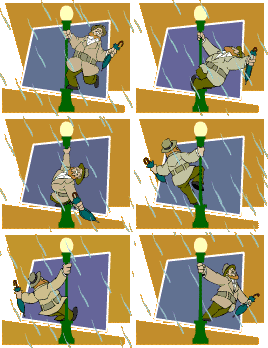
I am – Hercules!!
Longtime AICN spy “Gaspode” somehow got it in his head to interview one of the “Doctor Who” directors!
He says if we’re interested in a series of Doctor Who interviews to coincide with SciFi’s airing of season 28, he can make it happen. His first lurks below. Let him know what you think!
Euros Lyn: Directing ‘Tooth and Claw’
[I’m standing in the lobby of BBC Wales in Cardiff, where director Euros Lyn is editing his final two episodes for Doctor Who’s second season. The director comes out to meet me, pointing out the centuries-old orrery- an apparatus showing the relative positions of the solar system- that was used as set dressing in his episode ‘Tooth and Claw,’ and has now been placed on display in the lobby. We retire to the BBC’s crowded canteen to sit down for a quick chat about the episode and some of Lyn’s other work on the series…]
How did you first get involved with Doctor Who? It seems very different from the work you’ve done previously.
Euros Lyn: Do you think? I don’t know, I think it makes perfect sense in a way. It’s great drama, which touches on some classic human themes.
Was there someone on the production that basically put your name forward?
Lyn: I met Russell once. Before Doctor Who, he did a show for ITV called Mine, All Mine, which was set in my hometown of Swansea. I was desperate to work on it, and met Russell, but it didn’t work out. When I heard that Doctor Who was being made, it was one of my favorite shows from my childhood, so I got in touch with Russell and plagued him until he met with me, which he did, so it worked out brilliantly.
Your first block of filming for season one, ‘The End of the World’ and ‘The Unquiet Dead’ was pretty substantial, wasn’t it?
Lyn: It was, but we were blissfully unaware of its scale before we started. When you go into a show like this, you’ve got a certain number of visual effects shots that can be achieved financially and logistically within an episode, so we went into ‘The End of the World’ with a list of 80 shots. By the time we finished our first cut, we were way over our quota and realized very early into the edit that it was even more ambitious than we’d imagined, and finding our feet as we went through it was a big adventure and a real challenge. There were also a lot of characters in prosthetic makeup and explosions and things like the big fan sequence was massive in its conception.
What potential obstacles did you know you’d have to deal with up-front?
Lyn: We wanted to do lots of crowd duplication shots in the theater for episode three, the Dickens episode, but knowing that we had to get the dramatic scenes in first and make sure that the story was covered and then leaving those ‘scale’ shots to the end of the day meant that sometimes we didn’t get them. We’d reach the end of the day and it was those grander shots that fell off the list, which is always tough. We also had big snow scenes and paper snow in whipping wind, with horses and horse-drawn carriages and lots of extras, so there were lots of big set pieces that were really tricky to achieve.
Those first two episodes couldn’t be more different, could they?
Lyn: They are radically different, but one of the brilliant things about Doctor Who is that every episode is a genre piece and utterly different to each other. It’s like starting again every time; virtually nothing is current from one episode to another. It’s a bit like time travel: one day you could be shooting on a set two billion years in the future, and the next morning you’re stepping onto a set in 1879.
How difficult was it to get Simon Callow to play Charles Dickens?
Lyn: It was brilliant to get him. He’s an actor of such great stature and experience, and the work that he’s associated with is work of quality. The secret to getting him interested was the script. He read the script and loved it, but he’s also a Dickens freak. He loves everything about Dickens and has written books and performed one-man shows about him, so the material was of great interest to him and I think that helped. But he genuinely loved the script, and I think he was really excited when he finally saw the episode. He was telling me a story about how he had gone for dinner with the editor of the Times, who had seen the episode and was congratulating him on it. Yes, it’s Doctor Who, and yes it’s popular drama, but it also has an erudite and classical dimension to it.
What lessons did you learn from the first season?
Lyn: I think finding the fun in the Doctor’s adventures. Russell writes these grand epic themes, which are effortlessly there, so as a director, I think it’s keeping that pace and that fun in Rose and the Doctor’s relationship and in their discovery of the adventure of the week. It’s finding their passion for it.
At what point did the producers ask you to come back for season two? Four episodes can be a punishing workload.
Lyn: It wasn’t a punishment. I was delighted to be asked back, and Russell, Phil and Julie are a great team to work for. They’re incredibly free in the breadth of decisions they allow me to make, as well as being very supportive. They watch every single frame of the rushes of every day, and their scrutiny is great, but they’re also very trusting and liberating for a director.
How did your first two stories ‘Tooth and Claw’ and ‘The Girl in the Fireplace’ compare to your episodes from season one in terms of complexity?
Lyn: In ‘Tooth and Claw,’ most of the action is one Scottish castle, which in actual fact was six separate locations, spread over 45 miles, so just the logistics of working out how on earth we could move a unit most efficiently so that we weren’t spending all of our time driving instead of shooting; those kinds of questions were crucial. Fortunately, I had a great first assistant to take care of those decisions and work things out efficiently. And in episode four, there were things like mechanical revolves and sets in the future that run parallel to sets in the past, so getting the build right and getting the design team on board and coming up with creative solutions to those problems was the key to making it all work.
How tricky was the casting for those two episodes?
Lyn: They were key roles to cast. Madame du Pompadour, especially the way we’ve written her is the most beautiful, intelligent, amazing woman the Doctor has met in his life. He’s bowled over by her, so finding an actress like Sophia Myles who had those qualities was no mean feat, and it was absolutely crucial to the episode. With Pauline Collins as Queen Victoria, again finding an actress of the right age, with such fantastic dry wit and charm that she does, who was also prepared to sprint up stairs and along corridors, to be chased by a beast and scream for her life; she was very game, and of course she’s been in Doctor Who before, so she had some idea of what was facing her.
Is it true that you had originally approached some other actresses to play the queen, including Annette Crosbie, best known to some viewers for her work on One Foot in the Grave?
Lyn: I think Pauline was always up there as one of our favorites for the role. Obviously when you cast any role, you consider other options, but Queen Victoria is in her late fifties-early sixties, and we needed the character to sprint down corridors and up and down stairs at a hundred miles an hour, so getting an actor who’s not only fit enough but game enough was really important, and Pauline fit that bill. There were runners going down the middle of those corridors and at point, she was sprinting as fast as she could and the runner just went from beneath her and she slipped and landed badly. It doesn’t bear thinking about really.
As a fan of the original series, ‘Tooth and Claw’ is very much a throwback to some of the historical-based episodes of the sixties, isn’t it?
Lyn: Yes, but it works as a romp. It’s an adventure and there’s chasing and there’s screaming and running away from monster, so yes, in that respect, it is very classic Doctor Who.
Was there a deliberate effort to make it look different from ‘New Earth,’ the episode that preceded it, which has lots of splashes of color in terms of the look and design?
Lyn: Absolutely. In our tone meetings, we all agreed that we wanted to make it a dark episode, and [DP] Rory [Taylor]’s work in Wales, he’s well known for his fondness for darkness, and I think even he was rather shocked by how far we’ve actually taken it. We’ve really pushed the contrast on it, so that there are some scenes, especially up on the moors where the Doctor and Rose are almost back-lit by the sun, and their faces are thrown into quite hard shadow. It’s not particularly mainstream television; it’s slightly braver than that, and we’re in our second season now. In season one, we were always thinking, ‘Can we see their eyes? Are their faces well lit enough?’ and now I think we feel safe enough that the audience loves our characters enough and are wedded enough to the show that we can be a bit bolder and actually do things where you don’t have to see their eyes all the time to be involved with them.
Were you worried about featuring an all-digital werewolf? Presumably if the character doesn’t work, you’re in big trouble.
Lyn: You are. In episode two last year, Cassandra was absent, and at the end of our first cut, Rose was having a conversation with this character, so every time we cut to the character, it was just an empty frame. The scene died on its feet, because as a viewer, you can’t make sense of what you see, and I think that’s the challenge with an animated character that isn’t there. Until you’ve got some kind of guide animation in, it just doesn’t make sense, so you’ve got to have faith that the storyboards that were drawn up and the pre-visualization of it, the images that you have in your head an on paper, that they will work, as well as relying on a great animator, which we do in ‘Tooth and Claw.’
Was it a revelation to see the way it was all cutting together?
Lyn: I don’t think it was a revelation. I can say that I’m incredibly over the moon delighted with the work that the animator has done. I think it’s inspired, and he’s an incredibly talented guy. The other thing of course that really helps sell an animated character is the sound FX, that when we give that character a voice, it helps bring him to life. When we do a rough cut without the animation in it and having the sound effect of that character goes a long way to making it real and giving you a sense of what it will be like at the end.
The editing is so important, to an episode like that, isn’t it?
Lyn: I think so. There’s a truism that every part of a film or an episode has its own three-act structure in itself, so even in that pre-title sequence, there’s a very definite beginning, middle and end, with the payoff that there is this beast in the cage, so yes, it definitely has a structure.
From what I understand, this was a difficult episode to shoot because of all the various locations, lousy weather conditions and some very difficult technical demands that had to be dealt with.
Lyn: It’s the episode where we spent the most on diesel, because as I mentioned earlier, the house was split into six separate locations, which were an hour and a half away from each other, so there were constant unit moves, which obviously takes up time and money, and the logistics of it well. We don’t have a massive budget, and very few buildings, even period buildings don’t have things like satellite dishes and burglar alarms and security cameras, so hiding all of that is a big deal. And then there are things like the Scottish soldiers. When he hired the extras, we wanted 12 supporting artists with military training, so we got them from the Territorial Army, but when the costumes arrived, which were authentic period costumes, obviously they were made for the people who lived at the end of the 18th century, who are half the size of us now, so we had to check all of the real soldiers out and then got these slightly… I won’t be rude, but smaller people, who weren’t particularly soldierly, so things like that were quite a big deal.
What works about ‘Tooth and Claw’ as a finished piece?
Lyn: I think the pace of it. It really struck me how well-paced it was, with the frenetic pre-title sequence and then the careful introduction of the Host in the cage and the Doctor and Rose meeting Queen Victoria, which is like a big historical novel, and then the arrival in the castle and the introduction of a mystery. And then there’s the dinner party scene, which slowly cranks up the tension, and then once the wolf is out of the cage, there’s a burst of energy for all the chase scenes, and then this lovely lull in the library, where the Doctor gets to put two and two together and work out what’s going on, and then the final burst of energy as they race up to the room at the top of the castle. It was interesting to watch it with a group of people for the first time at the crew screening, because when you watch something time and time again, you’re always waiting for what comes next. You know where the cuts are, but I was able to watch it slightly more objectively at the screening, because I was in a room with 50 people and really appreciated it, because it was all in the script. Russell had paced the story very carefully in the script stage, so I was very impressed by how fantastically well-paced it is.
Having now directed the ‘The End of the World’ and ‘Tooth and Claw,’ is episode two the one to avoid next season?
Lyn: It’s been fantastic, so what’s to avoid there? It’s brilliant to get a chance to direct something like that, especially on television, because those opportunities come along so rarely. In a sea of cop dramas and law dramas and medical dramas, to have something that is as varied and inspired and ambitious as Doctor Who is fantastic.
How did your final two episodes, which air later in the season, turn out?
Lyn: Episode seven [‘The Idiot’s Lantern’] is set in 1953, and the other [‘Fear Her’] takes in the near future. It’s more or less present-day, so it’s the creepiness and scariness in the ordinary that we’re after, in a kind of John Carpenter way. And then episode seven is a classic Doctor Who period piece, in the same vein as ‘Tooth and Claw’ in a way.
What’s going with season three?
Lyn: I’d really like to come back and work on it, but we’ll see how things work out. There is nothing like Doctor Who on British TV, so once you’ve got that expertise, you’re in a very advantageous position to somebody who doesn’t have it so I’m lucky in that respect. I’m going back to do the Christmas episode, so I’m really delighted about that.
Herctacular Series-Box Deals!!

 Homicide: Life on the Street
$505.94 All Seven Seasons Purchased Separately
$209.99 The Complete Series
M*A*S*H
$335.67 All Eleven Seasons Purchased Separately
$139.99 The Complete Series (includes the Robert Altman Movie!!)
Six Feet Under
$382.27 All Five Seasons Purchased Separately
$195.99: The Complete Series
The Twilight Zone
$453.95 All Five Seasons Purchased Separately
$224.99 The Complete Series
The West Wing
$296.91 All Seven Seasons Purchased Separately
$209.99 The Complete Series
Homicide: Life on the Street
$505.94 All Seven Seasons Purchased Separately
$209.99 The Complete Series
M*A*S*H
$335.67 All Eleven Seasons Purchased Separately
$139.99 The Complete Series (includes the Robert Altman Movie!!)
Six Feet Under
$382.27 All Five Seasons Purchased Separately
$195.99: The Complete Series
The Twilight Zone
$453.95 All Five Seasons Purchased Separately
$224.99 The Complete Series
The West Wing
$296.91 All Seven Seasons Purchased Separately
$209.99 The Complete Series
