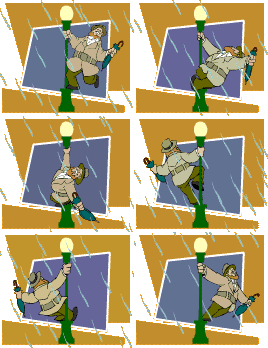
A Merrick Brightly...
In response to yesterday’s reviews, Darryl Revok and Hobbes sent in two more reviews from the recent Brandeis screening of A SCANNER DARKLY.
One review is generally positive, the other is…less-than-enthusiastic.
We’ll start off with Revok’s more positive assessment…
Here are some of my first impressions, as a Philip K. Dick fan and someone who has read the book, but only once.
The Look
The animation style does not detract from the film. If anything, it adds to the fundamentally trippy nature of the book. While it isn't perfect, it's done quite well. This screening was, from what I heard, of a version about 95% done, so one or two shots weren't fully animated yet; it's weird to see live action in an animated movie, but in one or two places the animation hadn't been completed.
The scramble suits are animated wonderfully. They're not exactly what I had imagined, but end up being perfect for the movie. People have complained about the decision to animate it in the first place, and here's what I have to say about that, after having seen the film: The animation works, simple as that. It adds a touch of unreality, a touch of strangeness, to the whole affair that is signature of Philip K. Dick, and in that I applaud the creators.
The Acting
The acting is surprisingly better than I had expected. Keanu Reeves still isn't a good actor, but he shys away for the most part from the dreadful overacting that he's prone too. He actually gets less screen time than you would expect; Linklater has made this into something of an ensemble movie.
Robert Downey Jr. is incredible as Barris. Talkative, loud-mouthed, arrogant, and exactly as I imagined the character in the book. He gets completely into the role (something I imagine isn't so hard for him), though the motormouthing part of it is slightly reminiscent of Johnny Depp's Hunter Thompson in Fear and Loathing. Winona Ryder as Donna is actually a small part, but well-acted, and I had no complaints about her. Woody Harrelson plays his part very well, and I enjoyed his character a lot. Freck, played by Rory Cochrane, was almost perfect. He played the paranoid schizophrenic on D part extremely convincingly.
Relationship to the Book
Hats off to Robert Linklater and his screenwriters. This is by far the most accurate book to movie transformation I have seen in years, and possibly one of the best done ever. Time and time again I heard lines directly quoted from the book, and not simply as an homage. Let's face it; not every scene could have gone into the movie, and Linklater did an admirable job of choosing what scenes to cut without losing the pace of the film. He even won my admiration by scrolling Philip K. Dick's list of dead friends at the end of the film, quoting him directly from his author's note.
As a whole, the film sticks remarkably close to the book, with only minor changes in the overall structure, all of them simply to clarify things that could not be explained in the amount of time they had. The one semi-large plot element that was completely cut was Bob Arctor's mood organ, but it doesn't make any difference; the mood organ and its ilk were one of PKD's trademark ways of adding sci-fi and transcendental messages to his stories, and for something set seven years in the future, it doesn't really make sense. I didn't miss that section at all.
I did feel, however, that not enough time was spent on the fundamental change from Fred seeing himself as Bob Arctor to Fred seeing Bob Arctor as someone entirely different. It was unfortunate that not enough time was spent on that, but in the confines of the cinema I think they did a good enough job of it; maybe not the best they could have, but still a good job.
Audio
Audio still needed some work; the dialogue was hard to hear in many scenes, but I'm confident that they'll clean that up by release time. Yes, there are a few Radiohead songs in it, but usually only snippets of them. The scoring is decent, but certainly not the best I've ever seen.
Overall Impression
Much better than I had expected.
I hadn't felt that the material could be adapted succesfully to the screen, but it was. A few diehard fans will, of course, object to every change that they find, but they will be in the minority. I think the film with tank in wide release, but not because of its quality, but because of the issues dealt with. On the whole, it was thought-provoking (my friends, who hadn't read the book, sat and talked about it for twenty minutes after the film) and entertaining (everyone agreed that it was good).
So, two thumbs up for the film, and I hope you all enjoy it when it comes out in theatres.
Now, here’s Hobbes alternate take on the film…
I was also at the "world premier" screening of A Scanner Darkly at Brandeis University, and after reading the reviews you posted I felt obliged to relate to you the views held by myself and all of my friends with whom I saw the movie.
First of all, I will tell you this: A Scanner Darkly is not an adaptation. I haven't read the novel (short story, whatever) myself, but the Producer, Erwin Stoff, revealed afterwards that the fight for rights to the story involved the concession that the movie be "true to the story." Unfortunately, they failed to realize that "true to the story" for an adaptation means "capturing the essence of the story" and translating it into a visual movie.
Visually, there was nothing here. Sure, the style of animation was impressive and hallucinatory, but simply filming everday events through black and white doesn't make something a movie, either. It makes it a bad home video. One of AICN's earlier reviews lauded the film for preserving even the dialogue of the original text. I can barely express the lunacy of that statement.
We don't watch movies in order to obtain the same art as a book. If I wish to read a book, I shall. I watch a movie because it's a visual media. And here, there was no visual story. It was a series of non-events and banterings that failed to develop beyond an addicted cop that was slowly going insane.
Why was he going insane? Because he was on drugs. Why did he get into drugs? Were we visually ever told? Not really. We're verbally told he was sick of his life, but not exactly why. Why was he a cop in the first place? Again, no visual clue.
When the "twist" happens in the third act, my friends and I were collectively outraged to discover that an actual story had been going on the entire time and that no one had felt we merited its telling. And it's sad how easily this story could have been artistically modified for the screen. Simply start with Keanu Reeve's character, Robert, deciding to take on a mission as a cop or becoming a narcotics cop and then becoming addicted to the drug, D, at the midpoint. That could have been moving: watching a civil servant lose his ideals, conceptions, and identity to addiction.
Really, that's the problem here. The movie starts in the second half of the second act of a real movie and somehow drags on for a few hours. It's all subtext without any text.
The "twist" reveals that there was a movie all along and that no one wanted to show it for the sake of being "true to the story."
