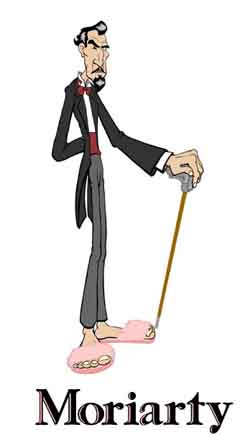
Hi, everyone. "Moriarty" here with some Rumblings From The Lab...
Another review from Mr. Sheldrake, our new NY correspondent. Three reviews so far this week. Busy man. Makes you wonder how he finds time to write up the films in between trips to the apartment with various members of the secretarial pool. At any rate... here's his take on Kevin Spacey's BEYOND THE SEA...
It’s another night in New York and the stars are out. Let’s go to the movies.
* * * * *
I met Kevin Spacey about 1990 at a restaurant called Vandam’s on Varick a little north of Tribeca (the TRIangle BElow CAnal Street). He was with his agent, Joanne Horowitz, and I was frankly more interested in Joanne, a very beautiful woman and the it girl at Studio 54 when that really mattered, and her biggest client, Robert Downey Jr., than I was in Spacey. At that time I watched no television, and while I was vaguely aware that Spacey had just starred in something about Jim and Tammi Baker, and had won critical acclaim for his performance, that telefilm didn’t really fallen within my sphere of interest. I remember he was very polite and rather quiet and shy. I had no idea then of the extent of his talent or training or his ultimate coolness, which I’ve since come to terms with following my personal revelation about his extremely happening mojo in LA CONFIDENTIAL, where he plays a very hip cat indeed. We live and we learn. I do remember thinking one other thing, as he gripped my hand and introduced himself: he had a resonant and beautiful speaking voice. Wow, check out those pipes, I thought. Even saying hello, you noticed them!
Spacey puts them to good use when he sings the hits in Beyond the Sea (executive produced by Joanna Horowitz), his new biopic from x studios in which he gives us an account of the singer/dancer/actor Bobby Darin. A fin-di-siecle talent who bridged the era between James Dean and the Beatles/Stones, Bobby Darin was a constant television and radio presence in the sixties before rock culture destroyed the movie-magazine culture that preceded it. He was cute, like James Dean, but boyish and unthreatening—the perfect celebrity magazine mate for his wife Sandra Dee. He carried the banner of hip, while the entire rest of the pop culture veered headlong into cool, long after the Rat Pack had collapsed of its own outmoded weight. Too bad he didn’t survive into the eighties when hip revived: he would have been a major act once more. That he survived as long as he did was, as the movie shows us, unlikely. He suffered from a heart condition that was supposed to limit him to the Wonder Years, yet he managed to stay alive until he was old enough to have a Midlife Crisis. His particular impending crisis was, of course, his always-just-around-the-corner death. Bobby Darin never lives outside the shadow of the clock, a point made in the film by a gift to boy Bobby from another relative: a wristwatch.
The mind is concentrated wonderfully by the knowledge that you’re to be hanged in the morning, it’s said. Most of us escape the thought of our own death and its universal devastation by pushing it out of our thoughts, placing it at a far off time in the vague future. Darin’s character in the film has no such luxury. The story of his early life and success in the film is one of a man dealing with his death through denial and the narcissistic pursuit of a grandiose goal – to be bigger than Sinatra – to be a *Star* (Sinatra was in his lifetime the touchstone of our culture: Bobby Darin wanted to compete with Sinatra, the Beatles wanted to spoof him, the Rolling Stones wanted to scorn him, the Sex Pistols wanted to nuke him.) Because if you’re a star, you’re beyond the fate of mortals, right? That thought’s not formulated, usually, in the mind of the star-to-be chasing the carrot, of course, but that’s unmistakably the hope compelling the journey: to find a place in a fantasy relationship to life and the world that will seal you off and protect you from the unimaginable horrors that are really a part of every day life. You’re father’s dead. You’ve got a cancer. You’re heart’s going to break. I’m sorry, Roy, you’ve a lifespan of only four years. The towers downtown have fallen and we’re at war with a billion enemies in an age of ubiquitous travel and nuclear weapons.
Darin was born into a tradition and grew into adulthood in the time of a kind of entertainment whose distribution, and so content, was centrally controlled and unabashedly pure, in that the goings-on of politics and war ran parallel to but never interfered with the Dream Factory that was popular entertainment. Movies, records and television were regarded as pleasant distraction and spectacle, and no one saw anything wrong with that (movies and television still are so regarded, unless Michael Moore is feeling Messianic that day). But Darin moved into that factory, married in it, furnished it and lived in it’s manufactured fictions for as long as he could, until he was brought down by another fiction manufactured by one his closest relatives. There’s a moment in the film that shatters Darin and shows him that he is quite literally, and not merely in the show biz sense, not who the thought he was. This revelation is the pivot the story turns on, the moment when Darin realizes he’s living in a cage and, for the first time, he sees the bars, wonders if he’s been a charming, talented fool wasting his life and begins the painful journey towards real knowledge of himself and of the world around him.
This film is well aware of its own intention regarding its material, and, if the material is a character with a divided heart, the film, too, has a divided heart whose schism lay in that gap between its intentions: one, to celebrate and unabashedly enjoy Bobby Darin’s swingin’ dancin’ chart-topping career, and two, to critique the career - the soul - of a man living inside a hermetically sealed fantasy from the point of view of a modern audience.
The film’s two modes may generate confusion in some members of its audience, but it will deliver rich rewards to those who are willing to go on the journey with the character. The film is intelligent and carefully designed, but it does ask a certain willingness and generosity of its audience. It deliberately tracks a self-conscious path to reflect Darin’s own revolution of consciousness that comes when he can no longer justify to himself his swingin’ dancin’ chart-topping career. If you go in with a sneer on your face or deep sentiment embarrasses you, well, you’ll get your yuks and the fun that comes with that. But if you go in with respect for a creative effort by an accomplished theatrical professional, and accept some of the risks the filmmaker takes, and some of the awkwardness that nearly always comes with taking genuine risks, you’ll find some uncommon treasures in this movie. You may even find yourself, in places, as I did, deeply moved.
The song-and-dance numbers are well done, athletic, joyful and entertaining completely on their own terms - they’re FUN, and at times caused me to mourn for the day when virtuoso displays of nightclub skills were the common coin of the realm, before the sullen, slouching, chain-smoking young took over the image producing machinery. There’s a dance number in the street as Darin slaps on his hat, pushes the brim down into his eyes and heads off to the Big City to seek fame and fortune. It’s a scene told in the vocabulary of traditional musicals, and one thing to admire about it is its storytelling efficiency: once you’ve viewed this scene you have no doubt about the sort of movie you’ll be seeing, and the kind of heightened reality, the movie inhabits. For its entire length the movie moves back and forth between scenes played “for real” and the scenes that borrow heavily from the sorts of movies both Bobby Darin and Sandra Dee played in - light mating comedies of the Rock Hudson/Doris Day variety.
Let’s talk frankly about the issue that’s getting play in the press, Kevin Spacey’s age. The movie works for me, and plays better, when you see the character Bobby as always 37 year old remembering his life - perhaps at the point of his death, a la JACOB’S LADDER - and seeing himself in his 37-year-old body as he remembers it. Then the scenes make complete emotional sense. There’s every reason to believe that Spacey intended this when he signals the audience with a Kirk-Spock “Aren’t you dead?” joke, in this case referring to Spacey’s age, right out of the Wrath of Khan playbook (everyone knew Spock was supposed to die in the film, so STII took advantage of that and gave Spock a fake death at the beginning of the movie.) No effort whatsoever is made to make Spacey look younger than he is. The film signals its willingness to use cinema to trick the audience very early on, in the very first scene, and it’s doubtful to me that anyone as smart as Spacey is - he isthe director of the Old Vic, folks! - would let the apparent age of the character stand as it is without a reason.
Throughout the film, a child actor plays Bobby as a young boy, and he has many scenes with the older Bobby. Remember that Spacey is a professional theatrical director. This is a stage-theatrical device, and it’s an interesting choice for Spacey to use it so extensively in this film. The choice makes some emotional sense, if it’s on occasion a little awkward. When, as an adult, you reach a certain age, you can feel the boy you grew through, to become the man you are “split off,” from you, and you find yourself able to look at the child you once were with empathy and distance that no longer directly involves you. You truly do have, or at least I have had, the strange experience of seeing the boy-you as someone else entirely. The boy reflects for the grown up Bobby the distance he’s come from the Bronx, and the boy’s scenes with his piano-playing vaudevillian Mother figure at the beginning of the film are vivacious and heartfelt.
As I’ve said in other ways, sometimes the movie just breaks out into song, as when Bobby makes up his mind to win over his co-star Sandra Dee (it’s a laugh line that her mother, Mary, prefers the studly Rock Hudson for her daughter). Darin’s seduction of Dee is every bit as charming as Spacey intends it to be. When the scene does turn into a musical number, we arrive at the moment where the audience is let to know what kind of movie this is and is asked to embrace it. If you’re not willing to grin, sigh at the romance and innocence of the scene, or if you’re squirming at Spacey’s age, then you have issues with what the film consciously chooses to be silent about.
The standout performances in the film, besides Kevin Spacey’s (and he really does channel Bobby Darin when he’s singing and dancing), are the women’s. Greta Scacchi as the woman who passes on to him the traditions skills and career ambitions of vaudeville gives a small, family style performance until the moment her character touches the piano, but then takes over the screen for the moment when the boy connects with his destiny for the first time. Caroline Aaron is convincing as the woman playing his tortured sister, and when you see the movie you’ll know how carefully I chose those words to describe her. Kate Bosworth, in the words of old movie PR, lights up the screen as Sandra Dee and plays the early 1960s symbol of girl-next-door innocence (she starred in Gidget! and other teenage beach movies) as a girl who drops out of the relationship and the business when she develops a drinking problem.
A few final notes. Much British financing, which makes sense. Also the first Tax Advisor credit I’ve ever seen on a film. There are two other words I want to add at the bottom of this review: Jack Nicholson. You’ll get it when you see the film—if you’re hip to movies. Dig?
Mr. Sheldrake
Thanks, man.
"Moriarty" out.