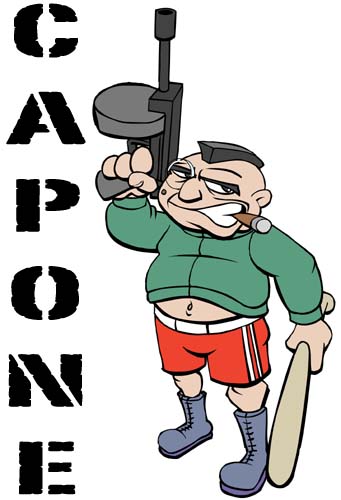
Hey folks, Harry here... Capone is THE man in Chicago and his cavorting about town has amounted to being treated like a booze running film critic gangster, and he wouldn't have it any other way. But notice how he avoids the question in his KINSEY review regarding his own sexual history, and what exactly he does with his baseball bat and why he wears actual boxing trunks... Or what is up with his mohawk? However, Capone does venture into spoiler territory on KINSEY, so watch out on that one, but we must all hate him for seeing the latest CREATURE COMFORT from Aardman. Sniffle. That's gotta be genius.
Hey all. Capone in Chicago here on the brink of launching into the event I live for every year here in the Windy City: the Chicago International Film Festival, celebrating its 40th anniversary with all sorts of special events, guests, and, of course, films.
This particular year was especially gratifying for me since I was tapped to be on the three-person jury for the Festival’s Short Film Competition. I lost count of how many hours I spent watching animated shorts, documentary shorts, narrative shorts, and the dreaded experimental shorts (which actually weren’t that bad).
I’m not sure if I’m allowed to announce the winners yet, but I will mention some of my favorites, including the new installment of CREATURE COMFORTS from Aardman Animation. This one is subtitled CATS OR DOGS?, and it is just as good as the original, maybe funnier. Seek this one out at any festival that comes with 200 miles of where you live.
Other highlights: the beautifully shot doc THE HOT 8; director Seth Henderson’s ZAMBONI MAN with an original score from Wilco’s Jeff Tweedy; the moving JOEY about a young boy caught in gang crossfire; the intensely suspenseful STRAY BULLET, from Brazil; the hilarious doc ON THE D.L., following The Roots ?estlove and Digable Planets King Britt in their quest for drivers licenses; SHOCK ACT, about an actor who gets a job pretending to be executed; the heartbreaking tales of teen living GREAT! and LOVE ME OR LEAVE ME ALONE; and the extremely short and funny I LIKE IT A LOT.
Although the festival has just started, I’ve already previewed a few of the selections, most of which are well worth seeking out. KINSEY Opening this year’s festival with a bang...literally...is the latest from GODS AND MONSTERS writer-director Bill Condon.
KINSEY chronicles the troubled and single-minded life of the man who essentially invented the scientific study of sexual behavior, Dr. Alfred Kinsey. There isn’t a minute of this film that I didn’t find compelling, informative, and absolutely worthy of every accolade and award it is destined to garner. With less than three months left in the year, I think it’s safe to say that KINSEY is far and away one of the best film of the year.
Since the script is from Bill Condon, we assume the framework of Kinsey’s life story will be unique. We learn about Kinsey’s history as he answers questions from his own Sex History questionnaire asked by one of his three assistants. Kinsey (played with absolute precision and humane depth by Liam Neeson, a 100 percent shoe-in for another Best Actor Oscar nomination) is attempting to pass on to his assistants his natural skills at making his interview subjects feel at ease and open up about subjects that prior to his research people just didn’t talk about with such frankness. At the same time, he’s giving honest answers to the questions, and this sets up flashbacks into Kinsey’s puritanical childhood. His God-fearing father (John Lithgow, who comes dangerously close to a cliche country preacher performance early in the movie but miraculously redeems himself later with a heart-breaking confession about his own sexual past) raised his children to consider just about every aspect of daily life as something sinful.
Kinsey broke free from his family and became a biologist at Harvard. As a professor at Indiana University, Kinsey dedicated his life to studying the unique habits and breeding patterns of a rare form of wasp. The pursuit afforded him a lot of alone time, so his social skills were a bit unpolished, but a student named Clara (Laura Linney, downplaying her good looks somewhat) finds him remarkable. We learn that they did not have sex until after marriage and that their first attempt at sex was a painful disaster.
Kinsey’s first curiosity in sex came as a result of this botched attempt, and he was astonished at the lack of scientific research on “normal” sexual behavior. Eventually, Alfred and Clara had a very active and healthy sex life, and this raised Alfred’s interest in the matters of all things sexual. Realizing that, like his rare wasps, all humans have distinct sexual histories and no two are exactly the same.
At Indiana University, the only class offered to students that even mentioned sex was a hygiene course taught by Dr. Rice (the appropriately snobby Tim Curry) that promoted abstinence and doled out loads of misinformation about masturbation, premarital sex, and homosexuality. Kinsey was determined to set the record straight in two ways.
First, he petitioned the head of the university (Oliver Platt) to allow him to teach a frank and honest “Marriage Class,” which gets into every aspect of having relations.
Second, he began the research into sexual practices that eventually led to the 1948 publication “Sexual Behavior in the Human Male,” an international best seller that made Kinsey an instant celebrity and the target of many morality groups.
Condon smartly keeps almost all sex talk (and a few surprisingly graphic photographs) extremely clinical, but that make it almost more shocking. We observe many of the Q&A session between Kinsey’s team and interview subjects from all over the country. Men, women, old, young, gay, straight. Some of these stories are downright tragic, some are absurd, some are disgusting, some are funny, but the cumulative results paints in retrospect appears to be a fairly honest portrait of the sex histories of most Americans.
One particularly disturbing scene involves the interview of a man (William Sadler in an unforgettably creepy performance) who has had more than 9,000 sexual experiences, including ones with multiple species of animals and countless young boys and girls. He has documented every encounter he’s ever had, and while his information is very useful to the study, the details are troubling even to Kinsey.
Neeson’s portrayal of Kinsey is both critical of his stubborn, narrow-minded view of scientific practice, while quite compassionate about his being the object of so much ridicule and disgust. His confusion about his own sexual identity (thanks to his upbringing) is brought to light early in the film when he takes on his first assistant, Clyde Martin (the remarkable Peter Sarsgaard), who is bisexual and offers Kinsey his first gay experience. This doesn’t sit well with Mrs. Kinsey, until months later Martin proposes a sexual liaison with her as well, which she readily agrees to with Dr. Kinsey standing right next to her. This is easily the funniest scene in the film, and gets right to the heart of what Linney is such a great actress. She perfectly conveys a woman who was raised with little or no sexual training, and feels like she’s constantly playing catch up with her husband. Sarsgaard is fantastic here, and with equally impressive work in BOYS DON’T CRY, SHATTERED GLASS, and GARDEN STATE, he’s fast becoming one of my favorite actors. He has the great ability to appear like he’s not acting, like what he’s saying is just coming out of him naturally. His seduction of Kinsey happens almost before you notice that he’s interested in the good doctor.
I was pleasantly surprised to see Timothy Hutton and Chris O’Donnell in the roles as Dr. Kinsey’s other assistants. As the years of research continues. The four men and their respective wives form a loose commune before that concept had really been born. In the name of research, wife swapping occurred and people tried to bury their natural instincts to get jealous (not always successfully). I also really like Dylan Baker’s performance as the representative from the Rockefeller Institute, which gave Kinsey the funding for his research and then pulled it when things got to scandalous. Also, near the end of the film, look for a lovely unbilled performance by a GODS AND MONSTER veteran who tells Kinsey her life story and how his work literally saved this person’s life. It’s the moment in the film I came closest to crying.
KINSEY is, simply put, a perfect movie covering a subject matter than seems as relevant today as it ever was. As the puritanical pendulum seems to be swinging away from frank and open discussions of sex, this film could not be more suited to the times. Condon manages to keep the mood light when it should be, but isn’t afraid to fill the movie with moments that are bound to make a few uncomfortable but also make viewers consider (and perhaps reconsider) why they feel that way. KINSEY is the consummate portrait of a man ahead of his time and whose impact is still being felt today. See KINSEY with the one you love, or at least one you’d like to love.
BATTLES WITHOUT HONOR AND HUMANITY
Kinji Fukasaku is probably best known to reader of this site for being the director of BATTLE ROYALE, but his multi-part Yakuza Papers series makes for an astonishing viewing experience.
To celebrate the release of the series as a DVD box set, the Festival is screening the first part of the series, BATTLES WITHOUT HONOR AND HUMANITY from 1973, which essentially lays out the origins of major Yakuza families after World War II. The film is complicated, violent at every turn, brutal, and brilliant. It’s quite easy to see how this film inspired a generation of crime film directors and writers, and why it is so highly regarded. The hand-held camera work adds a sense of immediacy and tension to the events, and the acting is nothing short of iconic.
The film is screening twice during the festival, and I desperately need the box set.
THE SOUVENIRS OF MR. X
The documentary offerings are particularly good this year, and Austria’s THE SOUVENIRS OF MR. X is my favorite so far. It begins with filmmaker Arash Riahi buying a truck full of Super-8 home movies from a street vendor. As Riahi watches these films (most of the edited and narrated vacation reels probably 30 to 50 years old), he becomes curious about the man who clearly spent a great deal of time putting them together and decides to seek out the man behind the camera, whom he dubs Mr. X. His quest for X takes him from the police to private investigators and eventually to the Viennese Club of Amateur Filmmakers.
At this point the the film becomes less about Mr. X and more of a heart-felt tribute to amateur filmmakers around the work, but especially in Austria. These are not people aspiring to be great directors or go to film school to be the next Spielberg. These largely older men and women are content with spending hour upon hour filming documentaries and narrative films whose greatest achievement might be to be accepted at a national amateur filmmakers competition.
Despite the filmmakers' limited dreams, they speak about making movies with such passion and fervor that you’d think they were making the next CITIZEN KANE. The film uses much of Mr. X’s footage to illustrate many of the point the interviewees are making about being a great amateur filmmaker, and THE SOUVENIRS OF MR. X brought me such joy that I wanted to rush out and make my own little films. So does Riahi find the elusive Mr. X? That question almost become irrelevant by the time the film gets back to his search, but the answer is not what you might expect. This is a charming, funny, and touching work that salutes the filmmaker in all of us and reminds us that there are not boring stories only boring storytellers.
ARAKIMENTARI
Coming in a close second for my favorites documentaries is this profile of Japanese photographer and ground-breaking provocateur Nobuyoshi Araki, whose phenomenal talent and vision was almost ignored when he became the first photographer in Japan to show pubic hair in his images. Yes, we get an array of naked models doing all sorts of nasty things to their bodies, contorting themselves, and inserting things in the name of art, but the real focal point of the film is the energetic Araki, who bounces across the screen, snapping shots like he’s firing a machine gun. He gropes his subjects, claims to have slept with most of his models, and is perhaps the most prolific photographer working (he puts several books a year and is said to have released more than 300 in his career).
Some of Araki’s more famous supporters and subject--including Bjork and Takeshi Kitano--are interviewed here, but simply listening to and watching Araki would have been enough. He’s a force of nature. But as the film goes on, we learn things about his life that impacted him in ways we never would have imagined. The death of his much-loved wife, for example, resulted in a series of photos that have to be seen to be believed. They are some of the most heartbreaking images I’ve ever seen, and suddenly Araki’s playfulness seems more like a mask to cover up his great sorrow. American filmmaker Travis Klose does a terrific job of getting to the soul of this great artist, who never sacrificed his vision simply to shoot pornography.
There’s a beauty to even his most sadistic work, and ARAKIMENTARI is one of the most thorough and probing looks into an artist’s mind that I’ve ever seen.
JOURNEY INTO BLISS
I’ve seen this film described as “surreal.” Wrong! This movie is Unreal. And while at times it borders on unwatchable, I was never once tempted to stop watching.
Imagine, if you will, a German children’s television show. The acting is exaggerated, the story is simple and full of colorful characters. Now imagine a young David Lynch got his hands on this show and filled it with sexual, scatological, and political references. Animals, humans, and machines treat each other as equals and embark on adventures that are simply so twisted crude that attempting to relay the plot would be pointless.
The whole film comes across as some madman’s fever dream (probably that of director Wenzel Storch). The random and absurd nature of this beast will likely result is many walk outs, but if you make it out the other side of this rabbit hole, you may actually find yourself quite amused my the whole experience. This is the kind of film I got to film festivals to see, because in all likelihood, I’ll never get another chance to see it. Experimental, deviant filmmaking at its most depraved.
MCDULL, PRINCE DE LA BUN
Making slightly more sense than JOURNEY INTO BLISS, but still exceptionally odd is this intriguing slice of Hong Kong animation from director Toe Yuen. Apparently this is a sequel to a film I’ve never seen, but somehow I don’t think seeing the original would have helped me understand this one any better. In this film, we find out where McDull the pig comes from, how he was educated, and who some of his early friends were (I seem to recall a talking pizza being one of his close associates). But I found most interesting about the film was that it starts out very lighthearted and childlike, but as McDull gets older, gets married, and becomes frustrated with his life, the film transform (both in story and animation style) into a domestic drama about a life unfulfilled. The animation of MCDULL is quite beautiful and certainly gives you something to gaze at while the confusing plot goes on. Still, in the end, I felt sorry for the grown-up pig-man, and the film had more of an emotional kick than I thought it would. I’m mildly recommending this one.
I’ll file a couple more reports on the next two weeks, including looks at BEING JULIA with Annette Bening; AROUND THE BEND with Christopher Walken and Michael Caine; THE POLAR EXPRESS; IMAGINARY HEROES with Sigourney Weaver; David Gorden Green’s UNDERTOW; THE WOODSMAN with Kevin Bacon; Alexander Payne’s SIDEWAYS; Theo Angelopoulos’ TRILOGY: THE WEEPING MEADOW; Brad Anderson’s THE MACHINIST; MA MERE with Isabelle Huppert; DEAR FRANKIE with Emily Mortimer; Tony Gatlif’s EXILES (Best Director prize at Cannes); Daremo Shiranai’s NOBODY KNOWS; and many, many more. Hold on folks. I have a press pass to the festival and I know how to use it.
Capone