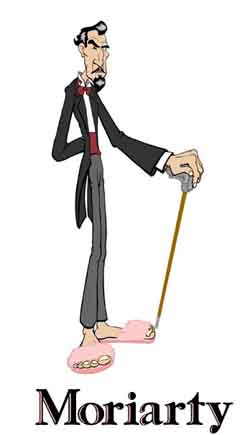
Hi, everyone. "Moriarty" here with some Rumblings From The Lab...
Sometimes, things get lost in the inbox, and it takes weeks before we’re able to sort through and figure out that we missed something. In this case, I thought the article was so good that I wanted to go ahead and post it even if a little time has elapsed since the event. She mentions that MELVIN GOES TO DINNER doesn’t have a release date yet, but it does. It’ll be out in December on DVD. In the meantime, check out the article and see what you think...
I love going to film festivals because they’re so democratic. You never know who you’re going to bump into who will actually deign to speak to you. On the way into a Mill Valley Film Festival screening I bumped into writer/producer/actor Chris Orf. He’s a tall, eccentric character that everyone seemed to know. From festival volunteers to the head PR bigwig to Sam Elliott, people kept yelling out “Orf!” like he was either the Dude himself, or Norm from “Cheers.” If you get a chance to meet him at Sundance, which is probably his next stop, make sure you buy the legend a beer.
So we were both walking into a screening of Bob Odenkirk’s “Melvin Goes to Dinner.” He was being harangued by a pretentious older woman who desperately wanted his views on Camus. Cheers to anyone who can look a person like this in the eyes and tell her he doesn’t really read Camus. Orf flagged me down to sit in between them, so I snagged a seat in the “reserved for filmmakers” row of the theatre. Little did he know that I was an AICN spy in disguise.
After a great screening of Okenkirk’s directorial debut, we decided the best way to follow “Melvin Goes to Dinner” was “Orf Drinks at a Pub.” For those of you who haven’t had the chance to catch “Melvin Goes to Dinner” at a festival, it is worth seeking out. Especially if you’re a fan of movies built around brilliant dialogue like “sex, lies, and videotape,” “Before Sunrise,” or the granddaddy of all low-budget talkies “My Dinner With Andre.” There’s no release date yet on this sharp little film, but keep your eyes peeled to their website right here. If you want to know the plot, several AICN reviewers have already covered it on this site – and their reviews are quoted on the official movie website right next to the “legitimate” press. In fact, the poster at the screening only listed two review quotes – from Variety, and the other an AICN quote right below it. How’s that for egalitarian?
We killed three hours before my next screening talking about Arnold, films, and sports (I slept through the sports part) and of course his upcoming screening of the animated short “SW II.V (The Pitch Wars).” More on that later. After a quick Chinese dinner that we went dutch on, he pulled some strings to get himself the last ticket to the evening showing of “The Singing Detective.” As you already know from the AICN coverage of Toronto, Robert Downey Jr’s last hope has not lived up to the early Oscar buzz. As I have not seen the British series, I don’t have an informed opinion. I will say that even if Anthony Minghella stole from Potter, “The English Patient” is a far superior and more watchable film than this Detective version. Then again, as a lady inspired by the beautiful Robert Downey Jr., it’s pretty confronting to watch him writhe in ugly psioratic-induced pain from the front row of a theatre. For male viewers, Mrs. Sean Penn has never looked lovelier onscreen, and looks to have a body harder than Demi’s. And Katie Holmes is, consistently, Katie Holmes.
Keith Gordon and Robin Wright Penn graced the packed audience with a twenty minute Q & A. Robin looked uncomfortable the whole time, like she’d heard her worst stalker was in the audience somewhere. She’s either super shy, or need of a stiff margarita before being viewed in public. Keith was unrecognizable from his “Christine”/”Back to School” days, but has a confident, informed presence when speaking as a director. The questions were pretty standard. Nothing earth-shaking, except that Dennis Potter wrote the script and actually approved of Gordon’s choice to have Downey sing the last number (For artistic reasons, Potter insisted all the songs be lip-synched in the original). Most of the songs Potter wanted were in the movie, and if they weren’t it was only because they were too expensive to licensed. The project had been shuffled around Hollywood for at least a decade, with Mel Gibson attached for many years. The most fascinating thing Gordon said is that back in the day, Potter had told someone that the only American actor he envisioned playing Dan Dark was Downey Jr., but it was a shame that he was too young. Of course, he was the perfect age by the time the film was actually made.
After the Q & A, Orf and I talked to Mr. Gordon for a while. We asked Keith what the disease is that Robert has in the movie, because it is never clearly stated and at one point a doctor calls it psychological. Keith said it was the one regret about the film that it never clearly names it “a rare form of psoriasis.” I have known two people with the disease, and they never looked or acted anything like Dan Dark. But Dennis Potter suffered from this extreme form of psoriasis, and the story is fairly autobiographical. Because Potter always had good reasons for his choices, Keith didn’t touch the script even for this minor adjustment. He wishes now that he had, especially after talking to confused people like me at festivals.
Orf’s short “SW II.V (The Pitch Wars)” screened a different night with several other fine animation entries. This time I sat in the filmmaker’s row between four of the hunky team behind Pitch Wars. There were some great shorts we all enjoyed. Much better than the last “Spike and Mike” fest I caught. If Harry gets the chance, I think he would love the celluloid origami in “Fast Film.” Though a little long and lacking a message, this horror/chase scene short had stunning visuals made from what must have been thousands of pirated clips of old movies. Half the fun was naming each star or movie as it popped up. You can find it at http://www.widrichfilm.com/fastfilm. Other standouts were two chairs having sex in “Roof Sex” by PES (which was a little uncomfortable to watch considering how many dolts brought their kids to the screening), and the medieval morality tale “Let Go,” by Wayne Gilbert. The plot reminded me of “Indiana Jones and the Last Crusade” where the senior professor tells Indy to let the grail go back to God. We all also enjoyed “Kate the Planet” by Wakana Mishima, a breezy tale of alien abduction by a very lonely club girl…who is the alien doing all the abducting in her search for Mr. Right.
The plot of the “Pitch Wars” film is that George finally comes to his senses and decides to hire a hot director for “Episode III.” The pitch interviews over the next three days with the crème de la crème of Hollywood provide the clever laughs. I don’t want to tell you any more than that because it spoils the film, but you can imagine the results of Lucas meeting Roberto Benigni, Nora Ephron, Spike Lee, the Wachowski brothers, etc. It was a little odd to be sitting in the middle of the filmmakers I was reviewing, but then again AICN prides itself on its unconventional press relations. “Pitch Wars” got some good laughs, but it suffered from being too smart for its audience. Though we were in Lucas country in Northern California and all the jokes directly about him got a good response, many of the other famous directors were not recognized by audience members. Thus some good lines fell flat in our crowd. Overall, people liked it and laughed, but the warm fuzzies died out when the credits rolled too long and people didn’t get the Pixar-style toon-outtakes. Director AJ Towne fretted over the misspellings in the credits and moaned “We’re doomed,” during the tense last two minutes. This was certainly an overstatement. The drag would be minimized or unnoticeable in a hip crowd well versed in every Star Wars film, Pixar film, and auteur film of the last decade. Is that too much to ask? Obviously, any AICN reader would laugh his ass off.
Four of the shorts were represented by filmmakers in a brief Q and A afterwards. The big message from that talk was that animation takes a long time. The director behind “Let Go” said that was his life story and his coming to terms with letting go of the importance of money. The “Pitch Wars” team said their initial inspiration came from the widespread email joke “10 Things I’d Like to Hear Sam Jackson Say in the Next Star Wars Movie.” They were asked if anyone satired in the film had seen it yet. The director AJ Towne said that Kevin Smith saw it and enjoyed it, and that Baz Luhrmann is supposed to be seeing it soon and passing it on to others. They aren’t nervous about anyone in it seeing it because they would love them to have “the opportunity to hate us or sort of be inspired.”
For any of you aspiring filmmakers out there, the interesting looking short “The Spirit of Gravity” was done entirely with thousands of photograph prints. The director Victor Bellomo said “for everyone who can’t draw like me, I encourage you to study photography.” Similarly, the “Pitch Wars” gang had no experience in animation so they hired pros and told them what to do. See, if you put your mind and wallet to it you could make your idea into a film.
On that note, especially for those either disenchanted with the Lucas prequel vision (all you “He raped my childhood” talkbackers) or truly interested in making your own short, I scored one long, plentiful interview with the pitch Wars contingency that serves as a blueprint to all you aspiring auteurs asking “how to.” Hopefully The Powers That Be will print it in its entirety, otherwise you can look it up at PitchWars.com or RestoreTheForce.com.
That’s all today from me, Mrs. Mia Wallace.
This next entry, also by Mrs. Mia Wallace, is a close-up look at one particular film, the aforementioned “The Pitch Wars.” Check it out...
“SW II.V (The Pitch Wars)” animated short
Summary: After repeated delays and creative personal blocks, George Lucas welcomes today's prominent filmmakers to pitch their vision for Star Wars Episode Three.
This is Mrs. Mia Wallace checking in again. Well, my fingers are worn to the bone, but I have just finished typing the interview I scored at the Mill Valley Film Festival with the new filmmakers behind “SW II.V (The Pitch Wars).” For those of you who ever thought “I could make a better parody short,” this is a blueprint of how this creative team with no practical experience in animation got a short written, produced, and winning awards at festivals across the country. It’s also relevant to those who aren’t happy with the new SW trilogy but don’t know how to be heard about it. And for any of you who have seen the cult hit stage show “Star Wars Trilogy in 30 Minutes,” you’ve already met three of these guys.
This is a 45 minute interview, so if TPTB don’t print the entire thing on AICN, it will be available on the movie’s official site, as well as on Restore the Force, a new website that is sponsoring a contest (You could win a plaque!) to find the fan who can write a better ending to the trilogy than Lucas, and vote on the fan with the best argument of why the new films are discounting the adult fans that built the House of Lucas.
Interview with Ariel Joseph Towne (AJ), Chris Orf (Orf), Mark Reilly and Craig Bilsky at the Mill Valley Film Festival.
Q: What did you think of the reaction tonight?
A: (Orf) I like the one guy behind us who was laughing at every single joke we had in there. (AJ) That’s always good when you find one person in the crowd who, the three dollars was worth it.
Q: So this is your third or fourth festival?
A: (Craig) Yes, this is our fourth festival and we’ve got a big one coming up. The first three were: Houston Worldfest, we got a Bronze Romi; we got Audience Choice Award for the LA Film Short Fest. (AJ) Sponsored by the LA Film School, but we didn’t do anything with the LA Film School. The third one in New York was the Freight Festival.
Q: Have you all been to all of the festivals?
A: (all) No.
Q: Is this the first time you’ve all been together?
A: (AJ) Yes. Mark Craig and AJ were together for the LA one, and Orf and I were together in New York. None of us were in Houston because we didn’t know we got into the festival until after it was done. My email address begins with an x. They mark any of the faulty email addresses with an x upfront, so they don’t send any emails that way. So we just got a letter saying “Congratulations! You have won a bronze Remy at the Houston World Fest!” and we were like “We got into the festival?” Poor people, they didn’t even know that we didn’t know we got in. But we have this plaque!
Q: Are you taking feedback from the festival and using it for the film to make any changes, or is it standing as it is?
A: (AJ) The budget is tapped. (Mark) If we could, we would. (Orf) We’d like to tinker with it some, but it’s time and money, and we don’t have the money. And the time is running short in a lot of cases as well.
Q: What about submitting to Sundance?
A: (Mark) Yes, we did submit. We just got it in under the wire. I had a friend who told me “You know, Sundance is today.” I called AJ and said, “Hey man, Sundance is today. I’m willing to work out something.” AJ called me and said “Took care of it.” And so we got it in right under the wire. Which is great because originally we had submitted a rough cut. (AJ) It was less than half done. The whole process was, we had started out trying to do a smaller idea: a simple film on a website. And it kind of grew. We had to keep raising money at different stages of it, and this group of investors said “Hey, if you guys are going to try to get it into Sundance, here, we’ll help you get it into Sundance. That’s when we hired a third animator full time, and we tried to make the deadline. Animation takes a looong time.
Q: It was animated in flash and transferred to 35 millimeter.
A: (AJ) Yes. Primarily. Everything but the outtakes were done in Flash.
Q: What did you do the outtakes in?
A: (AJ) I think it was done in some fancy 3-D. Maya? Or some derivative of Maya, a watered down version that’s easier to get. The poor man’s version.
Q: You guys aren’t animators. So how’d you get the idea that you were going to do this project and have other people animate it?
A: (Orf) That was by default. We wrote the script not really thinking about how we were going to do it. We were just having fun writing the script. And then when it came to “How do we actually make this” it was either hire actors who looked like the celebrities AND can act like them, so you know finding them would be impossible. There was no way we could ever afford that. There was no way we could find all the people we wanted anyway. And then I forget who came up with the idea of “why don’t we just draw it?”
(Mark) Actually, we had a friend, Michael Sloane. This is the way I remember it. He read the script and said “You guys this is great, this would be great animated.” And we went…you know when there is a snake in front of your face and it bites you? You know, it’s like yeah! Of course. (AJ) It’s the way it should have been done.
Q: It’s my favorite part. I love that none of you are animators.
A: (AJ, laughing) We’re like “Animation is simple, we’ll just throw that together.” (Orf) “We’ll just hire people to do this.”
Q: Like “I’ve got this great script idea, all you have to do is write it.”
A: (AJ) Exactly. Well, we were very fortunate because Leslie Shearing kind of cohesed the group. She stepped in immediately as a volunteer producer. She had a film she was just finishing up and submitting to Sundance and Toronto. We needed somebody that had been through the process soup to nuts: completing a film. And she knew through referral two animators she had us meet with in New York. We sat down and explained the idea and they really took to it. At the end of our hour conversation, TJ Morris had presented a drawing of George Lucas and a drawing of Woody Allen from memory, just you know, while we were at the table. (Orf) In a meeting. (AJ) I just looked down and said, “You’re hired.” I mean, I’m sure we talked more after that, but it was just so clear that these guys were the guys to do it. And Rob was wonderful, Rob and TJ were the two main guys. They did the storyboards and all that, the character sketches. Rob was wonderful at interpreting whatever words I was trying to get out in terms of framing. I was talking about almost photography terms, and he would translate that into how it looked onscreen. They were so good at translating.
Q: I felt like people really responded to the drawings. Is that what you have picked up?
A: (Mark) Yes, that was the greatest part. That was a great indication of how the actual animation was. Tonight, right when George Lucas came onscreen, everybody laughed. That was great. That was a great feeling because it gives props to our animators. They were phenomenal. (AJ) And we were faced with a decision early on, which was they showed us those two drawings at the table and said, you know, “This is what we can do.” And we said “Great! We want that!” And they said, “This is a lot more complicated than what you had suggested time frame-wise and budget-wise, everything.” And we said “We’ll try to find a way to make it work. But we want this drawing.” So they showed us a watered down version of it that could have been a lot quicker. But the quality was just so much different. And I said, “If we can get people to instantly recognize it, it’s going to make it so much better and people will be swept up into it.” It really paid off.
Q: What was the budget, and how did you get financing?
A: (AJ) Overall budget was $9,500 for the whole thing. Obviously it was more to submit to festivals, that wasn’t part of the budget. It started out as, you know we asked this producer “How do we create a budget?” And she said “Well you pick a number and you make it for that much.” And we said “No no, can you just give us a breakdown of, you know, all the different incendiary costs and everything you would need.” She said “No no, you just pick a number and then dole that out and see what you can get for free.” And we were like “Okay, well how about $2,000” which is what we picked, and we were kind of set on that. Fortunately, there came down to a day where it looked like it wasn’t going to happen and we were going to walk away from this, and Mark really stepped up to the plate and said “No, this has to happen. We’re going to do this.” And he found a way. He got on his knees and picked up the phone and I don’t know what he did after. (Mark) I got money. I called my biggest supporter, my grandmother, who always supports me. I just said “Can I borrow this money? I’ll pay you back; a year, two months, what do you think?” and she said “Oh no no, you don’t need to pay me back. Here, how much do you need?” And I said “Uh, $2,000?” So she was the one, I always want to say, who really got the ball rolling. She has so much faith in me and my friends that that started it. (Orf) Props to grandma. (AJ) After that, we basically decided we need more than this. So the three of us started talking about a fundraiser, and Orf really spearheaded that and got that going in New York.
Q: What was the fundraiser?
A: (Orf) The fundraiser originally started as the idea of a night of theatre where we would charge triple what we normally would charge for a show. And again, as you start looking at the when, the how, you’ve got to rent a theatre…AJ managed to find a restaurant that had a downstairs bar area that they said “Well you could do a little show performance there.” And we used Penang restaurant in New York City. We had a friend who performed a song on guitar. I did some stand-up improvisation performance. We had a silent auction where people donated things to us for free which we then sold, and they let us keep the profit. Like a friend who does massage said “I’ll do an hour long massage.” He did it for nothing and it ended up being like $85. You get a bunch of people doing that and it added up. We took in about $1500, $1600 on that night. (AJ) It’s amazing how many people donated their services, classes, tickets to ball games, we came up with drink special ideas to try and get the restaurant to get people buying drinks and then they did something and won a prize. We had friends who worked for big corporations who looked in their stockroom and saw what they had laying around. We did whatever we could to try to raise that. And that’s where we started. (Craig) Then it came down to pulling favors from people who were willing to help us, who were interested, who believed in what we were doing, who loved the idea. Legal help, financial advice, business advice. (AJ) And the actors, too. I mean, the actors did this for nothing with no concept that they would get anything.
Q: Was it AFTRA scale?
A: (AJ) It was an AFTRA experimental contract. The idea is if the movie makes money, they will be the first ones to get paid and everyone else will get paid back. We hope that that will be the case one day. But the guys just really believed in the story and we were so fortunate to get these guys that work all the time in New York on Broadway and doing movies. We really got amazing breaks with Danny Burstein, Jim Conroy, and Philip Rodriguez, you know those guys are off working like crazy now. So the timing was really fortunate as well.
Q: So the other thing we have to talk about is the music. The music was great. It added so much.
A: We were really blessed. Zack Ryan was referred to us. We originally went to the woman Debbie Lurie who did the music for “George Lucas in Love” and she was working on I think “Kill Bill” for Miramax and said “I wish I could, I’d love to, but I know this guy who went to Berklee Music School, Zack Ryan, you should call him.” This guy was so amazing. He sat down and said “Whatever you guys think you guys can afford, I’ve done only one other or two other shorts but I’d be totally happy to help out.” We just kind of gave him samples of different kinds of scores that inspired the different sections of the film and he really just tweaked every single one.
Q: And the end with the Randy Newman-esque song?
A: (Craig) That was my brother Aaron. My brother Aaron is a musician, and he and another of my good friends Scott has a music production company called FugFarm Studios, plugging them. Arial wrote the lyrics to a Randy Newman-esque song and he brought it to my brother and said “Here’s a Randy Newman song, here are my lyrics, can you transpose something a little differently that we can get away with legally?” My brother sat there and listened to it. Within an hour he had the song. And then Scott worked with him and we got to see the two of them work together and produce the music.
(AJ) Then the computer crapped out and we lost the song. We had to rerecord it. But they knew what they were doing at the point, so it was like an hour and we worked it out. (Craig) We were there for about eight hours doing the music, and Ariel sang the lead. My brother, Scott and I sang the background vocals, and the Billy Crystal guy who talked in the middle of the song. And it was fun. We had to end it that way because it was a ballad Pixar. (AJ) It was just so odd, too. Because the woman Cheryl King who put together the Santa Fe Project, which is where we sat down and wrote this during a weeklong acting/improv/writing retreat, she was doing a writing class in LA and Mark and I were both at it. She had given us a writing exercise, and we were in the middle of working on animation for this and I couldn’t get it out of my head. So I said “Okay, the end credits are Pixar, so we need to have a Randy Newman song. I’m not doing the exercise. I’m going to write a Randy Newman song.” And they all looked at me like I was crazy, like I was on fire. I started writing these lyrics, and they were so cheesy. We were like “Yup, that’s our song.” Fortunately, we went into it thinking Craig’s brother would sing it. I went there and I was like “Hey! Take this and make it good.” And he was like “You need to sing this.” Those guys were so encouraging and so supportive. I mean, everyone was so supportive. Everyone just came in and added something to it. At every level we had such help. (Craig) It was an amazing experience. We had our ups and downs. Especially with the animation, getting everything done, trying to meet deadlines. But once everything was said and done, on into post and then finishing the project and being able to work with each other was a really good experience.
Q: When you say May for the timeline, are we talking May 2003 or May 2002?
A: (Mark) May 2002. (AJ) First week in June we actually finished the script after three days. (Orf) June second. And then went back to New York and finished it in January 2003 so pretty much 2002. (Mark) We started submitting it in winter 2002 with the rough cut, which was very rough. It’s hard to sell something when it’s an animated short and you’re using, you know, stills and you don’t have all the music and cues set up. (AJ) And the voice over doesn’t lend itself to necessarily what’s going onscreen for some of the bigger sections. Like the Spielberg section wasn’t in it at all. And we had this tiny animanic that just was on loop. We realized the pace just felt so off and so weird in the rough cut. Just imagine. If you’re going to do a comedy, make sure they see the entire thing with the sound mix, because that makes such a difference. The sound mix alone, we realized in LA, God, to hear it on those speakers…we heard it in THX surround sound. (Craig) Just to see what the sound did to the piece. I mean, we had seen the whole thing from start to finish and then when we started mixing in the sound, and the guys we were working with had been through this a thousand times before, they would throw in sound cues that we didn’t even think of, and we didn’t tell them to do. They would just see something and say “Okay, this needs that, this needs that.” And they would play it back and we’d just sit there and go wow. It added so much depth to what you’re watching. I tip my hat to the sound guys. It’s half the movie. (AJ) One of the biggest laughs we got in LA was when George Lucas falls out of his chair after the Farrelly brothers, and that was…they made that work.
Q: Is this going to be online anywhere for people to see if they can’t make it to a festival?
A: (AJ) That’s an interesting question. We don’t know. We’ve submitted to Hypnotic Films and we’re waiting to hear back from them. The World Tour Festival has distributors that they end up showing it to. We’ve heard of other places and other suggestions.
Q: Sputnik7.com?
A: (AJ) Sputnik7. At this point we haven’t put it online. We kind of want people to be interested in seeing it and maybe request copies. I can’t imagine all of it would play online. It’s such a small screen with small sound. Ultimately we’d love to have people see it first in a big theatre with a big crowd, and if they want to take a copy home, great.
Q: Have you gotten what you were hoping to out of this as far as exposure? I don’t know what you were looking for when you did it, but…
A: (Craig) I think it was more a labor of love and an excitement of “Oh my God, we’re actually doing this.” And we got people working for us and making this happen. After that once it was all said and done, it was sort of “Let’s just submit it to festivals and see what happens.” The response we have gotten has been amazing. Even being here in Mill Valley has been too incredible. And we got gift bags! Never gotten that before. It’s just really neat. As far as getting exposure and distribution, one thing I think that we’re all realizing is that things take time to mature and that this is something we finished back in January. Now it’s just a matter of submitting and people start responding. And it’s like “Wow, oh yeah, okay,” because we’ve all moved on to other projects and we’re starting other things as well. So it’s sort of like the snowball rolling down the hill getting bigger and bigger and bigger with people saying “We want to take this for this festival and that festival.” ISCT next year, the possibilities of us getting a distribution deal through the people that they’re going to show it to are pretty huge. I mean, it’s three different countries that it’s going to be showing at. And we’ll be more than happy to cross that bridge when we get to it. (AJ) Not even distribution. I mean, I think this has surpassed all of our expectations on so many levels. We set out to do this because we had a story we wanted to tell. We wanted to do it in the means that would really showcase the story. And that’s why we were so fortunate to get such great animators and everybody along the way. But to be able to have people see this and to be able to say that we completed a project that we care so much about is the most important thing. The most ideal goal which has not been met would be that we would love to just have everyone see this. More so than to start making money from it we would love everybody…(Orf) The entire world. (AJ) All six billion people to sit down at dinner and tune in. No…(Craig) We’ll start with China. (AJ) We just know that with South Park it started with a Christmas card that George Clooney got, and it just spread and everyone saw it. Things kind of came from of it. Yes, we would love for this to open up doors to continue working because we love writing, we love performing, we love directing and producing. Hopefully this will allow us to continue doing this for a long time.
Q: Has this helped any of your acting careers?
A: (Orf) Acting careers?
Q: Aren’t you all actors? Or not all of you.
A: Some of us.
Q: Some of you…
A: (AJ) Not all of us are actively pursuing it all of the time, but they still act. (Craig) AJ, Craig and Orf. Mark has gone solely into writing. (Mark) Yeah, I do mostly writing. But I will act on occasion like in the “Star Wars Trilogy in 30 Minutes.” That’s my next gig. Again.
Q: How many of you were involved in that?
A: (Mark) The three: Craig, Mark AJ.
Q: Did you guys invent and produce it? A: (Mark) That was Patrick T. Gorman.
Q: And you guys came into it?
A: (AJ) What happened was, I was in a class with Patrick. I was in an Experimentals class at USC, which was a theatre class where they allowed you to do anything you wanted. You could direct, you could stage manage, sound design. And Patrick came up with this great idea similar to “The Fifteen Minute Hamlet” to do the entire “Star War” trilogy on the stage. He used the class to develop all the bits that ended up working. Try stuff out, stuff that didn’t work he revamped. And it went from like twenty people in the crowd opening night to sold out in three days at campus. And he was asked to go to the Edinburgh Festival in Scotland and perform there and it became a huge hit.
Q: The Fringe Fest, right?
A: (AJ) Yes. Then in the time afterwards, there were other directors that came in and kind of kept the show alive for six years. And then it came back to LA and it ran in the Coronet Theatre for eight months, and we went to Skywalker Ranch. (Mark) In Indianapolis, the Celebrations Two Festival to introduce “Episode II.” Now we’re getting ready to go do it again up in San Francisco at the Presidio we’re going to be doing it for the licensees of the “Episode III” toys. So they’re going to get a nice little performance of “Star Wars Trilogy in 30 Minutes” and then we’re looking into taking it to either New York or Vegas. Guam is on the table.
Q: Talk a little about your “George Lucas in Love” connection.
A: (AJ) The connection is almost a fishing wire, it’s so small. A roommate of mine from college, Tim Dowling and his good friend Joe Nussbaum who was a film student…Tim was a theatre student and a wonderful writer, comedian. He and Joe Nussbaum the film major sat down and wrote that and after college decided to go and produce it. Boy, it’s just taken off like wildfire. Tim went on to play Dr. Evil in “Evil Hill” which is also on the DVD collection. A lot of the people associated with that film have gone on to do so many great things. I know Joe Nussbaum is directing a feature from that, and Deborah Lurie, the composer, is doing films for Miramax.
Q: I know that inspired a lot of people to do satires. Was watching them succeed one of your inspirations?
A: (AJ) I didn’t see it, actually, until after we were halfway through animating this. I’d heard about it and I’d moved back to New York, so I wasn’t part of the whole screening process in LA. But I’d been hearing about it so much I though, “Okay, we have to see what this is.” So I sat at home one afternoon, a really frustrating “Animation Missed Deadline afternoon” and laughed my butt off the whole time. God, all those guys did such a good job. (Craig) And I have to admit I still haven’t seen it. (Orf) You’re not alone, Craig. (Craig) It’s just my tagline. We’ll all be hanging out and Mark or AJ will quote a movie and I’ll be clueless. I won’t know what the heck they’re talking about. (AJ) He’ll always say “haven’t seen it.” (AJ) “Star Wars?” “Yeah, heard of that.” No, that’s an exception to the rule. (Orf) These three have the big “Star Wars” connection, and I just like to make funny things.
Q: I actually noticed that because you kept calling “Star Wars” “Star Trek.” So…(all laughing)
A: (Orf) That was a slip. I did that twice. I admit. (Mark) Wow. (AJ) This is our co-writer and co-producer Chris Orf calling it “Star Trek.” (Craig) I’ve never heard of “Star Trek.” What is it about? (AJ) Galaxies. (Orf) It’s about explosions. In space. (Craig) “Star Trek.” I’ll look into it.
Q: Last question is what’s your message behind the film? You were talking about the shorts in there (Mill Valley Film Festival) that had one and how great that makes them. Do you guys have a message behind the film?
A: (Mark) Well, yeah. We do. When we started writing it…I believe I’ll speak for these guys here and some fans of “Star Wars” out there. The new films, Episodes I and II, have not really captured our imaginations as much as the original trilogy has done. I feel that in general there has been a lack of story in this, a leaning towards technology over the human spirit. That’s where we’re going with this. And that George Lucas ultimately has used the back drops and the big explosions more than the good warms fuzzies that a good story will bring, or that a great performance will bring. And so that’s what our message was at the end.
(SPOILER ALERT)
10
9
8
7
6
5
4
3
2
1
When George finds out that he can just do this all digitally, no actors, no directing, he hires Pixar to do it. When reality, what we fell in love with to begin with was the story and these wonderful actors. And Han Solo shooting first and his great cynical nature that he was a bad guy, so to speak, and becomes a good guy at the end of “Jedi.” You know what I mean? It’s all about the story, and that’s what’s lacking in the new trilogy. In my opinion. (Craig) And I think that the revamping of the old trilogy is sort of like a second guessing of his original work, and I don’t think he needed to second guess it. But that’s just my humble opinion. This piece was just a way to express what we felt, and also our respect for George Lucas and the whole trilogy and the impact that it has had on the entire world. (Mark) Because he was the one that…the original trilogy was the reason we wrote this. And even the next trilogy was the reason we wrote it. So he’s still doing what we love and I still love running around in there in his world. But it is really because of him. (Craig) Also, something that shouldn’t be forgotten is that our respect for George Lucas. Also our respect for the other filmmakers that we showed, that we dealt with. The filmmakers that we brought into the script, what their ideas of what “Episode III” would be like is based on the kind of films that they make. The kind of films that we’ve grown up watching and the kind of films that we respect as well. (Orf) As said by the Friar’s Club whenever they do a roast of anybody, “You only roast the ones you love.” Because if you didn’t like them you would just ignore them. So the fact that we had all these directors that we know them well enough that we can parody them and have fun with it is not a slam on them. It’s more like “Hey, we’d love to be at your level.” I’d love to be parodied by somebody. (Craig) Put us in “Episode III.” I don’t care.
Q: I actually thought you guys did a really good with that. That really came through that you have respect for it, and yet still have that grain of discontent. It was much more effective I think than the ranting I’ve seen online from some of the fans. I think it’s interesting because you’ve all spoken about your hope to get this movie to George Lucas and see what he thinks of it. And obviously if you use the usual “raped my childhood” line throughout the film, then there obviously wouldn’t be that opportunity there.
A: (Mark) You attack someone, it puts them on the defensive. If you show with an understanding and a respect of their work and say “Okay, but this is how we feel” they’re going to be much more willing to listen. I mean, it’s just a basic communication thing, I believe. (AJ) Also, when you get to the point in life where there are so few people to answer to, there seems to be a lack of tension that is necessary in sometimes making these compelling pieces of art. I know that he was struggling with his very first movie against budget, against time, against “how do I put this vision out there that I see that is so much in the future based on these tools that I have.” And he would cut away in that great space battle, he would just show you a brief glimpse and he would just cut away. And now, to showcase the technology he’ll hold on a shot for, you know, 15-20 seconds to say “Ohhh, look at the matte paintings we can do, look what we can do.” I think that’s so amazing, because it’s obviously pioneering new ground. But taking away the principles of good storytelling and taking away the principles of human spirit over technology, which was the message from the very first movie, which is now switched. The human spirit seems to be decidedly absent from these new movies. And the cynicism comes from respect and reverie. And so any cynicism that we put forth with this has to do with just trying to hold up a mirror to, you know, our crazy brains just piecing stuff together. It’s so much easier to kind of poke fun at even things that you love than it is to come up with something original. So our hat is off to all these people that have put forth their vision. But if they could somehow, you know, allow themselves to surround themselves with people that really can call them on their stuff and allow that tension to still be there, I think that the art will come through the rest of that. (Mark) It’s fun to use your imagination. And I think that the new movies aren’t necessarily letting us use our imagination. My favorite reference is don’t show us the shark. And that’s Spielberg, and that’s what I love. If that shark was working that day, you know for that first shot, maybe it would have been a whole different…maybe even had a different career. But it awakened something in filmmakers, of our generation I know. Because our generation sitting here tonight looked to the great movies of “Star Wars,” “Jaws,” “Raiders of the Lost Ark,” “E.T.,” those are the movies…Sorry if I’m speaking for you guys. I love those movies. (Orf) I’m with “Star Trek.” (Craig) Again, “Star Trek” I don’t know. (AJ) I don’t know about the other ones. (Mark) But it’s the reason I write today. (Craig) I’m just talking about as far as suspense and everything, Tak Fujimoto I think his name is, cinematographer for M. Night Shyamalan for “The Sixth Sense” and…(AJ) And for “Star Wars.” He was second camera assistant on the original “Star Wars” movie and “Silence of the Lambs.” (Craig) Well, there you go. His work is just amazing. I sit in awe with “Signs, ” with “Sixth Sense.” The manipulation of the camera work to heighten the suspense is just incredible. You can see that M. Night is definitely a student of our generation. He’s speaking for us because I believe M. Night really really captures what I want to be doing. (AJ) Yeah. (Craig) Especially with “Signs,” he didn’t show those aliens at all. Barely, until the very very end, you know, and there’s that one shot where he builds the tension with the camera and it’s shaky, and all the sudden just the quick walk. The alien just walks by and you “Whghh!”
Q: The tv?
A: (Craig) Yeah, the tv reflection. (Mark) That’s Tak Fujimoto, and they’re just…(Craig) These are great…It would be an honor to meet them. (Mark) And, likewise, the three of us were very fortunate when we were doing the “Star Wars Trilogy in 30 Minutes” at Lucasfilm we were able to meet Lucas and his son Jet, who was just a bundle of joy and just wanted to crawl over chairs and play around. But Lucas was very very soft spoken, and came across very much a family man, very private. And very appreciative of the play, and we were very appreciative of him. (AJ) It was very flattering. (Craig) We did a performance, we did Lucasfilm one day then we went to ILM the next day, and we found out later that Lucas actually snuck in and caught a performance that we didn’t know about. (Mark) He liked it. (AJ) I think maybe what captured him on it was not so much, you know he has a sense of humor, he can tell when people are poking fun in play and in love. And I think that he sees how much passion and love we put into that. That’s thing I respect most about this man. He’s created so many things that have changed so many of our lives because he cares about this stuff, and he cares about people, and cared, still cares so much about story that he included Joseph Campbell in all of that research and brought him to the limelight a little bit. I have the utmost respect for everything that he’s creating and hoping that someday we’ll be doing that. (Orf) As writers and performers as well, that’s the whole thing. Along the same lines as these guys have been saying, the neurosis almost of “I must do something good and people are going to tell me it’s not good unless I really really work at it to make it good” is the driving force of most artists. Even watching Jerry Seinfeld’s latest film where he’s a huge star and he’s at his show that he can rest on his laurels forever. If you go watch the film “Comedian” about him, he is still fretting over the delivery of one line in a new bit that he just came up with, you know, last week. And that is why he and other artists like that are going to remain at a high level because you still have to care and fret over it that much. And all of us need to make sure that we just need to keep that intensity up as well.
Q: That’s great. Anything more you want to add?
A: (Mark) Just, if you want to learn more about our film you can go to our official site. There you go. Just a little plug there so you can learn about festivals.
Thanks so much for your exceptional work on this one, Mrs. Mia Wallace, and thanks to the filmmakers for their patience in this making its appearance on the site.
"Moriarty" out.