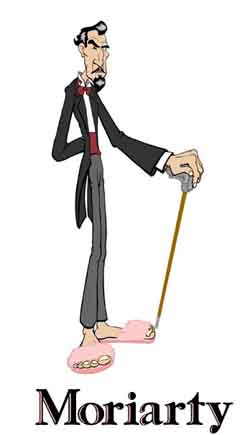
Hi, everyone. "Moriarty" here with some Rumblings From The Lab...
We’ve got a lot of regulars showing up and weighing in today, including Ghostboy with two great reviews:
Howdy,
I bring you today a lengthy expose on two independent, digitally shot films that can both at least ostensibly be classified as horror films, and which are both definitely worth your time. First up to bat is a movie that is getting a sneak preview around the country this Friday – the official website suggests that you 'wear a red shirt, and see what happens!'
28 Days Later...
No matter how original a horror film is, or how deftly it defies expectations, you can pretty much always count on one thing: a character (or characters) will do something that's obviously really stupid, and you'll want to yell at the screen and tell them not to split up or go down that dark hallway or whatever it is that they're about to do that's damn well going to get them killed.
In Danny Boyle's '28 Days Later,' the moment occurs in a dark tunnel, where the characters' car gets a flat tire. So of course, they stop to fix it. Even though they know that the city is overrun with zombies. Who like to hide in dark places like tunnels. At times like these, wouldn't you just drive on the rim for a little while? Horror movies thrive on human error, and the very best ones frustrate you because you really, really want to see the characters survive.
'28 Days Later' is a masterful entry in the canon of zombie films, a genre which hasn't truly been improved upon since George Romero's 'Dawn Of The Dead' two decades ago (please feel free fill me in on any that I might have mised, however). While lumbering, flesh hungry ghouls are always good for a few easy scares, it's about time someone utilized their potential in a new way. Boyle, finally living up to the promise of 'Trainspotting,' and screenwriter Alex Garland have provided a whole new take on the concept.
During the film's prologue, animal rights activists break into a medical lab to free a group of animal test subjects. A scientist catches them in the act, and begs them not to let the apes free. He explains they've been infected; with what? "Rage," he says, which isn't a good enough answer, because the activists ignore him and set loose the chimps, which promptly attack the first human they see with bloodthirsty zeal. Within seconds, the entire group of activists has been infected with the virus. Well, at least they meant well.
Twenty eight days later, a young man named Jim (Cillian Murphy) awakens in a hospital and discovers that the building, the streets, the entire city of London has been abandoned. There are signs of carnage, and frightening newspaper headlines reveal that a mysterious virus has decimated populations around the world en masse. He wanders into a church and finds a massive heap of corpses; and then he finds the priest, who attacks him like a rabid dog.
He escapes, and eventually meets up with a few other survivors; Selena, a beautiful, hard-as-nails girl (Naomie Harris), and a widower (Brendan Gleeson) and his daughter (Megan Burns). They fill him in on the details of the epidimic: one drop of infected blood or saliva is all you need to become infected, and it will take over your body within thirty seconds, rendering you a mindless zombie with an overpowering instinct to kill and consume; basically, it makes you really, really pissed off. There is an unspoken understanding amongst the survivors that the possibility of infection will not be tolerated; Selena is especially quick to demonstrate her willingness to kill at the first sign of zombification.
The zombies themselves are an interesting take on an old story; they aren't actually dead, and they don't have the drawbacks that normal ghouls do - namely, that slow, maddening gait. These creatures can leap and run like wild animals. Almost more frightening is the virus itself, which is so quick and fatal. We hear bloodcurdling testimonies of the pandemonium that ensued in the first days of the outbreak, and see proof of its sway in the bodies of those who chose to kill themselves rather than be infected (Jim's parents are among them; "they were lucky," Selena tells him). Althouh the movie was released in Europe last year, its timely arrival on our shores, alongside the advent of SARS, gives it a rather prescient, urgent edge.
The first two thirds of the movie take this new concept and and apply it to the classic zombie movie template; i.e. an appealingly ragtag group struggles for survival, the key to which seems to lie, in this case, in a radio broadcast the happen to catch, promising the cure to infection. They set out towards Manchester, the source of the broadcast, at which point the movie goes off in an entirely new direction; I won't reveal what happens, but its an expansion on that idea I mentioned earlier - that people in tense situations always end up doing something stupid. It's a smart move by Garland (who also wrote the novel 'The Beach,' upon which Boyle's last film was based); it takes the movie from straight horror to the very edge of the fine line that leads to social satire; he could have easily kept the story going along a more predictable path, and Boyle could have easily made it a compelling film, but this unexpected development is what takes it from being a good, efficient horror film to being a classic of the genre.
A word of the technical sort: the movie was shot on prosumer miniDV cameras by cinematographer Anthony Dodd Mantle, who gained fame as a DP for Dogme films like 'The Celebration' and 'julien donkey-boy.' Although he uses the same digital technology here, he employs traditional cinematic lighting and montage techniques. Could the film have worked just as well on film? Sure; it doesn't matter. This is proof once again that the story, and the talent with which its told, are far more important than the medium.
Or are they? All sorts of traditional barriers are broken in the next film I'd like to discuss, which I'm not even quite sure how to discuss...
Cremaster 3
To begin with, Matthew Barney's 'Cremaster 3' does have a plot; however, he can probably explain it best, so here is the official synopsis of the film, straight from the horse's mouth:
CREMASTER 3 is set in New York City and narrates the construction of the Chrysler Building, which is in itself a character - host to inner, antagonistic forces at play for access to the process of (spiritual) transcendence. These factions find form in the struggle between Hiram Abiff or the Architect, and the Entered Apprentice (played by Barney himself), who are both working on the building. They are reenacting the Masonic myth of Hiram Abiff, purported architect of Solomon's Temple, who possessed knowledge of the mysteries of the universe.
Reprinting that isn't laziness on my part, because if I tried to explain what the movie's about, it would be incredibly vague and confusing, but that's not to say I wasn't able to follow it. To wit: you will understand what's going on in the movie, you just may not be able to explain it. There's certainly a discernible plotline, but it isn't conveyed in any conventional way, and you have to slow yourself down to the rhythm of the movie before it will start to emerge. On the other hand, this is one of the 'purest' motion pictures I've seen in a long time, because the story is conveyed entirely through the visuals. In the entire three hour running time, there is one, barely discernable line of dialogue at the very end. Otherwise, the movie is propelled by the juxtaposition of images, and what incredible images they are! Bizarre, beautiful, disturbing, terrifying -- a few of the words that come to mind trying to explain the way the movie looks.
This is the final installment of Barney's epic, five part Cremaster series, which he made completely out of order. This chapter technically takes place in the middle of the series but officially is its grandiose finale. It is a major work of art, literally. Barney began his career as a sculptor, and then moved on to performance art, and these films are extensions of both. He developed the film not with a script but with a brief outline that gave way to shot lists, which in turn became the sequences that tell the story. "The genesis of these projects is in the object," he said in an interview with Filmmaker last year. "My concerns have to do with developing an 'object narrative'... I feel like the biggest part of my job is to create a situation where a character doesn't need to be directed, to create an enivronment with a set of problems for that character to walk in and solve."
I find that I'm grasping at straws here, trying to describe this movie. Let me call to mind just a few of the moments that I haven't been able to shake. There's the dead, decomposing girl with a mutilated vagina who exhumes herself from the dirt early in the film, only to be crushed in a sort of motor derby in the lobby of the Chrysler building. There's a scene in the Chrysler building's cloud club that is eerily hilarious, sort of as if the bar scene in 'The Shining' were played as slapstick. A horse race with decomposing horses. A beautiful amputee woman (Aimee Mullins) walking on glass legs. At one point, the Entered Apprentice (played by Barney himself) is subjected to a ritualistic dental exam that will have you cringing in ways you couldn't possibly expect. And the dizzying exterior shots depicting the construction Chrysler building, which climax in the eruption of multicolored ribbons from the building's tip, are simply stunning. The film cost barely four million dollars, every one of which is up on screen. It was shot on 24p High Definition Video cameras, which a.) probably helped cut down on the cost and b.) contributed to the rich texture of the image.
As I said, there is no dialogue; the soundtrack is made up of textured sound banks that range from ominous to unpleasantly grating. There are also several traditional Celtic songs, which tie into the film's mythic bookends on the Isle of Man in Scotland. At one point, a character plays a harp that is built out of an elevator. From my descriptions, you may think that there's much that is reminiscent of Kubrick or David Lynch; amazingly, nearly everything registers as completely original.
There will be plenty of people who won't care to see a film like this, and some that do will surely dismiss it as an exercies in redundant, narcisistic masturbation (exacerbated by the fact that Barney is the star of the piece). There will be people who fall asleep in the middle of it, and other people who will walk out. All valid reactions, to a point. I'm curious as to whether this work is very personal to Barney, or if it's merely a string of ideas that fascinate him - in which case I imagine he's only amused by his detractors.
In any case, he has it made; he's the youngest artist to ever have a solo exhibit in the Guggenheim (or to shoot a movie there, for that matter); he's able to make these movies without any fear of box office failure or audience rejection; and to top it all off, he's actually talented, and people respond to and respect his work. I'm one of them, and now I'm spent. If I haven't interested you in the movie by now, then you probably shouldn't go see it.
That's all for now - thank god for that, right? Rest assured, I'll be back soon....
But until then I'm outta here.
Ghostboy
Excellent work, man. I hope there’s a CREMASTER DVD set coming down the road. I’m fascinated by what I’ve seen and read about this cycle so far.
"Moriarty" out.