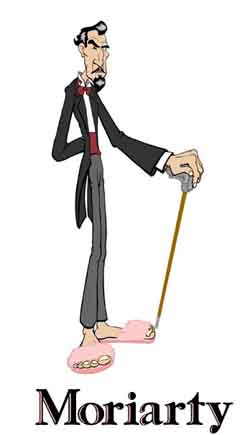
Hey, everyone. "Moriarty" here with some Rumblings From The Lab.
I met secretly with Frank Bascombe when I was in New York this weekend. Good guy. A surprise, as are all of our columnists when we finally meet face to face. It’s never quite what you expect. Still, it’s always nice to put a name to a face. Here he is with his seventeenth monthly column for AICN, and as always, we’re damn glad to have him...
I’ll admit there was a wave of joy that washed over me when I opened my mailbox and Stephen King stared up at me, declaring he was finished with the writing game. He’s become a parody of himself, an overused punch line. Sadly, he’s just another big budget author who’s brought into revive a sagging book industry. He’s shown the world that it is possible to get exactly what you want out of it and to get paid while doing it. He says he’s afraid of repeating himself. He wonders what else he has to write about. I’ve been asking that same question since I read Pet Semetary in one sitting in the ninth grade. I’ve recently decided that the world of books, for me, falls into two categories, what I’ll call After The Corrections, or ATC for short, and BTC, or Before The Corrections. King falls into the BTC category. He falls into the just discovering books section of life, which was high school. I wish the King well and am pleased that his glossy, thick, cumbersome re-wordings of the same theme will clutter the bookshelves no more. Maybe this will force the publishing world to find a new storyteller, and make him or her as big as life itself, or maybe they’ll just let Pandora out. But until then... It’s Not a Secret If I Don’t Tell Anyone.

WINOGRAND 64
Arena Editions, 281 pages
Copyright © 2002 Arena Editions from Winogrand 1964. - $60.00
To order, visit www.arenaeditions.com or call toll free 888-759-4851
The America I grew up with is long gone, the eighties are relived nightly on VH1, and sadly, the only thing anyone can recall about that decade was the music. Looking back, it was more about the torture of High School, discovering The Police, College, and enjoying being alive pre-9-11, as odd as that sounds. We find ourselves thinking back to a time when life seemed endless and nothing scared you about it. In college, I discovered a photographer that changed the way I felt about everything around me. Garry Winogrand was already dead by the time I was shown his work during a slide presentation in the History of Photography. Currently, two separate groups are celebrating his greatest work simultaneously.
The first: Arena Editions presents possibly the best book ever assembled about a photographer. That’s right... better than Annie Leibovitz’s Women and her Hollywood portraits, better than Avedon and his America series. This book helps bring the long forgotten Garry Winogrand into the spotlight that he’s so richly deserved. In the history of photography, at least the history I subscribe to, you’ve got Robert Frank, Bresson, Friedlander, Callahan, Siskind, Weston and Adams, to name just a few. These are the chestnuts of photography, but most people don’t know that street photography is best seen by viewing one photographer’s black and white work, Garry Winogrand. In 1964, Winogrand set out on a journey to photograph America, a place that he felt was about to vanish. He wrote in his application for the grant he would finally receive to fund this trip that he was worried America was going to get “blown up”, it was going to washed over in commercialism, it would dry up and disappear. He got the grant, and in his car he took off with his cameras around his neck, generally two, one loaded with color and the other with black and white.
1964 was a big year for America, we’d passed the ‘50’s, Ward and June Cleaver were still there nightly on re-runs with their separate beds and kids who did nothing worse than come home after the street lights had come on. The sixties were a time of change, and I don’t just mean the music. Politics were weird with Johnson and Nixon and the shadow of Kennedy. JFK’s assassination is perhaps the most important watershed event of that time and for many years to come. His death and its effects can almost be seen on the faces of the people Winogrand photographed. Winogrand 64 is a still life documentary of a time long since past. Clothing styles were still Ocean’s 11 but floral prints were sneaking in here and there. Some of these photographs leave you in complete shock. The cowboy walking across the street at night in Dallas balancing his hat on his head. Or the color, picturesque image of the books cover, set against a stark white background at White Sands National Monument. A family walking towards the horizon, leaving barbeque, car and maybe their worries behind. Leafing through this book, over and over there are images that simply blow you away. For instance, on page 23, we see from Winogrand’s point of view up on the sidewalk a red and white Chevy making the turn in front of him on a New York street. Mom’s in the front seat turning to see her child, who’s in the back trying to climb out the open window and looking right into the camera as they pass. Mom’s smiling; she doesn’t see Winogrand but the child does. Everyone in the car is in deep shadow, while on the street around them it’s a beautiful sunny day. The only part of the child in the sunlight is the tip of his nose. It’s a moment. It passes most of us unnoticed, and if you were looking at the car as it passed by you, maybe you’d wonder why a photographer was taking this picture, but looking at the print, you know exactly why he pressed the shutter release button.
Page 33 shows a hotel swimming pool from the perspective of a parking lot; we can see the pool through the open gate. People are sitting in lawn chairs in the background, enjoying the pool which is surrounded by a five-foot high brick wall. In the foreground, we can see the heads of two men waiting patiently for the man who is levitating on the diving board, just before he makes his plunge into the pool. The graceful act of a perfect dive, even though it hasn’t happened yet, the diver taking his last step before propelling him self into the air, arms extended out beside him, one knee bent for a jackknife, all captured forever by Winogrand. The diver is the main character; the men waiting on the side are secondary. Just below the diver’s feet in the far distance on the wall of the pool, just above the water line, is the number three, denoting the depth of the pool. It’s striking and worrisome at the same time. Three men, the number three, three feet of water and there is a diving board? The black and white image holds your attention, and the windows of the multi-leveled hotel in the far background act as a canvas for our star diver. It’s moments like this, taken for granted, forgotten, these people long gone now, that live forever in this exciting and potent image.
Winogrand caught people with their guard down; unsuspecting, not knowing they were being watched. The nine people sitting on the park bench at the New York’s World Fair. Six women and two men, and none of them know that Winogrand is ten feet away watching them through his viewfinder. From the left hand side of the picture, a young twentysomething black man is talking to a white women of the same age. Is he making a pass? Has he made one? You might take her reaction as anger, but you might make something totally different out of her open mouth, her hand gesturing in front of her as if she’s asking, “What?” His _expression is blank, but with a hint of a smile. Next to her is the most compelling aspect of the photograph, three women sitting side by side, one whispering in the ear of the other, her shades on as she tells her friend some secret. Her attentive friend has her mouth wide open in obvious shock at what she’s hearing, and in her lap, she’s soothing her friend who obviously is too exhausted to keep awake as their friend whispers a story. To their right, two women are turned away from the action on the bench and have spotted someone or something in the out of frame background, something that gets one of them to run her hand through her hair and the other to take her glasses off for closer examination. And sitting half in and half out of the picture, an elderly man is reading a newspaper. If you’re not blown away by this image, and the multitude of action that it’s filled with, the accidental composition, which was no accident but just looked like it was, then you’re just not looking hard enough. This book is filled with images that hold a power over the viewer that has never been matched by any other photographer, then or now.
Winogrand knew that the cars, the clothes, the way people acted, and the nuisances in life were all changing. I don’t think he was looking to preserve this time; he just wanted a record of it in case the Russians got their way. Nostalgia is for Old Navy and The Gap. Clothes didn’t shape that period, people did, and Winogrand has saved some of the most amazing images for all to see. This was not the fifties, where everything was safe, cars were oversized, suits were worn around the clock, and the bomb shelters were stocked with Martini mix. 1964 was the year America really realized it was something. To find out just what that something was, you can look to Garry Winogrand and this book for the answer. This work can also be seen at the International Center of Photography in New York until December of this year.
INSPIRED SLEEP by Richard Cohen
Vintage Books, 398 pages
This would be an ATC book, and one that I feel could rival The Corrections in scope and style. Richard Cohen takes on the pharmaceutical industry with one hand and battles the doctors who dole out the prescriptions with the other, and it’s a fight to the death on both counts. Sleep is the one thing all humans have in common, and with this meaty trade paperback, Cohen explains why it’s so important to get a whole lot of it. We’re presented with two separate sides of the sleep coin. There’s the patient, an academic, a single mother of two with one on the way, even if she’s not showing yet. Then there’s the good research/student/doctor/research scientist/mental mess that takes Bonnie in for a sleep study. His boss Howard Heflin is a dark figure who rules over his sleep study with a hope that it will be bigger than Prozac and reap the same financial rewards. Cohen shows with a severe talent for the big picture a glimpse of life, pursuit of the normal, and the fears that dreams can remind us of exist in the everyday. The good scientist is wondering what effects a triple dose would have on a pregnant woman who is an insomniac. Bonnie wants to sleep her worries away, and Cohen wants to show you how dreams evolve, what happens to your mental state with too much sleep, and how the medical industry is dying to create something that can be delivered en masse to the American public while quietly reaping the financial rewards.
Cohen’s copious talents are on display here, and he knows everything about the medical industry, the pharmacy world, and the minutiae that exist in the medical business. He presents extremely flawed and mistake-prone characters that act as if there is no tomorrow. Franzen did the same with a family of six, presenting a Pandora’s box of background, all exciting and thrilling. Richard Cohen almost matches that storytelling talent here with Inspired Sleep, but what Franzen has in excess, like sharp wit, command of vocabulary, and acrobatic sentence structure, Cohen is still discovering. His next book will hopefully deliver the promise that lays in wait with this dreamy novel.
As always, Frank, you rock. Thanks, and I can’t wait for my next trip east so we can break bread again, man.
"Moriarty" out.