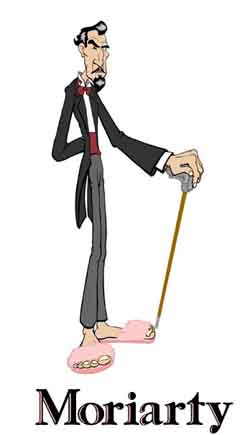
Hey, everyone. "Moriarty" here with some Rumblings From The Lab.
There have been seventeen of these columns since we began. I take great pride in the fact that Frank is our man in the publishing world so far. I’d love to branch out further into coverage of books. I really would. For right now, though, I’m pleased we’ve got this particular guy on the beat. Here’s another of his typically great columns. Take it away, Frank, and happy Labor Day to your and yours...
The wealthiest members of the sporting community have decided that they’ve got enough to go around, and they voted against a strike. A friend of mine asked me what Rick Reed, a non-union baseball player, would do if there was a strike in Major League Baseball. Well, he’s not working for minimum wage; he can afford to take a break. I suggest a candy bar and a relaxed viewing of the new RESERVOIR DOGS DVD. I was saddened by the looming work stoppage, afraid you would have had to look pretty hard for a sporting event to watch through the fall season. Thankfully we won’t have to. Last year’s World Series was so much fun, I’m actually looking forward to this one. The Yankees may not be so excited with the Diamondbacks on the horizon, and Randy Johnson is waiting to give them a little lesson in déjà vu. If you’ve had it with the overpaid members of your local baseball team, try something else on for size that doesn’t involve having to sit through another Carrot Top commercial during the seventh inning stretch.
Without television, It’s Not A Secret If I Don’t Tell Anyone.
JULY, JULY by Tim O’Brien
Houghton Mifflin
322 pages
I took a day between finishing this new novel by Tim O’Brien and writing the review. I’m glad I did; it’s been resonating with me ever since.
Over the last six or so years, discovering Tim O’Brien and his novels has been an incredible pleasure. I can clearly remember the first time one of his books kicked my ass. It was a thick manuscript copy of TomCat In Love, an exceptional portrait of an intellectually overstimulated, womanizing, brilliant asshole. Getting up early to read it before heading off to work was a pleasure I looked forward to every day. It was something to savor; it’s actually that good.
He’s known for his writings on Vietnam. Mr. O’Brien is a veteran of that conflict, and he’s got all the details right, leaving you completely riveted to the page. In The Lake of the Woods, another novel about a man trying to live his life with the horrors of the war behind him, got a read on the plane back from Dallas one summer. You ever see the book depository in Dallas? Remember the chills you got the first time you went in that spooky museum, or stood in Dealey Plaza? You’ll get the same batch of chicken skin when reading In The Lake of the Woods. O’Brien writes about the experience of Vietnam so clearly and with such power, it’s difficult to think of him as anything but a sort of biographer of that war.
Thankfully, he just plain knows how to put a sentence together. Despite what Kakutani of The New York Times said about TomCat In Love, I believe it is one of the best novels ever written. I said that at the time, and now I have to add another one of his books to that rarefied list, his newest novel, July, July.
O’Brien has written several books about Vietnam and life afterwards like The Nuclear Age, Going After Cacciatto, The Northern Lights, The Things They Carried, If I Die in a Combat Zone, and those I previously mentioned. I was fortunate enough to meet O’Brien at an industry function that I was accidentally invited to. He read the nastiest parts of TomCat in front of a group of publishing tight-asses, composed mostly of women. O’Brien is not shy about his feelings towards the opposite sex. He portrays them in a real and unflattering light and spares no expense with the men. He’s not trying to win over any special interest groups with his writing.
This book on the other hand paints a picture of a large group of men and women who offend, compliment, love, destroy and hate each other. They’ve all grown up together and, at the outset of this book, are attending their high school reunion. This event acts as a structure to hang the book around and a metaphor for all the things that have rudely changed in this world. Some of these chapters were excerpted in Esquire Magazine and The New Yorker; these chunks are some of the most powerful of the novel. A one-legged Vietnam Vet recalls his marriage to his high school sweetheart and his dashed dreams of becoming a baseball player. He recalls the girl who marries him out of pity after the war. He recalls their doomed life together, and the life she leaves him for, equally tragic. Then there’s Dorothy, who’s got breast cancer, and who is informed of her pending death by a Vietnam Vet neighbor who knows more than he should about her personal life. Paulette, a women of the cloth, breaks her vows to comfort an old man who’s caught in a horrific marriage to a woman that finally undoes her. In my estimation, that’s one of the finest sections of the book.
There is a sense of tragic loss that surrounds each character in this novel, and time changes all of them, mostly for the worse. Some fled the war, others married to get away from it, and some just can’t figure out why kids of today don’t want to listen to the protest songs of the sixties. There is no central character for you to latch on to, but you don’t need it. O’Brien’s mastery of the ensemble cast is something to behold. This group of characters is by far one of the finest I’ve ever had the good fortune to read about. Telling you more about it here would do everyone involved a disservice. O’Brien has shown that he can keep several balls in the air at once, so to speak, without ever letting you or them down. You never lose interest in these people or their pasts, shared and singular, which are fantastically realized and compelling. This book could have easily been three hundred pages longer, and I’d have read it with just as much excitement.
In July, July, O’Brien shows why he’s one of the very best storytellers working today, and that things change even if people never do. Here’s to hoping that Tim O’Brien never changes.
TROMBONE by Craig Nova
Grove Atlantic
247 pages
I first discovered Craig Nova’s books almost ten years ago when I moved to New York City. Found him almost accidentally. I was without a television set for the first five years I lived in the City. Entertaining myself was easy, but after a while I had to find something a little more intellectually stimulating. Reading a book did the trick. Sitting at my desk, looking out into the airshaft, listening to the hum of the fans eleven stories below and the far-off symphony of the Middle Eastern cab drivers playing their rock music on the cab radios in the parking lot behind my apartment building, I found Craig Nova.
It was one of his earlier books, Incandescence, which so completely blew me away that I think about it almost every day. My father had sent me a stack of books, and out of sheer boredom, one of them found their way into my hands. Going forward, Nova’s books signaled the beginning of my fascination with contemporary American first editions and collecting them. I scoured the city, which is the epicenter of the book world. Every five feet or so, there’s someone selling used books. The Strand Bookstore proved to be a gold mine for Nova’s books, all in first editions. I collected every one, and even ordered the one I was missing, Turkey Hash, from a highway robber in the diamond district, not caring. The collection was complete, but they weren’t signed. For a collector, that’s the brass ring; the value goes through the roof.
Working within the system, I got to Mr. Nova at a book signing. He was only happy to sign them all; the crowd was light, and the line to see him was thin. At that time, he had just finished The Universal Donor, a brilliant character piece on a woman who’s an actual universal donor. After that, Nova vanished for a few years. I developed a correspondence with him. Around that time, it seemed like magic when he delivered a complete 180 degree turn from his previous books with Wetware, reviewed here in this column. It was a deep exploration of future cloning applications as well as a story of the human condition run wild. Universal Donor and Wetware were barely reviewed, sadly, but Mr. Nova continued to write. In a wild stroke of good thinking, Grove Atlantic has repackaged one of his earlier books, Trombone. A blistering image covered the original, and it was thankfully retained for this trade paperback edition.
In any collection of one author’s books, you see patterns develop from book to book, but going back into the earlier days, you can sometimes see the foundation. Even here in this early book, Nova puts it all together for a tightly woven father and son mystery. In his other books you bounce around, getting to know people, learning back-story through old headlines or memories. In Trombone, we are treated to a close-knit hand of five-card stud between a father, a son, a gangster, a girlfriend, and a dog breeder. Dean, Ray’s father, works at a printing shop and burns down buildings for a Chinese gangster to pick up extra money for the bills so he can keep his own home fires from going out. Ray wants to learn from his father, but knows that his education comes first. Ray gets a college back east to accept him, but jealous father and son... they both burn. Iris comes along, drawn to the scent of this wild pack of dogs, sending them all into a frenzy, Ray and his father included.
It’s all shocking enough to make you put the book down and wonder how this can happen. They share the same women, something almost unbelievable, but Nova has an authority about him and controls this part of the story, making it palatable. That’s with pure technique. He’s got a keen eye for the style of the time period, (late ‘70s), and he basks in the pleasure of the atmosphere around his characters. The descriptions of Los Angeles alone are worth the price of this book. Seeing it through your eyes and Ray’s as he accelerates through his future, finding his girlfriend, saving her from what she’s become and himself from what he could be. Watching a fringe member of the story breed greyhound dogs. These are amazing experiences even though if the people or the dogs don’t win, place, or show.
Excessive praise is lavished on some of the most suspect of writers these days, but sadly, it’s rarely on the right suspects. Craig Nova is a writer whose books include Turkey Hash, The Geek, Incandescence, The Good Son, The Congressman’s Daughter, Tornado Alley, The Book of Dreams, The Universal Donor and Wetware, which can all be found in your local used bookstore. He even wrote a Norman McClean-ish autobiography called Brook Trout and Writing Life. I wish this man would get some press so the world would discover just how fantastic his books really are. In a selfish way, though, I’m glad he doesn’t.
It almost feels like I have his books all to myself.
If you want to talk books, you can e-mail me here
As always, great work, sir. Maybe I’ll see you when I’m in New York later this month for the AICN Evening at the New York Independent Film and Video Festival. I certainly hope so...
"Moriarty" out.