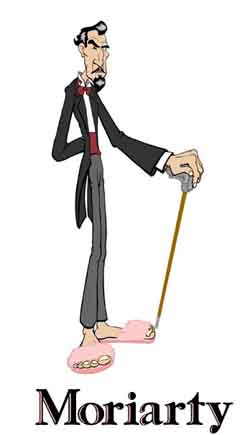
Hey, everyone. "Moriarty" here with some Rumblings From The Lab.
Here’s m’boy Frank with another of his columns about those lovely vacations between two covers. F all these imposters with their “book clubs.” You don’t need someone to tell you to all read the same thing at the same time. Orwell would be aghast. Instead, here’s my favorite sportswriter to offer you three options...
It’s been quiet here in the city... too quiet.
Everyone knows something is about to happen; they just don’t know what. Could the Yankees win another World Series or The Mets get the wildcard? Either one is likely, but one more so than the other. Or will an even dirtier secret be unleashed? If you read The New York Times Magazine section, you’re thinking twice about living in the Big Apple. In this country, it’s become increasing clear to me (and I’m not soap boxing here, since all you have to do is just open a newspaper or turn on the television) that big business has taken over, and before you know it baseball will be all re-runs, and your 401K a memory.
Not a day goes by when you don’t hear about some kid getting snatched off his or her front lawn or a C.E.O getting to wear a set of the silver bracelets. It’s amazing how the entire corporate structure is crumbling like a house of cards. Would I be a suspicious paranoid to wonder why the “energy” meetings with Enron in tow were held in the White House? Funny, now there’s a secret that every one knows about. Or Ashcroft and his political religious right getting a band of local torchbearers together to “rat” out their friends and neighbors.
It’s happening, it happened, and will continue to happen and all while we sleep with the comforting glow of J.A.G re-runs quietly gliding through the background.
To be perfectly honest, the media is a great place to start when looking for answers to your questions, and a bookstore or library the logical first stop when trying to find out more about something, or to just plain escape. Let’s be brief this month, to the point, get right down to it and let you know about the good and the bad.
IT’S NOT A SECRET IF I DON’T TELL ANYONE...
HONEYMOONERS: A CAUTIONARY TALE by Chuck Kinder
Plume, 357 pgs.
After you’ve read a book or two, and seen about a thousand movies, you start to hear stories about writers... some of them true, others just good stories. Like the one I heard about Michael Chabon. He’s a pal with everybody, and he’s got awards that prove he’s a first class literary talent. From where I sit, he’s got so much going on it’s hard to wrap your mind around his writing. He’s like a juggler who never lets the balls hit the ground; he just keeps adding to them. Now Chuck Kinder is the author of Snakehunter and The Silver Ghost and for some reason the author of this hallucinatory mumbo jumbo of a novel. Chabon knows this guy, or so I’ve heard, and based his character of Grady Tripp (Wonder Boys) on him. I don’t think that each characterization in every novel ever written since before electricity is actually based on someone, or a collection of someones, but this might just be one of those times when that person actually existed. Actually, he existed in a watered-down form in Wonder Boys, or at least at the hands of Curtis Hanson, and in the novel was a far more outlandish loose cannon. What makes me sick and will ultimately see this book tossed into the fire place alongside my first fall fire, is that I was lead to believe that this writing would be along the lines of an author I really do care about, Raymond Carver. And whom do we have to blame for this? Mr. Jay McInerney. With his quote on the paperback edition, on the cover no less. It reads, and it pains me to write this:
“Anyone who knew Raymond Carver will be continually delighted and horrified... If Honeymooners doesn’t make you laugh, cry, and cringe with sympathetic embarrassment, then you should adjust you medication immediately.”
First let me say that it’s all bullshit. Jay Mc, as I like to call him, must stop writing quotes immediately. He also needs to thank the literary community for putting up with him for so long. How long has it been, Jay? Ten years now since Brightness Falls? I didn’t know Ray Carver personally, nor did any of my friends. But from what I read, his writing and about him, he was nothing like either of the main characters in this book, Jim Stark (James Dean reference perhaps?) or Ralph Crawford. Their women were nothing like Carver’s wife Tess, but Chuck Kinder has described them as perfectly as Webster’s did when it defined “stereotype.” To read this book is to test your pain threshold. Not only do the alcoholics who populate it drink and smoke themselves to death, obviously with some literary motivations in mind, but they also bore you to sleep. Your mind wanders as Kinder with his 1960’s hippie escapee prose stumbles through drunken brawl after drunken brawl. These men hit their women, and the women hit back. These men cheat on their wives, and their wives put up with it because they know it doesn’t get any worse than this and it’s so hard to change a man.
To hell with that logic, and if this novel has anything to do with a literary form, it owes more to On The Road, another wandering mess of brief and brilliant ideas that are all drowned in drug and alcohol abuse. What is most offensive about this book is that it’s about nothing. Really. Nothing at all. Sure, Ralph and Jim are writers, but you actually never read about them writing anything, or discussing creative inspiration. This book screams for it. They drink. That’s their main course of action. They talk the drunken talk of inspired ideas, plan outlandish futures, and live their lives as if it only matters who will get the next bottle of scotch. There is one line in this book that matters, one lousy line, the last one, where two of the characters come together after Ralph dies of lung cancer, a sudden shock to all:
“And so maybe they could all carry forth the hope that they would, indeed, have other chance in other lifetimes to do better by one another.”
That’s it, and then I closed the book, leaned back in my chair and screamed with joy that it was over. If you are taking a class with a teacher who is trying to impart some wisdom about the craft of writing upon you by making you read this book, don’t. Lie. Tell them you read it, and send me an e-mail for a plot synopsis. I’d be happy to give it to you. But as Dean Keaton said in THE USUAL SUSPECTS, “I swore I’d live above myself.”
MIDDLESEX by Jeffrey Eugenides
Farrar Straus and Giroux, 532 pgs.
On the other hand, I’d love to hear some stories about this guy, and I’ll bet that there pretty good, pretty good indeed.
Back a few years, a book came out that sort of slept its way into people’s hearts, and without much fanfare was snapped up by little Sofia Coppola. Perhaps her father had something to do with this acquisition, who knows. Before we knew it, Hollywood’s stars-to-be Kirsten Dunst and Josh Hartnett were thrown together like peanut butter and jelly. And like all good things, it came in spades for Eugenides.
THE VIRGIN SUICIDES was remarkably realized on the big screen, and Sofia Coppola won some respect from me. Sadly, I fear the material is what kept me riveted to the screen, not her Tylenol P.M. direction. It was interesting, exciting, morbid, shocking, weird, stuffy, cold, frigid, sexy and all around bizarre, this collection of sisters that all kill themselves in what I thought was the name of parental smothering. Jimmy Woods and Kathleen “have another drink” Turner give knock-out performances as the parents who make one of the daughters burn her records. What the fuck? That’s what I was thinking. The Virgin Suicides is a wonderful book, with a very rare thing these days, a companion movie that does it justice. So the years go by and rumor has it he’s got a whopper of a book waiting in galley form for a September ’02 release.
Middlesex is a novel along the lines of The Corrections, in the sense that it’s about a family, but it covers a large span of time in a linear form instead of hopping back and forth like Franzen’s masterpiece. Also, it’s hefty in size and deserves every page of its length. We get involved with the turn of the century Greek and Turkey. The early 1900s were not sweet on those ethnic groups, and wars were waged, people died, and silk was spun.
The main spinners of said silk are Lefty Stephanides and Desdemona Stephanides; you’ll get to their relationship when you read the book, so there’s no sense spoiling it. They’re the first of the family to make it out of the village near Asia Minor, and flee they do with a pal of theirs, Dr. Philobosian, who seems to be marching to his own drummer. We get a brilliant perspective about the early lives of these three major characters that spans most of the first hundred pages. Everything, right down to desire, and the lack of suitable women in the village who don’t have a mustache. You’ll be stunned at the detail Eugenides goes into. He spares nothing, and I can’t think of a better way to tell the story.
Funny, he also uses the metaphor of silk worms and spinning silk to frame this enormous tale of wonderment. We get the kids; they grow up under the glow of Henry Ford and the Detroit industrialization complex. Lefty works there briefly before taking up with his landlord to run liquor across the river from Canada during prohibition. Finally we’re at the halfway point of the book and we have not even heard more than a page or two from the main character, Callie Stephanides, granddaughter of Lefty and Desdemona, who’ve moved into a lovely suburb of Detroit.
If I didn’t know better, I’d say they existed, and we watch them make a fortune on the franchise business with diners and then hot dog carts. Here’s the scary part of the book... Eugenides makes me believe and forget he’s a guy, because he’s made the illusion so real. The book just slips away, and you’re caught in the story, the history, and the horrid details of Callie, who at an early age discovers she’s a hermaphrodite. That’s right... she’s got a little boy trapped inside her little girl’s body. She’s a regular Jamie Lee Curtis.
What happens going forward... the discovery, the love of other women told from a man’s perspective, the gender flip flop through the entire narrative structure of this novel... is awe inspiring. You’re not likely to read anything like it. Eugenides moves from Callie’s parents to her grandparents’ ritualized lifestyle so easily that you’ll never know you’re reading about someone who is completely at odds with themselves. Callie is a man and she’s a woman, and a man is writing her, and Eugenides pulls the rabbit right out of the hat and makes the elephant stand on a pinhead. Callie makes your heart drop right into your stomach. She’s given all the best lines, and she’s stronger and filled with more sheer force of will than anyone I’ve ever had the pleasure to read about. Middlesex is only the second novel from Jeffrey Eugenides, and it’s so accomplished that you’re likely to freak out at its brilliance. Next month, you’ll have the chance to check this out of the library or for those of you cash ready, you can buy it.
Please do, it comes highly recommended, not only by me, but by he rest of the English-speaking world.
Maybe even by Jay McInerney.
Write me here, you subliterate book-chewers!!
As always, thanks, Frank. Looking forward to Middlesex now.
Also, I want to remind readers to find a copy of Michael Blake’s THE HOLY ROAD, which just hit paperback. Don’t worry about whether or not Kevin Costner wants to film this follow-up to DANCES WITH WOLVES. Just enjoy it as a book. It’s a great read.
"Moriarty" out.