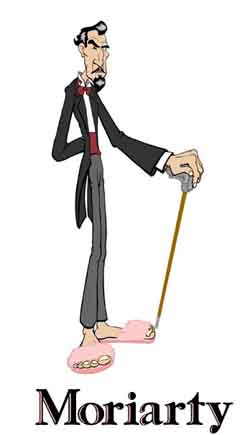
Hey, everyone. "Moriarty" here with some Rumblings From The Lab.
Here’s a review from a reader regarding a film I’m curious to see, if only because I’m tired of waiting for another dose of the luminous Kate Winslet. Single again, eh? Maybe it’s time for a trip back to England to pitch some freakin’ woo...
I thought I’d drop you a line about a movie that opened in England a couple of weeks ago. I don’t think it’s opened in The States yet so I though I’d give you some advance word, as it’s a pretty decent little movie that deserves to find a wider audience than it has here.
Anyway, it’s ENIGMA starring Dougray Scott and Kate Winslett and, like U571, involves the German enigma code. This was a scrambled communications code that was cracked by the code breakers at Bletchley Park. They were, as I’m sure you know, a bunch of tweedy, eccentric proto-geeks who, after being recruited from Universities and via newspaper crossword puzzles (!), were set to work in a stately home in the English countryside. Their breaking of the code was one of the turning points in the war, saving countless lives and arguably cutting it short by several years.
Over here, the fuss over U571 was considerable - questions were asked in Parliament and there were plenty of furrowed-brow editorials from middle-market tabloids over the way that the Americans had appropriated ‘our’ story. Quite why historical veracity was demanded of an action movie is beyond me and just as no right thinking person would look to U571 for the true story of the Bletchley Park code-breakers they shouldn’t expect to find the truth here either, as at its heart ENIGMA is as false as U571 was.
What it means is that the same historical events have produced two pretty solid movies and that’s what ENIGMA is – a movie, no more and no less. Not an important statement designed to tell the world what happened like, say, BAND OF BROTHERS but a boy’s own adventure story played out in the English countryside – chock full of Nazi agents, sinister spy-catchers, steam trains and U-boats, with a mysterious hero and, of course, a femme fatale.
It’s pretty much an old-fashioned mystery of the kind you’d associate with Agatha Christie or John Buchan. It owes an awful lot to Hitchcock’s version of THE THIRTY NINE STEPS - a journey taken by our hero that leads to a remote Scottish cottage and a scene where a man is hunted on a train are only the two most obvious nods. It’s the sort of film where an awful lot of cups of tea get drunk and bicycles with baskets on the front are ridden about the countryside in search of clues in true Enid Blyton fashion. There’s something immensely pleasurable about seeing such an old-fashioned film up on the big screen – if only because it makes a nice change from the CGI and bullet-time explosions that we’ve been bombarded with recently.
The plot centers around genius mathematician Tom Jericho (Dougray Scott) who returns to Bletchley after a nervous breakdown resulting from a failed romance with base sex-pot Claire (Saffron Burrows). Claire has vanished and Tom finds evidence linking her to the theft of vital coded messages. Loyalty to his ex-lover means that he won’t go to the authorities so, accompanied by her tweedy room mate Hester (Kate Winslett), he decides to investigate her disappearance – drawing the attention of dapper spy-catcher Jeremy Northam.
Director Michael Apted nicely captures the austerity of wartime Britain and the cinematography is marvelous - depicting a provincial England of dingy boarding houses, country lanes, church yards and lowering skies. In fact it’s so persuasive that it’s a wonder the screen doesn’t curl up at the edges from the damp. There are great looks at the cutting edge technology of the day and it’s shocking to see how far we’ve come in this age of satellite navigation and laser guided missiles. Brief glimpses of German soldiers on the Eastern Front sending messages in Morse code through suitcase-sized wooden encryption devices and the primitive computer room at Bletchley both feel like they belong to a world far more than sixty years distant. The computer room itself is a marvel (Apted has filmed the real one) -full of whirring cylinders trying combination after combination (“like trying to find a needle in a haystack as opposed to trying to find a needle in a thousand haystacks” as Jericho puts it) until the code is cracked.
Of course, the old British movies that ‘Enigma’ is so influenced by didn’t have the tricky flashback structure that Tom Stoppard (adapting Robert Harris’ book) employs to such good effect and the viewer is kept off balance enough to be able to easily follow the story but still kept wondering just what revelation is going to be thrown out next and, even though we may grow to like and identify with the characters, there’s always the possibility that they may not be entirely what they seem. He’s pretty good on exposition too – it’s a talky movie but doesn’t get too bogged down in technical detail. It’s not perfect though, and the plot twists and turns a little too much for its own good before limping to a fairly uninspired conclusion (horribly similar to the ending of PATRIOT GAMES) but there’s plenty of good stuff before you get there.
The leads are just fine – Dougray Scott (who was pretty damned dreadful in MI:2) acts convincingly like someone who’s been to hell and back, so much so that it’s a shock to see him pre-breakdown. He has a pretty tricky task as, although (thankfully) there are no scenes of breakdown histrionics, the screenplay is structured so that you’re never entirely sure where you stand with him. It also largely manages to avoid the cliché of movie stars playing regular people – the ‘Michelle Pfieffer as dowdy waitress syndrome’ that dogs so many movies - he’s sufficiently shy and diffident (not to mention pale and drawn) that when it’s pointed out that people like him wouldn’t get second look from girls like Claire anywhere but at Bletchley Park, it seems entirely reasonable.
Kate Winslett essays her galumphing but foxy-if-she’ll-just-take-off-those-glasses Hester much as you’d expect. Again, she’s convincingly a normal person, saddled with a spectacularly unflattering haircut and dowdy clothes. Thankfully Saffron Burrows is on hand for glamour in the flashback scenes, which is just as well as everyone else is gray-skinned and unshaven or possesses Austin Powers teeth. Although Winslett is very much a supporting player she has a great scene that should remind people just how good an actress she is. It’s a scene that’s returned to several times in the movie and shows her watching Claire dancing in her bedroom. She watches from the doorframe both appalled and fascinated as Claire, wearing only her negligee, jiggles in front her record player. You can see in her face that she’s shocked yet deeply envious as Claire is as wild and free as she is sensible and cautious. When Claire spies her, she doesn’t laugh at her but pulls her into the room and dances with her (very awkwardly in Hester’s case) in a scene that beautifully shows why Hester is prepared to take enormous risks for someone that you’d imagine she would disapprove of terribly.
So there you go, it’s certainly not an explosive action flick and most of it takes place in the tranquil English countryside. There are shots of convoys and U-boats and an off-screen convoy battle plays a major part of
the climax of the movie but the sense is of the war being fought elsewhere – it’s about how men and women hundreds of miles away from the front lines made a difference and has a timely message about how
sometimes it’s necessary to withhold evidence for the greater good. It’s a pretty good mystery and the clues are of the best “of course - that’s why we saw that!” variety, with pretty good (and occasionally great)
performances made in a resolutely old-fashioned style. It’s a solid movie – it probably won’t make many top ten lists and its best home is probably as a Sunday matinee on television but there are worse things than
that. Oh, and fans of ‘Young Sherlock Holmes’ will be pleased to see Young Sherlock himself as a naval officer.
Sounds cool. Thanks again for the review, Jon Boy. We appreciate it.
"Moriarty" out.